Reviewed · TOURS
9 days Balkans Tour from Bucharest to Sofia and Budapest
The most interesting thing here is the route: you start in Bucharest and finish in Budapest after crossing much of the Balkans by road. In nine days, you move from Bulgarian caves and monasteries to Ohrid’s lakeside churches, Kotor’s stone lanes, Sarajevo’s layered past, and Belgrade’s fortress above the Danube.
I like the one-way design, since you do not waste a day returning to Bucharest. I also like the mix of famous sights and smaller stops, especially Devetashka Cave, Krushuna Waterfalls, Lovech, and Novi Sad. The main caution is the amount of time spent in the vehicle, plus a reported problem with an uncomfortable small van, a damaged front windshield, and late starts.
In This Review
- Key points to know before booking
- A fast-moving route through the Balkans
- Day 1: Devetashka Cave, Krushuna Waterfalls, and Lovech
- Day 2: Lovech’s Covered Bridge and Sofia’s cathedral quarter
- Day 3: Rila Monastery and Skopje
- Day 4: Skopje’s Old Bazaar and Ohrid’s churches
- Day 5: Tirana and the road toward the Adriatic
- Day 6: Kotor’s fortified old town
- Day 7: Mostar and Sarajevo
- Day 8: Belgrade, Skadarlija, and the Danube
- Day 9: Novi Sad and arrival in Budapest
- What the $1,191 price covers
- Walking, luggage, and daily comfort
- Who should book this route
- Should you book the Bucharest to Budapest tour?
- FAQ
- Where does the tour start?
- Where does the tour end?
- How long is the tour?
- What countries does the route visit?
- Are hotels included?
- Is breakfast included?
- Are meals other than breakfast included?
- Are entrance fees included?
- Is a passport required?
- How many people can join the tour?
Key points to know before booking
- Nine days, seven countries, one continuous route: The tour links Romania, Bulgaria, North Macedonia, Albania, Montenegro, Bosnia and Herzegovina, Serbia, and Hungary.
- Major UNESCO stops: You visit Rila Monastery, Ohrid, Kotor, and the Old Bridge area of Mostar.
- Several local walking tours: Guides are provided in Romania, Sofia, Skopje, Tirana, and Sarajevo.
- Hotels and breakfast are included: The package covers eight nights and eight breakfasts, with accommodation listed as 4-star hotels.
- Expect long road days: Some destinations receive only a few hours, so this suits you if seeing many places matters more than lingering in one.
- Check the vehicle before departure: Transport is advertised as air-conditioned, but a small and uncomfortable van was reported on one trip.
A fast-moving route through the Balkans
This is a sightseeing tour for someone who wants a broad first look at southeastern Europe. You will not spend several relaxed days in one city. Instead, you will regularly pack, ride, check in, walk, and move on.
That pace has a clear payoff. You can compare Orthodox churches, Ottoman bazaars, Austro-Hungarian streets, medieval fortresses, socialist-era city squares, and Danube capitals within a single trip. The route also gives you sights that are difficult to connect with simple day trips from one base.
The tradeoff is time. A 9-day schedule covering Bucharest, Sofia, Skopje, Ohrid, Tirana, Kotor, Mostar, Sarajevo, Belgrade, Novi Sad, and Budapest leaves little room for unscheduled wandering. I would book this for the route and the variety, not for slow mornings or long museum visits.
The group can reach up to 46 people, which matters during walking tours and border crossings. A professional tour leader travels with you, while local guides join in several cities. The local guide setup is useful because Sofia, Skopje, Tirana, and Sarajevo each have different historical and cultural layers that are hard to explain well in a quick orientation.
Other Bucharest days worth putting on the list:
- Bucharest: Dracula’s Castle, Peles Castle, & Brasov Old Town
★ 4.5 · 17,858 reviews - Bucharest: Dracula Castle, Peles Castle & Brasov Old Town
★ 4.6 · 10,891 reviews - Bucharest: Dracula’s Castle, Peleș Castle & Brașov Day Trip
★ 4.5 · 5,919 reviews
Day 1: Devetashka Cave, Krushuna Waterfalls, and Lovech
The trip begins in Bucharest at University Square, in front of the statues. The information gives both 8:00 am and 8:30 am as start times, so confirm the exact departure before you arrive.
The first stop is Devetashka Cave, about an hour from the day’s schedule. This is not a dark, narrow cave experience. Large openings bring in daylight, and the floor can be covered with greenery in spring and summer. That open, plant-filled interior gives the cave a more unusual feel than a standard underground attraction.
Admission is not included. You should also expect uneven outdoor surfaces at nature stops and carry only what you need for the short visits.
Next come Krushuna Waterfalls, Bulgaria’s largest travertine cascade. Water drops over soft limestone terraces, forming smaller falls and natural pools among thick vegetation. The stop lasts about an hour, enough to walk around and take photographs, but not enough for a long nature outing.
You then continue to Lovech for the night. The day includes two outdoor sights before the hotel, so this is a useful first taste of the tour’s rhythm: see a place, walk for a while, get back in the vehicle, and continue.
Day 2: Lovech’s Covered Bridge and Sofia’s cathedral quarter
Lovech receives a short morning visit. Its best-known feature is the Covered Bridge over the Osam River, which connects the two sides of town. The bridge gives you a compact introduction to Lovech and makes a worthwhile stop between the natural sights of day one and the larger cities ahead.
By evening, you reach Sofia. The city walk covers Alexander Nevsky Cathedral, with its gold-colored domes, as well as Saint Sofia Church, Banya Bashi Mosque, the Sofia Synagogue, and Vitosha Boulevard.
This is one of the stronger city introductions on the tour because the route shows several religious traditions within a small central area. You will also get a sense of Sofia as a working capital, rather than seeing only one monument and returning to the hotel.
The three-hour city visit is still an orientation, not a full exploration. Museum entrances are not included, and the schedule may leave little time for them. If Alexander Nevsky Cathedral is a priority, use the guide’s walk to get your bearings, then ask whether free time is available for a closer look.
Day 3: Rila Monastery and Skopje
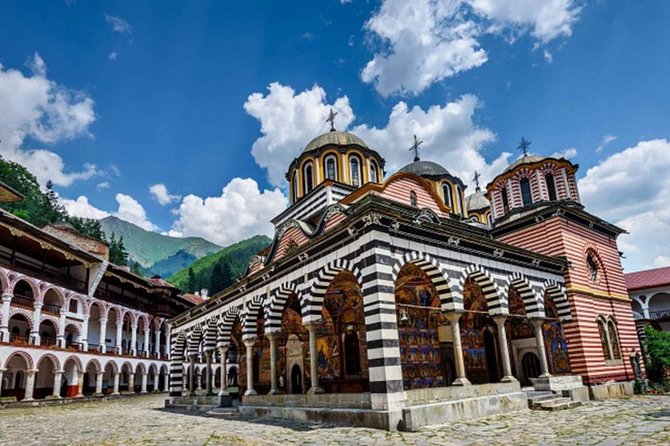
Rila Monastery is one of the tour’s most important stops. Founded in the 10th century by Saint Ivan Rilsky, it served as a center of Bulgarian Orthodox culture for centuries. The setting in the Rila Mountains adds to the sense that this is more than a quick roadside monument.
The visit includes the monastery church, known for its painted decoration and carved woodwork. The schedule allows about an hour, so you should focus on the main courtyard and church rather than expecting to see every part of the complex.
In the early evening, the tour reaches Skopje, North Macedonia’s capital. An orientation walk introduces the center before you check into a centrally located hotel. A central hotel is helpful here because the next morning’s walk begins with the city close at hand.
Rila Monastery and Skopje make an interesting contrast. One is a long-standing religious center in a mountain setting. The other is a capital shaped by Ottoman, modern, and national symbols. The short time in each place means your guide’s explanation will be important.
Same mountains, a completely different day out:
- Bucharest: Palace of Parliament Tickets and Guide
★ 4.3 · 3,182 reviews - Bucharest: Day Trip to Dracula Castle, Peles Castle & Brașov
★ 4.4 · 3,049 reviews - Bucharest to Dracula Castle, Peles Castle and Brasov Guided Tour
★ 4.5 · 2,933 reviews - Bucharest: Palace of Parliament Tickets and Guided Tour
★ 4.4 · 1,877 reviews
Day 4: Skopje’s Old Bazaar and Ohrid’s churches
The Skopje walk covers the Vardar riverfront, Macedonia Square, the Kale fortress, the Memorial House of Mother Teresa, and the Old Bazaar. The bazaar is described as the largest preserved bazaar in the Balkans, with narrow streets that give the morning a more traditional feel than the broad central square.
The itinerary also includes the statue of Alexander the Great on horseback. Skopje’s central monuments can prompt questions about national identity and the city’s changing public image, so this is a place where the guide’s context adds real value.
The walking portion is not extreme, but you should be ready for two to four hours on foot on some days. The tour estimates Skopje’s walk at about four kilometers for one and a half hours, though the full schedule includes more time around the city.
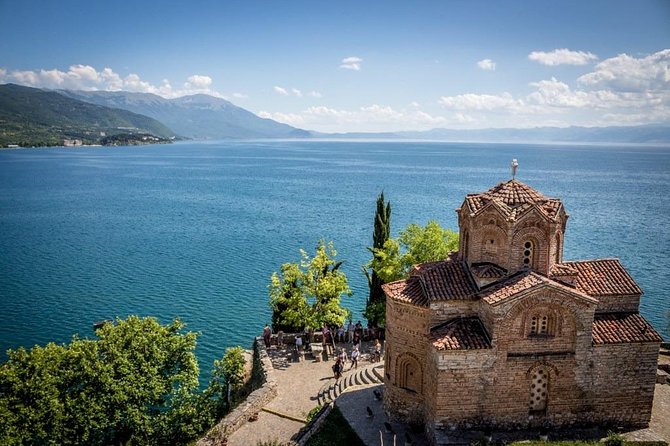
Later, you continue to Ohrid, on the shores of Lake Ohrid. The old city tour includes the Ancient Theater, Saint Sofia Church, other old churches and basilicas, Tsar Samuil’s Fortress, narrow lanes, squares, and the pedestrian shopping street.
Ohrid is one of the most appealing stops for a first Balkan trip. Lake Ohrid is described as more than three million years old, and the old town shows how long people have lived around it. You will see a place where the lake, churches, fortress, and steep old streets all fit into one compact visit.
The drawback is that Ohrid receives only about three hours. You can see the main center, but you will not have time to treat it as a relaxed lakeside stay.
Day 5: Tirana and the road toward the Adriatic
The route crosses into Albania and continues to Tirana. The city walk centers on Skanderbeg Square, the National History Museum, Et’hem Bey Mosque, and the statue of Skanderbeg.
This is a useful introduction to Albania’s capital because the central sights sit close together. The square provides a large civic focus, while the mosque and museum point to different parts of the country’s past.
Three hours gives you a solid orientation. It does not include museum admission, and the tour’s overall pace may mean you see the exterior of some sites rather than spending time inside. I would treat Tirana as a guided snapshot, not as a full city visit.
The road itself is part of the experience, but this is also one of the days when the vehicle matters most. Ask about the vehicle’s size, seat layout, air conditioning, and safety condition before setting off. A comfortable coach can make a long transfer manageable. A cramped van can change how you feel about the whole trip.
Day 6: Kotor’s fortified old town
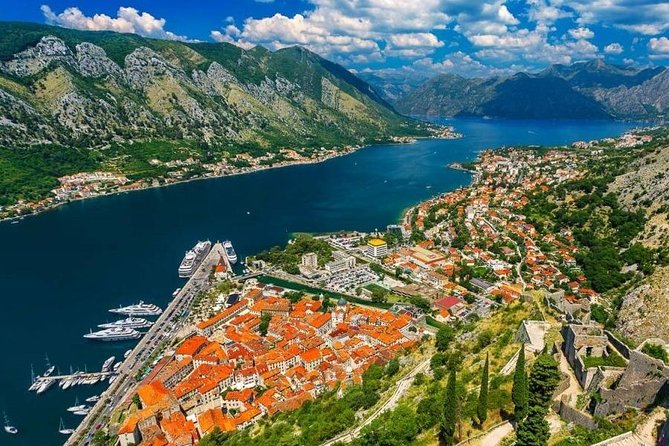
The tour reaches Kotor in the evening and gives you about three hours in Stari Grad, the fortified old town and a UNESCO World Heritage site.
Kotor is at its best on foot. The stone lanes, compact squares, defensive walls, and old religious buildings create a very different mood from the broad squares of Skopje or Tirana. An evening arrival can be pleasant because the visit focuses on the old town rather than a long list of distant sights.
You should not expect a climb of the surrounding fortifications to be included. The schedule specifically centers on the old town, and the listed walking time is limited. Comfortable shoes will help on stone streets.
Kotor is also a good example of the tour’s priorities. You receive the key setting and a guided introduction, then continue rather than staying long enough to explore every corner.
Day 7: Mostar and Sarajevo
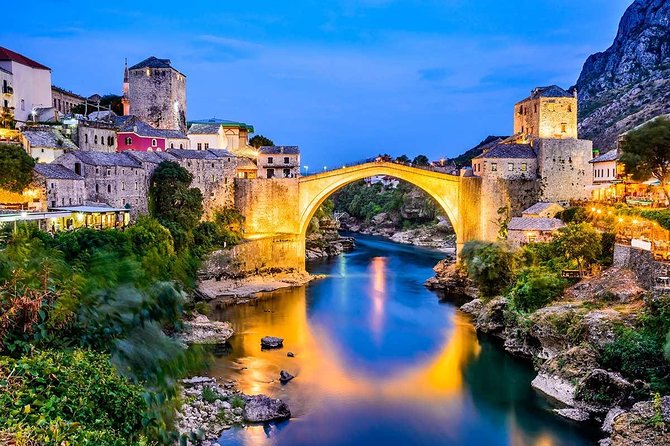
Mostar is one of the day’s major highlights. The old town centers on the Old Bridge, built in 1566 and destroyed during the Siege of Mostar in 1993. The walking tour covers the bridge’s destruction and reconstruction, bringing recent conflict into the story of a beautiful historic center.
You may see young men perform jumps from the bridge in front of visitors, a local tradition that has become part of the town’s tourist identity. The activity is not presented as something you must join, and the focus remains on the town and the bridge.
The route from Mostar to Sarajevo is particularly scenic, passing Jablanica Lake and the Neretva River canyon. This is another stretch where a good vehicle and sensible driving make a real difference.
Sarajevo receives a three-hour walking tour covering the old town and center. You will move between Ottoman and Austro-Hungarian quarters, markets, mosques, churches, and synagogues. The Latin Bridge brings the story of the event that triggered World War I, while the guide also covers the 1984 Winter Olympics and daily life during the Siege of Sarajevo.
Sarajevo may be the most historically layered city on the route. In a short walk, you encounter several faiths, empires, and modern conflicts. The limitation is obvious: three hours can introduce the city, but it cannot give you much private time to absorb it.
Day 8: Belgrade, Skadarlija, and the Danube
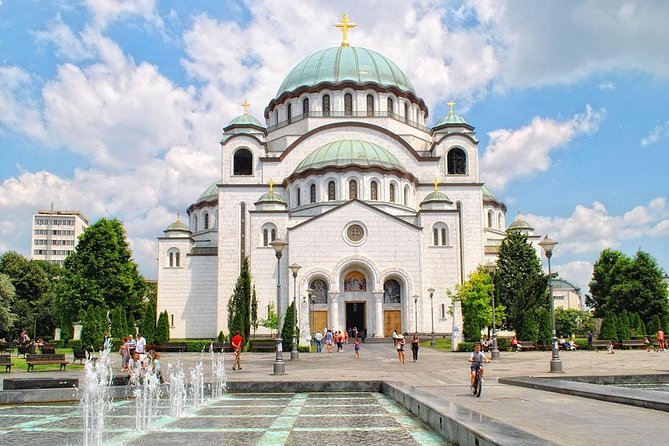
After breakfast, you head into Serbia and reach Belgrade in the afternoon. The city tour includes Republic Square, the National Theatre, the National Museum, Skadarlija, Kalemegdan Park, Belgrade Fortress, and the Victor monument.
The strongest part of the Belgrade visit is the fortress area, where the Sava and Danube rivers meet. It gives you a physical sense of why this spot mattered for settlement and defense. Skadarlija offers a different side of the city, with its older street pattern and Bohemian associations.
Again, three hours is enough for a guided overview but not for a full museum visit. The National Museum is named in the route, yet entrance fees are not included. If you want to go inside, ask the tour leader about timing before leaving the group.
Day 9: Novi Sad and arrival in Budapest
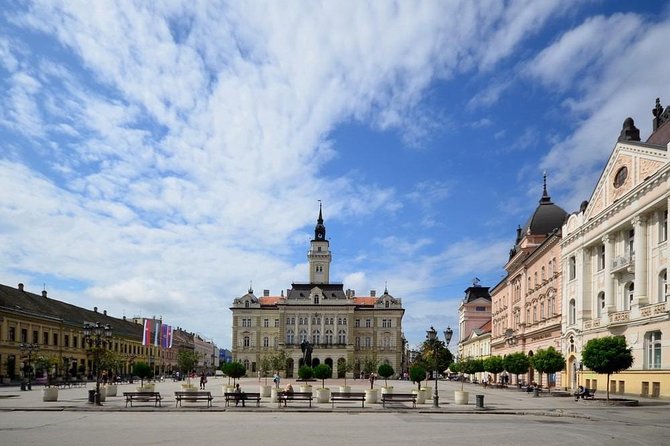
The final morning includes Novi Sad before the route ends in Budapest. You will walk along Zmaj Jovina Street and the city promenade, see the Orthodox Bishop’s Palace, continue through Dunavska Street with its 19th-century houses, and view the Danube embankment and the outside of Petrovaradin Fortress.
Novi Sad is a sensible final stop because it breaks up the transfer north and gives you one last look at a Danube city. The visit lasts about an hour, so keep expectations modest. You will see the central streets and fortress exterior, but you will not have much time for museums or a longer walk across the river.
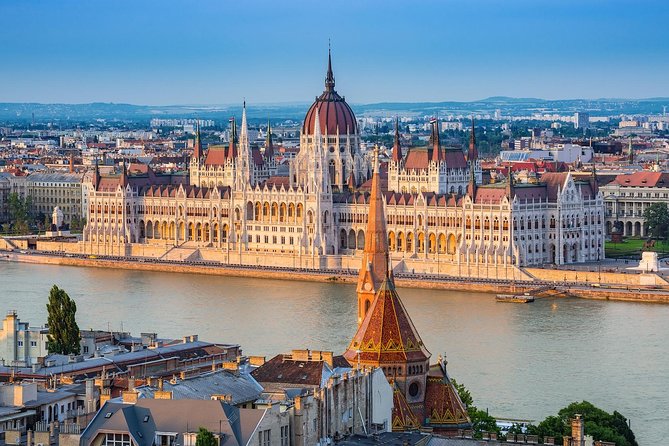
Arrival in Budapest is planned for the evening at the train station on Kerepesi út. The endpoint is practical if you need rail connections, but it is not a hotel drop-off. Plan your onward journey around that location.
What the $1,191 price covers
At $1,191.42 per person, the price includes eight nights in 4-star hotels, eight breakfasts, air-conditioned transportation, a professional tour leader, and local guides in Romania, Sofia, Skopje, Tirana, and Sarajevo.
The value depends on how you price the logistics. You are paying for one continuous route through several countries, accommodation changes, border crossings, transfers, and guided walks. Arranging the same path independently would require careful planning and several separate hotel and transport bookings.
The price does not include meals beyond breakfast, museum and other entrance fees, or tips. The suggested tip is 5 euros per day per person for the driver and tour guide, which adds about 45 euros across nine days if you follow that guidance.
I see the tour as better value for a first visit to the Balkans than for a repeat visit focused on depth. You save planning time, but you give up control over how long you stay in each city.
Walking, luggage, and daily comfort
The tour calls itself an easy walking trip at a moderate pace, but that should not be read as completely effortless. Walks can run from two to four or five hours, with distances from about one to seven kilometers depending on the day.
You may need to carry your own bag up some hotel steps, although most hotels have elevators. Pack light. Moving every day with a large suitcase will make the constant hotel changes harder.
The main comfort concern is the road transport. One reported trip used a small van with uncomfortable seats and no captain-style seats, and the front windshield was damaged. The same account described fast driving and departures that began late enough to reduce time at the destinations.
That is not a minor detail on this itinerary. Ask Guided Europe Tours to confirm the vehicle type, seating arrangement, windshield condition, expected daily departure times, and how delays are handled. The advertised vehicle is climate-controlled, but air conditioning alone does not guarantee a comfortable nine-day ride.
Who should book this route
I would choose this tour if you want a wide Balkan overview and prefer a guide to handle the complicated route. It suits people who enjoy historic city walks, short nature stops, hotel breakfasts, and seeing a lot in a limited number of days.
It is also a good fit if you value local explanations in major cities. The walks in Sofia, Skopje, Tirana, and Sarajevo can help you understand places that may feel unfamiliar at first.
I would hesitate if you need free time, dislike long vehicle transfers, or want to choose your own hotels. You should also reconsider if a late start would frustrate you, since every hour matters when a city visit lasts only three hours.
A current valid passport is required. The tour is offered in English, confirmation is provided at booking, and group discounts may be available. Cancellation terms are strict close to departure: six full days in advance is required for a full refund, with a 50 percent refund possible two to six days before the start time.
Should you book the Bucharest to Budapest tour?
Book it if the route matters more to you than a relaxed pace. The combination of Rila Monastery, Ohrid, Kotor, Mostar, Sarajevo, Belgrade, and Budapest gives you an impressive first survey of the region, while the one-way format avoids backtracking.
Before paying, get clear answers about the 8:00 versus 8:30 start time and confirm the vehicle. If the transport is comfortable and the group keeps to schedule, the tour offers strong practical value for a complicated route. If comfort and extra time are your top priorities, choose a slower trip with fewer cities.
FAQ
Where does the tour start?
It starts in Bucharest at Bulevardul Regina Elisabeta 7, near University Square and the statues.
Where does the tour end?
It ends in Budapest at the train station on Kerepesi út 2, 1087 Hungary.
How long is the tour?
The tour lasts approximately nine days and includes eight nights of accommodation.
What countries does the route visit?
The route goes through Romania, Bulgaria, North Macedonia, Albania, Montenegro, Bosnia and Herzegovina, Serbia, and Hungary.
Are hotels included?
Yes. Eight nights in 4-star hotels are included.
Is breakfast included?
Yes. Eight breakfasts are included.
Are meals other than breakfast included?
No. Food and drinks are not included unless specifically stated.
Are entrance fees included?
No. Museum entrance fees and other listed admission fees are not included.
Is a passport required?
Yes. You must have a current valid passport on the day of the tour.
How many people can join the tour?
The group can include a maximum of 46 people.
Just added around Bucharest
- Village Museum Bucharest Guided Tour★ 5.0 · 6 reviews
- Bucharest: Dealu Mare Winery Private Trip with Wine Tasting★ 4.9 · 6 reviews
- Winery touring & private wine tasting – one day private tour★ 5.0 · 3 reviews
- Transylvania Tour: Dracula’s Castle, Peles Palace & Brasov★ 5.0 · 19 reviews
- Discover Medieval Transylvania Small Group Tour – 7 days★ 5.0 · 4 reviews
- Bucharest Airport Transfer To Constanta Mamaia★ 5.0 · 3 reviews
- Airport Henri Coanda (Otopeni) to Bucharest – Private Transfer – Driver★ 5.0 · 5 reviews
- Gems of Transilvania: Brasov,Sighisoara,Sibiu,Viscri and more★ 5.0 · 6 reviews
Tours, compared.
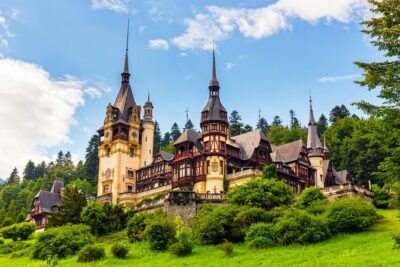
Bucharest to Dracula Castle, Peles Castle and Brasov Guided Tour
Read our review →
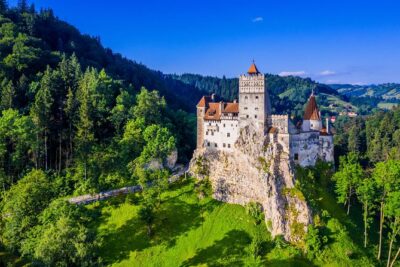
Transylvania and Dracula Castle Full Day Tour from Bucharest
Read our review →
Peles Castle, Bran Castle, & Brasov Old Town Tour
Read our review →
Small-group tour Bran, Rasnov, and Peles Castles
Read our review →