
Reviewed · BULGARIA DAY TRIPS
Bulgaria -Private Tour- Basarbovo, Arbanasi, Veliko Tarnovo
Bulgaria’s medieval capital makes a surprisingly reachable day trip from Bucharest. In one long outing, you cross the Danube frontier, visit a monastery carved into a cliff, walk through an old merchant village, and explore the hilltop fortress of Veliko Tarnovo. It is a fast but meaningful introduction to northern Bulgaria.
I like the private format, which lets your guide adjust the pace and stop for questions, photos, or lunch. I also like the mix of faith, architecture, and military history: Basarbovo feels quiet and personal, while Tsarevets gives you the grand royal story. The drawback is the drive. Expect roughly three hours each way, plus border time, so this is a full day rather than a relaxed local excursion.
In This Review
- Key points to know before booking
- Why this Bulgaria day trip works from Bucharest
- Basarbovo Monastery and its cliffside cells
- Arbanasi’s fortress-like village homes
- Inside Konstantsalieva House
- Tsarevets Fortress, the day’s major sight
- Veliko Tarnovo beyond the fortress
- Samovodska Charshiya and the final walk
- The long road, border, and practical tradeoffs
- Who should book this 11-hour excursion?
- Should you book the Basarbovo and Veliko Tarnovo tour?
- FAQ
- How long does the tour last?
- Does the tour include hotel pickup and drop-off?
- Is this a private tour?
- Is transportation included?
- Is the guide available in English?
- Are entrance fees included?
- Is lunch included?
Key points to know before booking
- Cross-border history in one day: Add Bulgaria to a Romania itinerary without changing hotels.
- A rare rock monastery: Basarbovo is Bulgaria’s only active rock-hewn monastery.
- The main event is Tsarevets: Allow time for steep walking, stone paths, and broad views over Veliko Tarnovo.
- Private guiding matters: Guides including Sebastian, Bogdan, Radu, Alin, and Octavian have received especially strong praise for history, driving, and flexibility.
- Budget for entrance fees: The listed admissions total €12 per person, and lunch is extra.
- Border delays are possible: A bridge construction project reported in September 2025 reduced traffic to one lane and caused waits of about 20 to 25 minutes.
Why this Bulgaria day trip works from Bucharest
The appeal is simple: Romania and Bulgaria sit close together, yet their stories feel distinct. Starting in Bucharest, you head south toward the border and continue into northern Bulgaria. The route takes you to places that would be awkward to connect by public transport in a single day.
The excursion lasts about 11 hours and includes hotel pickup and drop-off in an air-conditioned vehicle. Since only your group participates, you do not spend the day collecting strangers or waiting for a large coach to load. That private setup is particularly useful on a long route, since you can ask for more explanation at a site or keep moving when you have seen enough.
The English-speaking guide handles the practical side of the border crossing and Bulgarian place names. That does not mean the day is effortless. You still need patience for the road and the crossing, but you are not left to work out the route or language on your own.
The price is listed at $170.16 per person. That is not a bargain basement bus trip, but it becomes more reasonable when you consider private transport, a dedicated guide, hotel transfers, and the chance to reach three major areas in one day. Group discounts may improve the value for families or friends traveling together.
More bulgaria day trips in Bucharest:
- Full Day Trip to Bulgaria from Bucharest
★ 4.5 · 343 reviews - Day Trip to Medieval Bulgaria- Small group tour
★ 3.5 · 75 reviews - Small-Group Day Trip to North Bulgaria
★ 4.5 · 60 reviews
Basarbovo Monastery and its cliffside cells
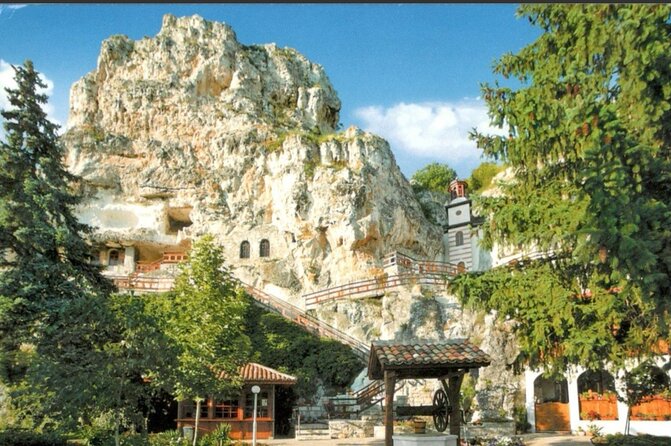
The first major stop is St. Dimitrii of Basarbovo Monastery, about 10 kilometers south of Ruse along the Rusenski Lom River. This is the most unusual stop of the day. Rather than presenting a grand church with a broad façade, the monastery uses rock caves cut into the cliff.
Basarbovo is known as Bulgaria’s only active rock monastery. Its origins reach back to the era of the Second Bulgarian Empire, from the 12th to the 14th centuries, although its first recorded mention appears in an Ottoman tax register from 1431.
The monastery is tied to St. Dimitrii Basarbovski, a hermit who lived an ascetic life in its caves. His relics were later moved to Bucharest during the Russo-Turkish War of 1768 to 1774. They are now kept in the Church of Sts. Constantine and Helena, where he is honored as the patron saint of Romania’s capital.
That connection gives the stop extra meaning. You are not just crossing into Bulgaria for a monument. You are seeing a place whose religious story is directly linked to Bucharest.
Plan on about an hour here. You will have time to look at the rock chambers, take in the setting, and listen to the guide explain the saint’s story. The stop is compact, but the atmosphere is quiet and distinctive. It provides a welcome change from the larger fortress later in the day.
The listed admission is not included and costs €2 per person. Wear shoes suited to uneven ground, and remember that this is an active Orthodox religious site. Modest, respectful clothing is the sensible choice.
Arbanasi’s fortress-like village homes
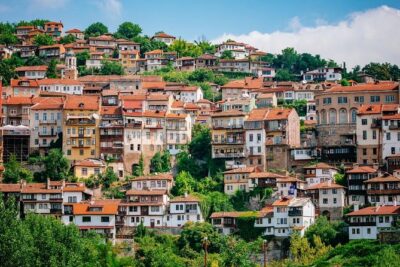
From Basarbovo, the tour continues to Arbanasi, a historic village about four kilometers from Veliko Tarnovo. Arbanasi sits on a high plateau between Tsarevets and Trapezitsa, giving it a useful viewpoint over the surrounding hills and river valley.
The village took shape in the medieval period, with origins linked to Bulgarian nobles who settled here after the Battle of Klokotnitsa in 1230. The name is associated with the medieval Bulgarian word Arbanas, meaning Albanian, reflecting the identity of some early residents.
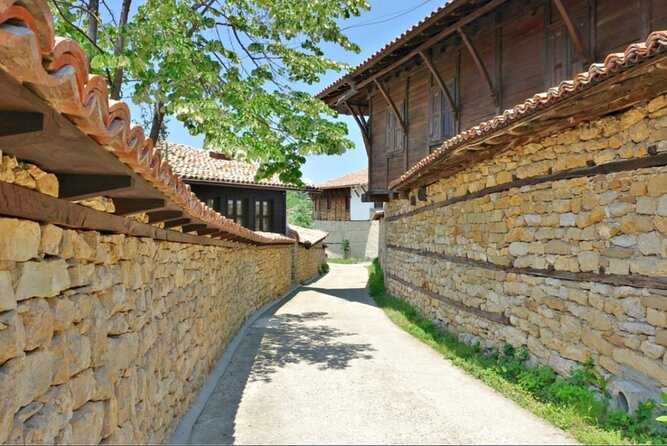
Arbanasi later grew wealthy through trade during the 16th and 17th centuries. Its richest families built houses that look almost defensive. High stone walls, small windows, thick wooden gates, and heavy construction protected residents from raids. Inside, the mood changes. Carved ceilings, wooden furnishings, textiles, rugs, and household objects show how prosperous these merchant families became.
I like this contrast between the plain exterior and the carefully finished interior. It helps you understand that historic houses were not simply pretty homes. They were places where people balanced security, commerce, family life, and status.
The village stop itself is free, and you have about an hour to walk around. Do not expect a large open-air museum or a long list of major monuments. Arbanasi works best as a short stroll through a preserved settlement, paired with the Konstantsalieva House.
Inside Konstantsalieva House
The Konstantsalieva House is the clearest look at Arbanasi’s merchant culture. Built in the 17th century, it belonged to a wealthy family and combines defensive stonework with a more comfortable interior.
The small windows and fortified walls make sense once you know the setting. From outside, the house can feel stern and closed. Inside, traditional furniture, carved wood, rugs, clothing, and household items give the building a more human scale.
You can use this stop to picture daily life during Bulgaria’s National Revival period. The house is not merely a shell. Its rooms show how people organized domestic space and how wealth appeared in details such as textiles, ceilings, and furniture.
Admission is listed at €5 per person and is not included in the tour price. The visit takes about an hour, though your actual time may depend on the day’s traffic and border conditions. If you are most interested in architecture and ordinary life, this may be one of the day’s most rewarding stops.
A few more Bucharest trips to weigh up
- Castles of Transylvania: Private Day Trip from Bucharest
★ 4.5 · 248 reviews - Dracula’s Castle, Peles Castle and Brasov – Private Day Trip from Bucharest
★ 5.0 · 211 reviews - Best of Bucharest | Private Walking Tour
★ 5.0 · 199 reviews - Bucharest Panoramic Sightseeing – Private City Tour
★ 5.0 · 128 reviews
Tsarevets Fortress, the day’s major sight
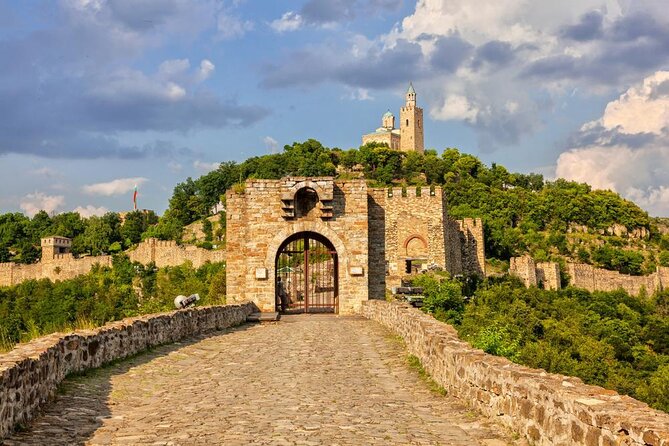
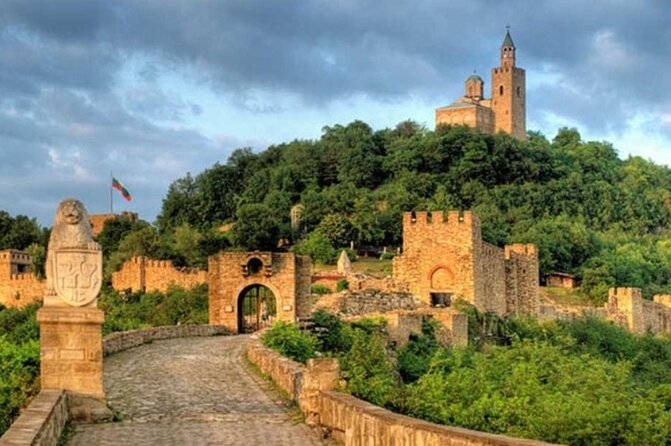
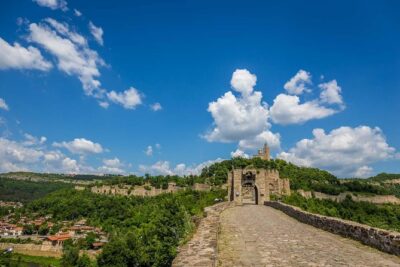
Tsarevets is the largest and most important stop. Allow about two hours, and expect walking on slopes and stone surfaces. The fortress occupies Tsarevets Hill, with the Yantra River curving around three sides. That setting explains why medieval rulers chose it as their main stronghold.
Veliko Tarnovo served as the capital of the Second Bulgarian Empire from 1185 to 1396. During that period, Tsarevets held the royal residence, administrative buildings, churches, towers, and defensive walls. The walls are about three meters thick, enclosing an extensive hilltop complex that once included more than 400 structures.
The fortress is partly reconstructed, so you need to keep your expectations in check. You are not walking through a completely preserved medieval palace. Instead, you are reading the surviving walls, rebuilt sections, and foundations across a dramatic site. That reconstruction makes the layout easier to understand, but it can also give the place a more polished appearance than an untouched ruin.
Baldwin’s Tower is one of the best-known features. The reconstructed tower is named for Baldwin I of Constantinople, who was captured after the Battle of Adrianople in 1205 and is said to have died at the fortress.
At the highest point are the remains of the Palace of the Bulgarian Tsars, including the former throne hall, royal church, and royal chambers. The views are a major part of the experience. From the hill, you can see the Yantra River, surrounding hills, and the layered form of Veliko Tarnovo.
The fortress admission is listed at €5 per person. It is worth paying for if medieval politics, forts, or Orthodox architecture interest you. If steep walking is difficult, discuss the pace with your guide before entering. The private format helps here, since you are not tied to a group’s fixed speed.
Veliko Tarnovo beyond the fortress
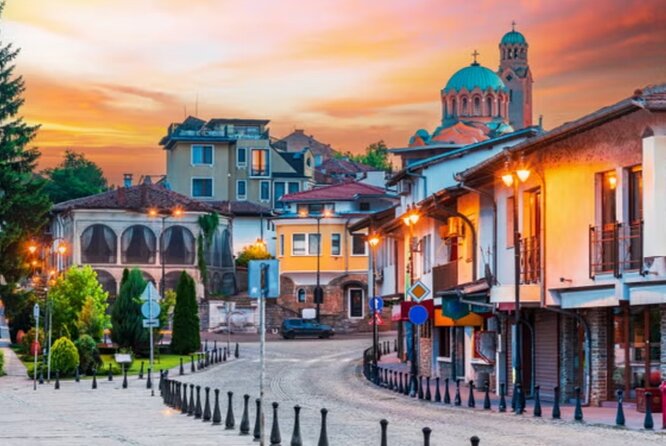
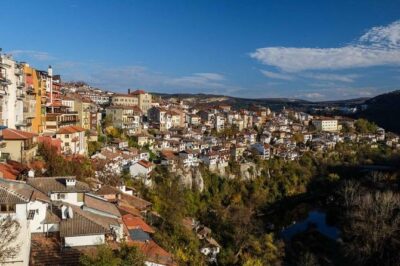
Veliko Tarnovo is more than a fortress with a city attached. Its streets follow three hills, Tsarevets, Trapezitsa, and Sveta Gora, while the Yantra River bends through the city below.
Archaeological evidence points to settlement since the Neolithic period, followed by Thracian and Roman activity. The city became a political center after the 1185 uprising led by the brothers Asen and Peter. It also became a center of Orthodox religion, writing, and architecture.
The city portion of the tour gives you time to connect the fortress to the living town. You may walk through old streets, pause for views, and hear how Veliko Tarnovo functioned as the seat of Bulgarian power. The city stop is listed as free, though your time is limited by the long return to Bucharest.
This is where a flexible guide can improve the day. Bogdan, Sebastian, Radu, Victor, Valerică, Octavian, Alin, Andrei, and other guides have been praised for explaining both Bulgarian and Romanian history, answering questions, and adjusting the experience. Names are not guaranteed at booking, but the repeated praise for individual guides suggests that the person assigned to your vehicle can shape the quality of the trip.
A guide may also suggest a restaurant for Bulgarian food. Lunch is not included, and the exact restaurant is not promised, so treat this as a useful possibility rather than a fixed feature. One guide also added a winery visit when asked, showing that customization may be possible if time allows.
Samovodska Charshiya and the final walk
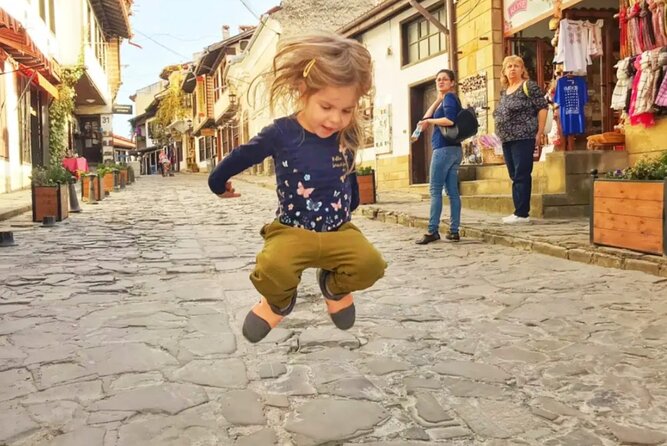
The last scheduled area is Samovodska Charshiya, an artisan quarter in central Veliko Tarnovo. It developed in the 1860s and 1870s as a market and craft district during Bulgaria’s National Revival period.
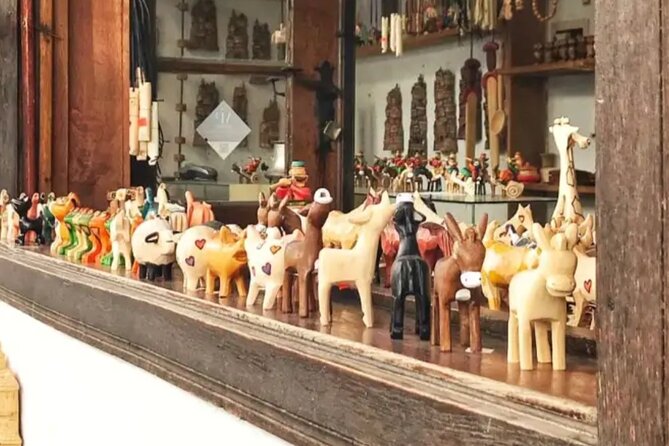
The name comes from the nearby village of Samovodene. Women from the village once spread produce on colorful rugs in the market. Today, the quarter occupies two narrow cobblestone streets lined with old-style houses, workshops, small inns, souvenirs, and handicrafts.
This is a good final stop because it is less formal than Tsarevets. You can browse, take photos, and buy a small reminder of Bulgaria without needing another long museum visit. The quarter is free to enter, but purchases are your responsibility.
The craft district can feel tourist-oriented, and one rating described the overall day as touristy. That is fair. Samovodska Charshiya is designed for visitors, and the fortress has been reconstructed. Still, these places are useful introductions when you have only one day. You are seeing historic forms that remain part of the city’s public identity, not just checking off an isolated ruin.
The long road, border, and practical tradeoffs
The biggest question is not what you will see. It is whether you are comfortable spending much of the day in a car.
The drive from Bucharest to Veliko Tarnovo takes about three hours in one direction, before accounting for traffic or the border. That makes the excursion tiring, especially when combined with several hours of walking. On the other hand, the drive lets you see a wider slice of the region and adds another country without requiring an overnight stay.
Border conditions can change. In September 2025, construction on the bridge between Romania and Bulgaria reduced traffic to one lane, with a reported wait of 20 to 25 minutes. Build some mental space into the schedule. A delay may reduce free time in Veliko Tarnovo, especially because the return journey cannot be pushed too late.
You receive private transportation in an air-conditioned vehicle, along with hotel pickup and drop-off. One account described a newer, clean vehicle with phone charging and Wi-Fi, but those details should not be treated as guaranteed features for every departure.
The tour is offered in English, and most people can participate. Confirmation is provided at booking, and free cancellation is available up to 24 hours before the start time. Admissions and lunch remain extra, so add €12 per person for the three listed entrance fees, plus food.
Who should book this 11-hour excursion?
I would choose this trip if you have several days in Bucharest and want a practical first look at Bulgaria. It is especially well suited to you if you enjoy medieval politics, Orthodox religious sites, traditional houses, fortifications, and scenic hill towns.
Families and small groups can get strong value from the private setup. The vehicle and guide cost are easier to justify when shared, and a private guide can keep children or older relatives from being dragged through every stop at the same pace.
Solo visitors can also benefit, but the price per person may feel high. If you are traveling alone, compare the cost with an overnight trip or a longer Bulgarian itinerary before booking.
I would not choose it if your priority is slow travel. You will not have a full day to explore Veliko Tarnovo at leisure. You also should not book it expecting untouched medieval buildings everywhere. Tsarevets includes reconstruction, and Samovodska Charshiya is aimed partly at sightseeing and shopping.
One poor experience described a guide who took private phone calls and gave limited historical explanation. That appears to be an exception among the supplied feedback, but it is still a useful reminder: the guide matters enormously on this tour. If you can communicate with the operator before departure, confirm the language, pickup details, and whether you have any special interests such as wine, architecture, or religious history.
Should you book the Basarbovo and Veliko Tarnovo tour?
Book it if you want a broad, efficient taste of northern Bulgaria and accept a long day on the road. The strongest parts are the private transport, the unusual Basarbovo monastery, the dramatic position of Tsarevets, and the chance to ask a guide about the closely linked histories of Romania and Bulgaria.
The $170.16 price is fair when shared by a small group and when you value door-to-door transport. Add entrance fees and lunch to your budget. If you have only one free day from Bucharest, this is one of the more substantial ways to use it.
Skip it if you prefer a leisurely pace or dislike border crossings and long drives. But if the idea of standing above the Yantra River where Bulgaria’s medieval rulers once held court sounds worthwhile, this day trip gives you a lot of history for the hours involved.
FAQ
How long does the tour last?
The tour lasts approximately 11 hours, including travel from Bucharest, sightseeing in Bulgaria, and the return to your hotel.
Does the tour include hotel pickup and drop-off?
Yes. Pickup and drop-off at your Bucharest hotel are included.
Is this a private tour?
Yes. Only your group participates in the activity.
Is transportation included?
Yes. Private transportation in an air-conditioned vehicle is included.
Is the guide available in English?
Yes. A professional English-speaking tour guide is included.
Are entrance fees included?
No. The listed entrance fees are €2 for St. Dimitrii of Basarbovo Monastery, €5 for Konstantsalieva House, and €5 for Tsarevets Fortress.
Is lunch included?
No. Lunch is not included in the tour price.
Just added around Bucharest
- Winery touring & private wine tasting – one day private tour★ 5.0 · 3 reviews
- Village Museum Bucharest Guided Tour★ 5.0 · 6 reviews
- Bucharest: Dealu Mare Winery Private Trip with Wine Tasting★ 4.9 · 6 reviews
- Transylvania Tour: Dracula’s Castle, Peles Palace & Brasov★ 5.0 · 19 reviews
- Discover Medieval Transylvania Small Group Tour – 7 days★ 5.0 · 4 reviews
- Bucharest Airport Transfer To Constanta Mamaia★ 5.0 · 3 reviews
- Airport Henri Coanda (Otopeni) to Bucharest – Private Transfer – Driver★ 5.0 · 5 reviews
- Gems of Transilvania: Brasov,Sighisoara,Sibiu,Viscri and more★ 5.0 · 6 reviews
Bulgaria Day Trips, compared.
Visit Bulgaria – Veliko Tarnovo Medieval Fortress – Private tour from Bucharest
Read our review →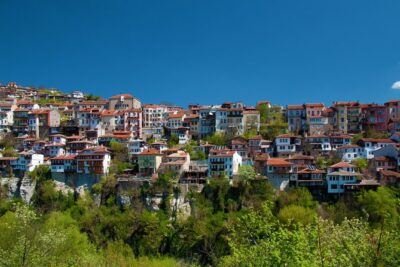
Private Day Trip to Bulgaria and Veliko Tarnovo from Bucharest
Read our review →
Private Daytrip to Buzludzha Monument and Veliko Tarnovo
Read our review →
Bulgaria -Private Tour – Caves, Waterfalls, Hiking, National Park
Read our review →
Browse the lists this tour appears in