Reviewed · TOURS
Unique Tour of Hidden Bucharest
Bucharest reveals its best stories on the small streets behind the grand avenues. This walk leads you through old mahallas, Belle Epoque mansions, Armenian and Jewish quarters, quiet gardens, and buildings still marked by earthquakes, war, and communist demolition. I like the local scale of the tour and the way guides such as Andreea, Ioana, Mircea, and Lala connect architecture with everyday life.
I also like the flexible style. Guides have adjusted routes for photography, brought a traditional pastry or Romanian cake, stopped at cafés, and offered restaurant tips. The main consideration is physical: this is a walking tour, and the advertised duration varies between about two and three hours. Some guests also found the route a little loose, while solo bookings may require payment for two people.
In This Review
- Key points at a glance
- Why this Bucharest walk is different
- Starting at the National Theatre
- Strada Batiștei and the old mahallas
- Parcul Ion Voicu and Belle Epoque Bucharest
- Churches, cafés, and small local touches
- What the guides add
- Group size, private-feeling departures, and value
- Who should book this experience
- My practical take on the experience
- Should you book the Hidden Bucharest walk?
- FAQ
- Where does the tour start?
- What time does the tour begin?
- Where does the tour finish?
- How long does the tour last?
- What language is offered?
- How many people can join?
- Is hotel pickup included?
- What is included in the price?
- Are drinks and meals included?
- Is the tour suitable for people with limited walking ability?
- Can I cancel for a refund?
Key points at a glance
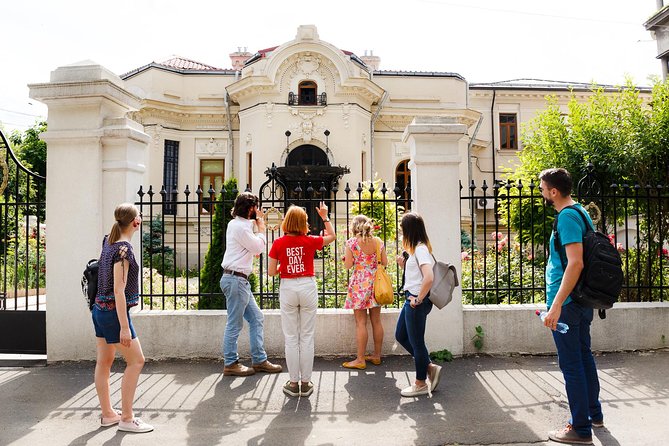
- Small-group format: The maximum group size is 12, and some departures have operated as private walks for solo visitors or small groups.
- Mahalla history: Learn how religious, ethnic, and social quarters shaped central Bucharest before later modernization.
- Architecture first: See French, German, Armenian, Jewish, Belle Epoque, Orthodox, and communist-era influences side by side.
- Useful local advice: Guides have suggested restaurants, cafés, photo spots, and other places to visit after the walk.
- Refreshment stops: Snacks are included, while drinks and additional food can be bought along the way.
- Central start and finish: Begin at the National Theatre Ion Luca Caragiale and finish near KFC on General Gheorghe Magheru Boulevard.
Why this Bucharest walk is different
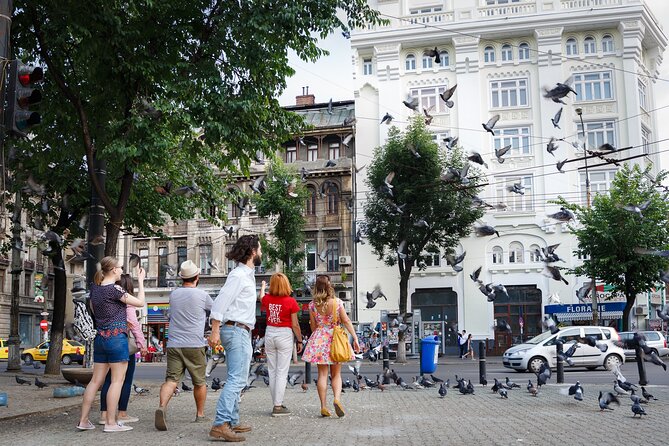
Many first visits to Bucharest focus on the Palace of Parliament, the Old Town, broad boulevards, and the marks left by Nicolae Ceaușescu’s rule. Those places matter, but they do not explain the quieter city behind the main roads.
This tour takes you into neighborhoods where the story is told through details: a crumbling mansion, a church tucked behind a wall, a decorative façade, a street plan shaped by an old community, or a restored house now used as a restaurant. You are not simply checking off monuments. You are learning how Bucharest was built, altered, damaged, and slowly repaired.
The central idea is the mahalla, a small urban quarter often formed around a religious building and associated with a particular ethnic, social, or religious community. As Bucharest expanded, these quarters blended into larger neighborhoods. Their older identities did not vanish completely, and a good guide helps you read those layers in the streets.
I find this approach especially useful in Bucharest because the city can feel confusing at first. Architectural styles change quickly. A French-looking villa may sit beside a plain communist block, while an abandoned house shares a street with a newly restored café. The tour gives those contrasts a reason.
Other Bucharest days worth putting on the list:
- Bucharest: Dracula’s Castle, Peles Castle, & Brasov Old Town
★ 4.5 · 17,858 reviews - Bucharest: Dracula Castle, Peles Castle & Brasov Old Town
★ 4.6 · 10,891 reviews - Bucharest: Dracula’s Castle, Peleș Castle & Brașov Day Trip
★ 4.5 · 5,919 reviews
Starting at the National Theatre
The meeting point is outside the National Theatre Ion Luca Caragiale at Bulevardul Nicolae Bălcescu 2. The start time is 10:00 am, and the location is near public transportation, making it a practical place to reach from central Bucharest.
The theatre is more than a convenient landmark. It introduces the theme of the walk: Bucharest is a city where public buildings, old quarters, outside influences, and political change overlap. The first part of the tour looks at the capital’s development and its unusual relationship with the Ottoman Empire.
Bucharest was not an Ottoman town, but it shared features with places inside the Ottoman sphere of influence. That distinction matters. It helps explain why the city’s growth did not follow one neat Western European pattern. Your guide uses the theatre area to set up this wider story before turning into the older streets.
Plan to arrive a little early. Several people have had trouble spotting one another at busy meeting points, and one tour began late because the guide and guest missed each other. Bring comfortable shoes, water, and a phone with the meeting details available.
Strada Batiștei and the old mahallas
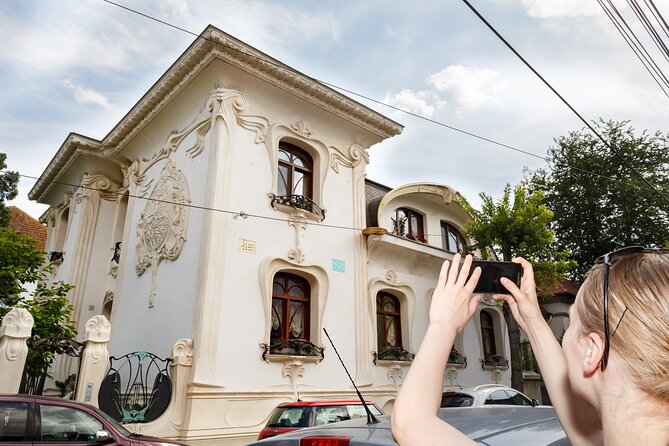
The stop on Strada Batiștei is the historical heart of the experience. Here you learn how mahallas worked and how several quarters developed, merged, and changed over time.
The areas connected with the walk include Batiștei, the Armenian Quarter, Mantuleasa, the old Jewish Quarter, Olari, Ioanid-Grădina, and Icoanei. The exact route can be adapted by the guide, so you should think of these as the walk’s main territory rather than a rigid checklist.
This flexibility is useful. Guides have changed the route to suit photography, walking ability, and individual interests. A visitor drawn to abandoned buildings might spend more time looking at neglected houses. Someone interested in churches or food might receive more local suggestions in those areas.
The trade-off is that the route may feel less tightly organized than a standard sightseeing walk. One guest found parts of it slightly random. The provider explained that guides follow a planned route but can adjust it when the changes fit the story or the interests of the group. I would see this as a choice between polish and personal attention. If you want a fixed sequence with exact timings, this may feel loose. If you enjoy following a good story down an unexpected side street, it works in your favor.
The architecture is the main attraction here. You might see French, German, Armenian, Jewish, and communist influences close together, often in very different states of repair. Some mansions are restored. Others are empty or deteriorating. The contrast is not always pretty, but it is honest, and it gives you a clearer sense of what happened to Bucharest during the twentieth century.
Your guide also explains the effect of earthquakes, wars, modernization campaigns, and Ceaușescu’s demolition projects. The result is a city center with gaps, mismatched buildings, disputed residences, and surviving streets that escaped total destruction.
Parcul Ion Voicu and Belle Epoque Bucharest
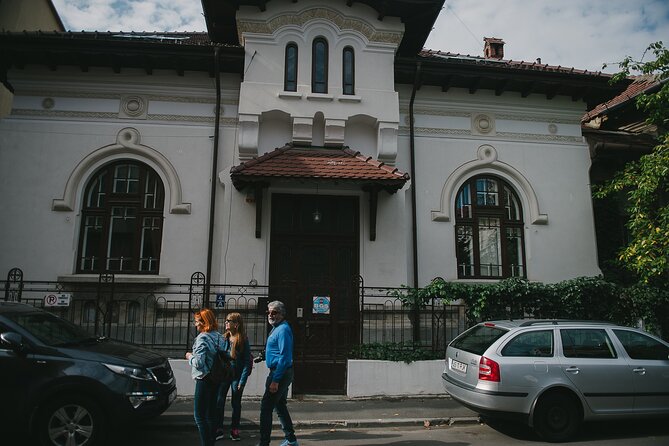
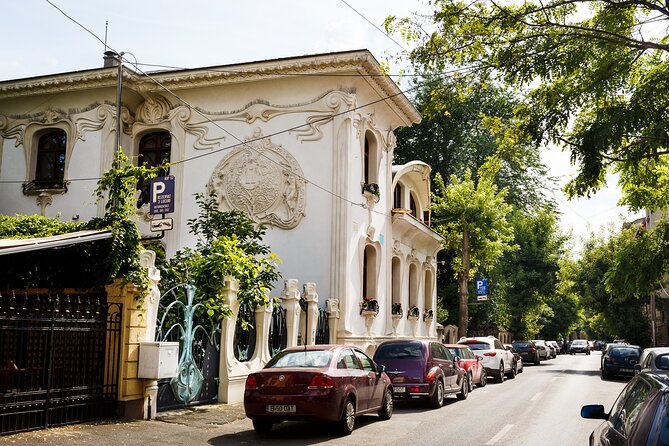
The walk continues toward Parcul Ion Voicu, an elegant Belle Epoque area with mansions dating from the late nineteenth century. This section offers a gentler change of mood after the heavier discussion of destruction and political upheaval.
The mansions help you picture the city before the World Wars and communist dictatorship changed its fortunes. Guides point out architectural features and explain how the buildings fit into Bucharest’s social and cultural past. You may also see houses that are being restored, alongside those still showing years of neglect.
This is one of the best sections for photographers. The tour is not built around famous postcard views. Instead, you are looking closely at façades, doors, balconies, courtyards, and street corners that are easy to miss when you walk alone.
The condition of the buildings is part of the lesson. Bucharest’s older homes have not all had a simple path from private residence to protected landmark. Some properties remain caught in ownership disputes, while others have found new life as restaurants or cultural spaces. A guide can explain why a handsome house might be empty and why another has been carefully repaired.
Same mountains, a completely different day out:
- Bucharest: Palace of Parliament Tickets and Guide
★ 4.3 · 3,182 reviews - Bucharest: Day Trip to Dracula Castle, Peles Castle & Brașov
★ 4.4 · 3,049 reviews - Bucharest to Dracula Castle, Peles Castle and Brasov Guided Tour
★ 4.5 · 2,933 reviews - Bucharest: Palace of Parliament Tickets and Guided Tour
★ 4.4 · 1,877 reviews
Churches, cafés, and small local touches
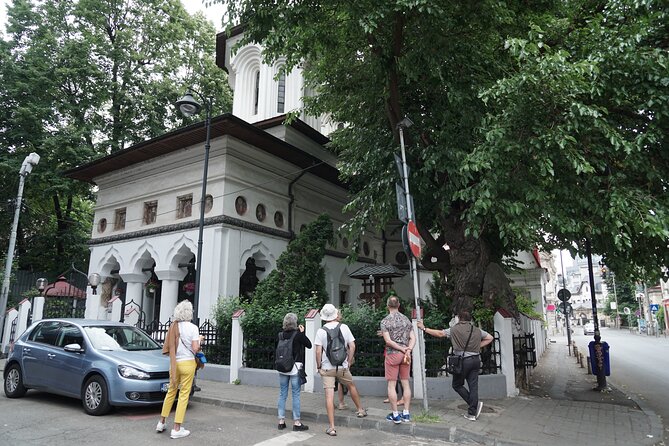
Refreshments make this more than a nonstop history lecture. Snacks are included, and guides have offered traditional pastries, Romanian cake, coffee, lemonade, or a stop at a garden café. Extra food and drinks are not included, and alcoholic drinks are available to purchase if you want one.
The exact stop depends on the guide and route. Past walks have included places such as Simbio, Share Café, and a café garden. One guide ended the walk at a restaurant and helped arrange a later reservation. Another took the group to Hanu Manuc for lunch. These are useful touches because the tour gives you places to continue eating and exploring after the official walk ends.
Do not treat the refreshment stop as a full meal. The tour includes snacks, but the details of any café or restaurant purchase are your responsibility. If you need a special diet, it is sensible to raise the issue with the guide. A gluten-free lunch was arranged for one visitor, but that should not be taken as a guaranteed feature of every departure.
Some guides add personal touches that make the morning feel less formal. Lala has greeted visitors with a traditional pastry, while Ioana brought a Romanian holiday cake to one Easter tour. Those gestures cannot be promised, but they show the sort of friendly, personal tone this experience aims for.
What the guides add
The guide is the main reason to choose this tour over walking the same streets alone. The buildings may be visible to anyone, but their connections are not.
Guides including Andreea, Ioana, Irina, Alex, Elena, Anita, Tudor, Roxana, Mircea, and Lala have led different departures. Their approaches vary, but the strongest pattern is local knowledge combined with flexibility. Several have adapted the pace, added photo stops, answered many questions, and offered advice by email after the tour.
Mircea, for example, took special care of a guest during a day when temperatures reached 45 degrees Celsius. When another guest could not complete the final hour on foot, he arranged a car from the office so the tour could continue by vehicle. That does not make the experience fully accessible, but it shows that guides may respond thoughtfully when a problem arises.
You should still expect a moderate level of physical fitness. The tour involves walking through central neighborhoods, and good footwear is important. The duration is listed as roughly two hours and thirty minutes, while the highlights describe it as a three-hour tour. In practice, allow at least half a morning, and do not schedule a tight appointment immediately afterward.
Group size, private-feeling departures, and value
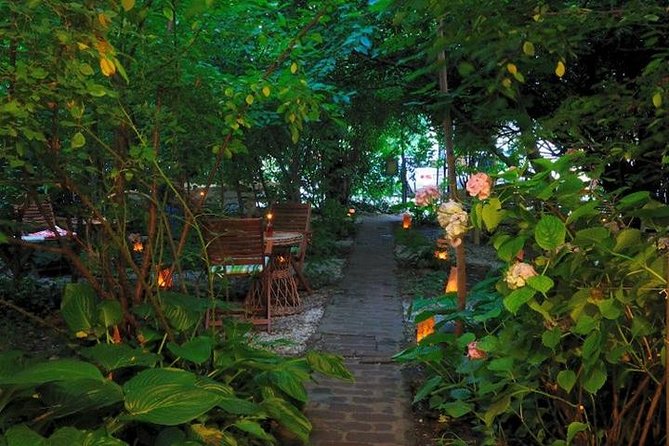
The maximum group size is 12. That is small enough for questions and conversation, without requiring you to trail behind a large crowd.
A few departures have turned into private or near-private walks because only one person or one small group booked. That can be a major advantage. Guides have been able to adjust the route for photography, interests, pace, and food needs. The downside is financial: one solo guest reported having to pay for two people even when attending alone.
At $46.86 per person, the tour is not the cheapest way to spend a morning in Bucharest, but it offers more than a basic orientation walk. You are paying for a local guide, a carefully chosen area, historical explanation, snacks, and practical recommendations. The value is strongest if you want architecture and context rather than a quick parade past headline sights.
The group discount option may help if you are traveling with friends or family. Since group size and private treatment can vary, I would check the final booking details carefully, especially if you are traveling alone.
Who should book this experience
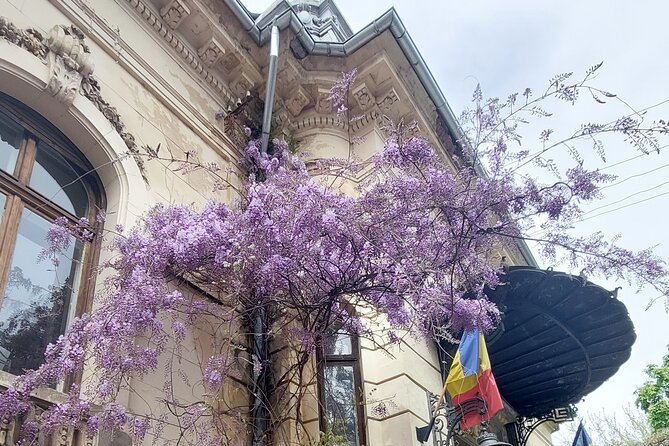
I would recommend it to you if you have already seen, or plan to see, Bucharest’s standard sights and want a quieter side of the center. It is also a good first-day activity if you want to understand the city before exploring on your own.
Architecture fans will get the most from it. So will anyone curious about how Armenian, Jewish, French, German, Ottoman-influenced, Orthodox, and communist elements have shaped the city. The tour also suits photographers who enjoy worn façades, restored houses, and streets with fewer people.
It may be less suitable if you want grand interiors, a major museum, or a tightly timed list of attractions. Most of the experience happens outdoors, and the appeal lies in observation and explanation rather than formal entry tickets. The itinerary lists free admission at each main stop.
The tour is offered in English, includes a mobile ticket, and confirmation is sent at booking. Hotel pickup and drop-off are not included, so you will need to reach the theatre on your own and make your way from the final stop near General Gheorghe Magheru Boulevard.
My practical take on the experience
I like this tour because it gives Bucharest room to be complicated. You see beauty beside decay, old ethnic quarters beside later construction, and ambitious restoration beside unresolved property problems. A guide turns those contrasts into a readable story.
The best moments are likely to come between the named stops: a mansion you would have walked past, a side street with a church, a café that becomes a useful lunch tip, or an architectural detail that suddenly makes sense. The tour does not hide the city’s rough edges, and that honesty is part of its appeal.
Keep your schedule flexible. The walk may last closer to three hours, the guide may adjust the route, and you may want to stop for photographs or a drink. Free cancellation is available up to 24 hours before the local start time, but changes or cancellations inside that window are not accepted for a refund.
Should you book the Hidden Bucharest walk?
Book it if you want to understand Bucharest through neighborhoods rather than monuments. The 4.9 rating from 42 reviews and 98 percent recommendation rate fit the experience’s strongest qualities: personable local guides, excellent architecture commentary, flexible routing, and access to streets most people would not find alone.
I would especially choose it early in a Bucharest stay. You will leave with restaurant suggestions, a better sense of the city center, and a sharper eye for the buildings you pass afterward. Skip it only if you dislike walking, need a completely fixed route, or want a tour centered on major ticketed attractions.
FAQ
Where does the tour start?
The tour starts at the National Theatre Ion Luca Caragiale, Bulevardul Nicolae Bălcescu 2, Bucharest.
What time does the tour begin?
The scheduled start time is 10:00 am.
Where does the tour finish?
The tour finishes near KFC at Bulevardul General Gheorghe Magheru 28-30, Bucharest.
How long does the tour last?
The stated duration is approximately two hours and thirty minutes, while the tour highlights describe it as a three-hour walk. Allow at least half a morning.
What language is offered?
The tour is offered in English.
How many people can join?
The maximum group size is 12 people.
Is hotel pickup included?
No. Hotel pickup and drop-off are not included, so you must make your own way to and from the meeting areas.
What is included in the price?
Snacks and a local guide are included.
Are drinks and meals included?
Food and drinks are not included unless specifically stated. Alcoholic drinks are available to purchase.
Is the tour suitable for people with limited walking ability?
The tour requires a moderate level of physical fitness. It is primarily a walking experience, although a guide may be able to respond to individual needs in some situations.
Can I cancel for a refund?
Yes. You can cancel at least 24 hours before the local start time for a full refund. Cancellations or changes made less than 24 hours before the start are not accepted for a refund.
Just added around Bucharest
- Bucharest: Dealu Mare Winery Private Trip with Wine Tasting★ 4.9 · 6 reviews
- Winery touring & private wine tasting – one day private tour★ 5.0 · 3 reviews
- Village Museum Bucharest Guided Tour★ 5.0 · 6 reviews
- Transylvania Tour: Dracula’s Castle, Peles Palace & Brasov★ 5.0 · 19 reviews
- Discover Medieval Transylvania Small Group Tour – 7 days★ 5.0 · 4 reviews
- Bucharest Airport Transfer To Constanta Mamaia★ 5.0 · 3 reviews
- Airport Henri Coanda (Otopeni) to Bucharest – Private Transfer – Driver★ 5.0 · 5 reviews
- Gems of Transilvania: Brasov,Sighisoara,Sibiu,Viscri and more★ 5.0 · 6 reviews
Tours, compared.
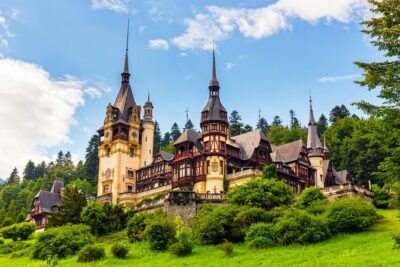
Bucharest to Dracula Castle, Peles Castle and Brasov Guided Tour
Read our review →
Transylvania and Dracula Castle Full Day Tour from Bucharest
Read our review →
Peles Castle, Bran Castle, & Brasov Old Town Tour
Read our review →
Small-group tour Bran, Rasnov, and Peles Castles
Read our review →