
Reviewed · TRANSYLVANIA TOURS
6 Days Transylvania and Bukovina Small Group Tour from Bucharest
Romania packs a remarkable amount into this six-day circuit: medieval Saxon towns, fortress churches, royal castles, Byzantine frescoes, and Carpathian mountain roads. The most memorable stretch is likely Bucovina, where Moldovita, Sucevita, and Voronet monasteries turn exterior walls into enormous painted storybooks.
I like the small maximum of seven people, which makes a long route easier to manage, and I like having one licensed guide who also drives, rather than juggling trains, hotels, and rural connections yourself. The main caution is pace: you cover a lot of ground, and entrance fees, lunches, tips, and the single-room supplement are extra.
In This Review
- Key points to know before booking
- Why this route works for first-time Romania visitors
- Day 1: Cozia Monastery and the medieval squares of Sibiu
- Day 2: Sighisoara, Hungarian influence, and Bistrita
- Day 3: Bucovina’s painted monasteries and Marginea pottery
- Day 4: Piatra Neamt, Bicaz Gorge, and Red Lake
- Day 5: Brasov and the Dracula question at Bran Castle
- Day 6: Peles Castle and a Bucharest finish
- What the $1,163.56 price really covers
- Hotels, group size, and practical comfort
- Who should book this Romanian circuit?
- FAQ
- How long is the tour?
- What time does the tour start?
- How many people can join the tour?
- Is hotel accommodation included?
- How many breakfasts are included?
- Are entrance fees included?
- Is a single room available?
- Who drives the vehicle?
- What clothing is required at churches and museums?
- Should you book the six-day Transylvania and Bukovina tour?
Key points to know before booking
- Three painted monasteries in one day: Moldovita, Sucevita, and Voronet are the artistic heart of the route.
- A genuine small group: The vehicle carries no more than seven participants, with pickup offered from Bucharest.
- Guide-driver arrangement: Your professional licensed guide handles both the driving and the explanations.
- A strong castle pairing: Bran Castle supplies the Dracula legend, while Peles Castle shows royal Romania at its most refined.
- Five breakfasts included: Hotels are rated 3 or 4 stars, but lunches and most admission tickets are separate.
- A demanding but rewarding route: Six days take you from the Olt Valley to Bucovina, the Carpathians, Brasov, Sinaia, and Bucharest.
Why this route works for first-time Romania visitors
Romania is not a country I would reduce to Dracula and a few pretty streets. Its appeal comes from the mix: Romanian Orthodox traditions beside Saxon town planning, Hungarian cultural influence, royal architecture, mountain scenery, and local crafts.
This tour gives you a useful first look at that mix without requiring you to work out every connection. The guide-driver format matters here. Several stops are outside major cities, and the route reaches monasteries, gorges, and villages that would be awkward to connect by public transport in only six days.
The group size is another practical advantage. With a maximum of seven people, stops should feel more personal than on a full-size coach tour. Still, this is not a slow, stay-put holiday. You change bases and cover long stretches of Romania, so pack lightly and expect regular time on the road.
One detail needs clarification before you pay: the tour is presented as six days, while some descriptive wording refers to an eight-day tour. The detailed schedule clearly runs from Day 1 through Day 6, so confirm the exact dates and number of hotel nights with Trip2Ro.
More Transylvania Tours in Bucharest
- Transylvania and Dracula Castle Full Day Tour from Bucharest
★ 4.5 · 1,589 reviews - Castles of Transylvania: Private Day Trip from Bucharest
★ 4.5 · 248 reviews - 2-Day Medieval Transylvania with Brasov,Sibiu and Sighisoara Tour from Bucharest
★ 4.5 · 145 reviews
Day 1: Cozia Monastery and the medieval squares of Sibiu
The first morning begins at 8:00 am, with departure from Bucharest toward the Olt Valley. Cozia Monastery offers a quiet and meaningful opening stop. Founded in the fourteenth century by Mircea the Old and restored later by the Cantacuzino family, it combines Wallachian religious tradition with Armenian decorative details.
You have about 30 minutes here. That is enough for a focused look at the facade and frescoed interior, but not a long, unhurried visit. Dress properly from the start: shoulders and knees must be covered at places of worship, for both men and women.
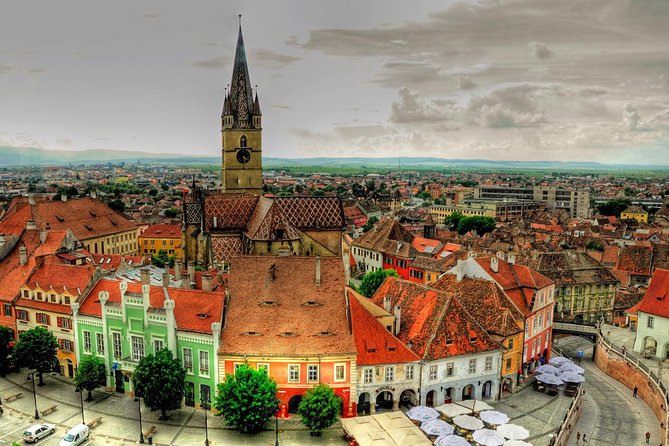
Sibiu receives the bulk of the day, with about three hours to explore. This is one of Romania’s most appealing historic cities, shaped by centuries of coexistence among Romanian, Saxon, Catholic, Orthodox, and Protestant communities.
The city’s three main squares give the visit its structure. Big Square, Small Square, and Huet Square are close enough to explore on foot, with towers, old bastions, museums, and the famous houses with eyes overhead. The large Gothic evangelical church is another important stop.
Sibiu was European Capital of Culture in 2007, and its cultural life remains a central part of its identity. I like that this tour allows more time here than at some of the smaller stops. Three hours gives you a proper walk and a chance to understand how a medieval trading city still functions as a living place.
Day 2: Sighisoara, Hungarian influence, and Bistrita
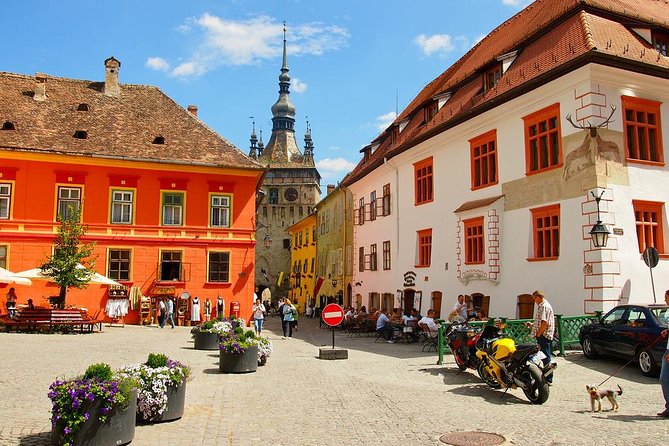
Sighisoara is one of the trip’s essential stops. Its historic center has UNESCO status, and the old citadel is still inhabited. That last detail matters. You are not walking through a dead museum set, but through a preserved town where the Clock Tower, narrow streets, and old houses remain part of daily life.
You have around two hours. The Clock Tower is the obvious landmark, but allow time for the Church on the Hill, reached by the covered wooden Schoolchildren’s Stairway. The route also includes the Shoemakers’ Tower, the Catholic church associated with the Hungarian community, and a statue of Hungarian poet Petofi Sandor.
Lunch at the house associated with Vlad the Impaler is possible, but it is not included. Treat this as a themed option rather than the main reason to visit. Sighisoara’s real value lies in its medieval streets and the way Romanian, Saxon, and Hungarian stories overlap.
The stop in Targu Mures is brief, about 30 minutes. The Palace of Culture is the main point of interest, reflecting the city’s strong Hungarian architectural and cultural influence. This is more of a visual introduction than a full city visit, so do not expect time for a museum tour.
Bistrita receives about an hour for a walking tour. Its Lutheran church, first built in the fourteenth century and later altered with Renaissance details, anchors the visit. After the scale of Sighisoara, Bistrita feels like a shorter, more focused stop. I appreciate the variety, but you should know that the schedule favors breadth over long independent exploration.
Day 3: Bucovina’s painted monasteries and Marginea pottery
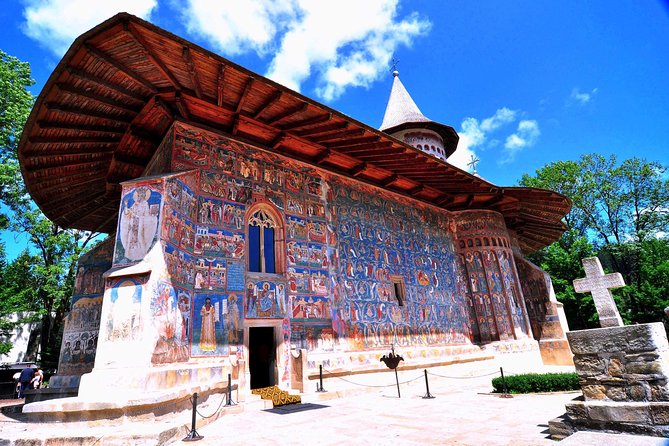
For many people, Day 3 is the artistic high point. Bucovina’s monasteries are known for exterior and interior frescoes that cover religious stories, saints, and biblical scenes in bold colors.
Moldovita Monastery, founded by Petru Rares in the sixteenth century, is the first major stop. You have about an hour, enough to examine the painted walls and the monastery setting without rushing through in a few minutes.
Sucevita Monastery follows, also with about an hour. Founded by the Movila brothers in the seventeenth century, it brings together Gothic and Byzantine elements in a style strongly associated with northern Moldavia. The northern frescoes are especially important because the protective walls helped preserve them.
At Marginea, you spend around 15 minutes with local pottery makers. The area is known for black ceramics, and you can see the basic stages of the work inside a workshop. Painted eggs and other traditional items are also available for purchase.
The short timing makes this a quick craft encounter, not a full workshop lesson. Still, it adds a useful human touch to a day otherwise centered on major religious monuments. If you like buying crafts, this is one of the clearer opportunities on the route. Keep purchases small, since you will continue moving between hotels.
Voronet Monastery closes the day’s main sightseeing. Its famous blue exterior has earned it the nickname the Sistine Chapel of the Carpathians. The comparison is dramatic, but the blue color is the point: it is distinctive, memorable, and closely tied to the monastery’s identity.
The monastery was founded by Stephen the Great. You receive about an hour here, and that is a sensible amount of time for studying the frescoes and hearing the stories behind them. Admission is not included at any of the three monasteries, so budget separately for tickets.
Same mountains, a completely different day out:
- Bucharest: Dracula’s Castle, Peles Castle, & Brasov Old Town
★ 4.5 · 17,858 reviews - Bucharest: Dracula Castle, Peles Castle & Brasov Old Town
★ 4.6 · 10,891 reviews - Bucharest: Dracula’s Castle, Peleș Castle & Brașov Day Trip
★ 4.5 · 5,919 reviews - Bucharest: Palace of Parliament Tickets and Guide
★ 4.3 · 3,182 reviews
Day 4: Piatra Neamt, Bicaz Gorge, and Red Lake
Day 4 shifts from religious art to mountain scenery. Piatra Neamt is a short 15-minute stop, with views toward the surrounding mountains and a glimpse of its historic citadel and eighteenth-century synagogue.
This is a brief orientation stop, not a city tour. The city is known as a ski resort and for its connection with the era of Stephen the Great, but you will not have time to explore it in depth.
The road through Bicaz Gorge is one of the most striking parts of the trip. Cliffs rise close to the road, with a stream alongside the route and small stalls selling handicrafts and souvenirs. The scenery is dramatic, but the road can feel tight and winding. If you are sensitive to motion, sit where you usually feel most comfortable and bring anything you normally use for mountain travel.
Red Lake is a natural barrier lake formed after a section of mountain gave way. Tree trunks still rise from the water, giving the place an unusual appearance. The stop lasts about an hour and includes local legends connected to the lake’s name.
The appeal here is not a long hike or a planned outdoor activity. It is the combination of geology, folklore, and a scenic pause. After Red Lake, the route continues toward Miercurea Ciuc through the Carpathians. The area is known for very low temperatures and is sometimes called the Siberia of Romania, so bring layers even if Bucharest is warm.
Day 5: Brasov and the Dracula question at Bran Castle
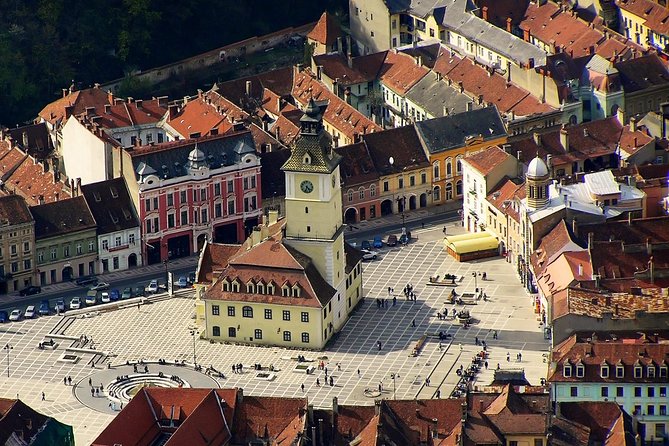
Brasov is one of the trip’s strongest city visits. Once fortified, it developed as an important cultural, commercial, and religious center. Its architecture blends Gothic, Baroque, and Renaissance elements, with a strong German influence.
The tour allows about two hours in the historic center. You visit the Black Church and the First Romanian School in the Schei district, the old Romanian quarter outside the medieval Saxon core. Catherine’s Gate and Schei Gate help explain how access to the city worked in medieval times.
The First Romanian School gives the visit extra depth because it shifts attention away from facades and toward education and language. Brasov is a place where the city’s Romanian and Saxon identities are both visible, and a guide can help you read that division without reducing it to a simple story.
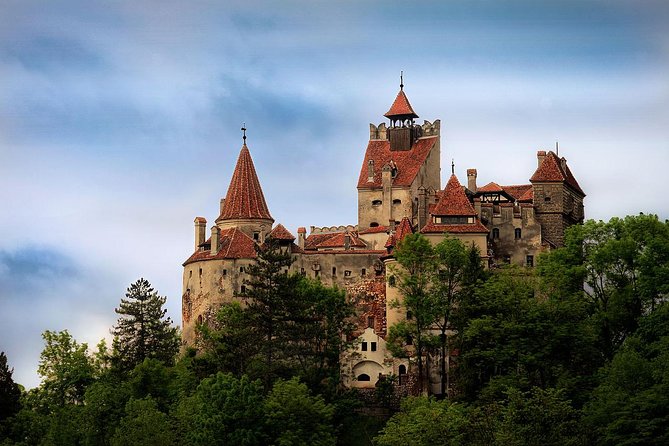
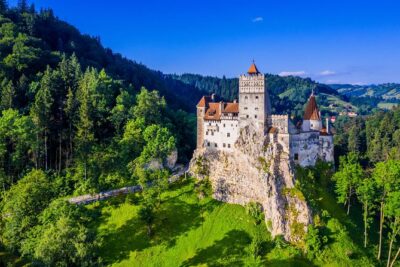
At Bran, the famous castle is marketed as Dracula’s Castle. The real historical setting is more practical. Bran stood near the border between Wallachia and Transylvania, making a defensive stronghold useful to Brasov’s residents.
The castle is connected to the Dracula legend, but the experience is not a literal visit to a vampire’s home. Go for the fortress setting, the mountain backdrop, and the way modern tourism has built a powerful story around Vlad the Impaler and Bram Stoker’s fiction.
You have about two hours at Bran Castle, and admission is extra. Lines may occur, especially at a major attraction like this. One past account specifically praised guide George for helping the group move ahead when lines were present, but a particular guide or priority access is not guaranteed. If George is assigned to your departure, expect an enthusiastic guide who takes pride in explaining Romania. It is worth confirming the guide name with the operator rather than assuming it.
The day ends with arrival in Sinaia late in the evening. That timing is important. You get a full Brasov and Bran visit, but Day 5 is not a relaxed evening in Sinaia.
Day 6: Peles Castle and a Bucharest finish
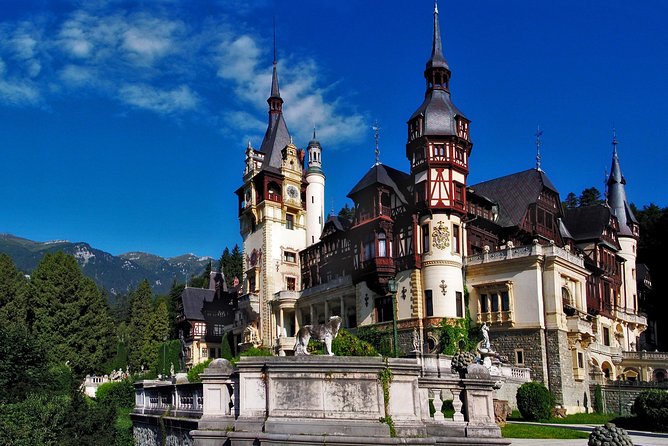
Peles Castle is a strong final sightseeing stop. Built as the summer residence of King Carol I of Hohenzollern, it reflects Romania’s royal ambitions in the late nineteenth and early twentieth centuries.
The building was designed by a Czech architect and was considered highly modern for its era. Its rooms do not follow one single decorative plan. Each has a different style, including a Florentine room with Italian Renaissance touches.
You have about two hours, which should allow a proper guided visit if access is running smoothly. Admission is not included, so keep extra money available. Peles is not another medieval fortress like Bran. It is a royal residence built for comfort, ceremony, and display, and that contrast makes the pairing worthwhile.
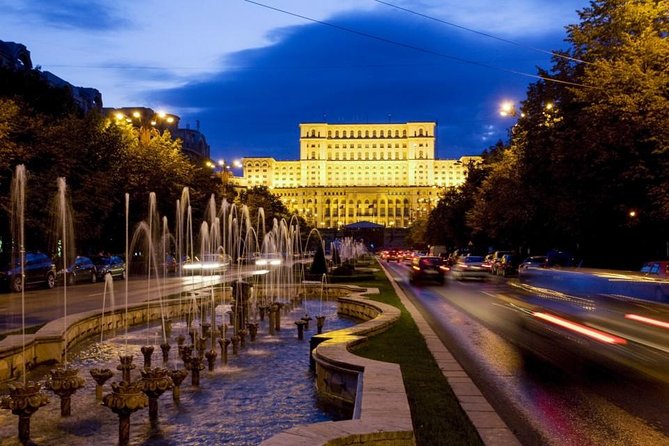
The return to Bucharest includes a panoramic tour with the Triumph Arch, the Romanian Athenaeum, Revolution Square, and the Parliament Palace. This is an overview rather than a full interior tour. It gives you useful orientation for a later independent stay in the capital, but do not book this expecting extensive time at every landmark.
What the $1,163.56 price really covers
At $1,163.56 per person, the price is not simply paying for six days of sightseeing. It includes an air-conditioned vehicle, a professional licensed guide who also drives, five breakfasts, and 3- or 4-star accommodation.
That package can offer fair value if you want one organized route through places that are spread across several regions. You avoid arranging separate hotels and transport, and the small group keeps the experience more personal than a large coach circuit.
The price does not include entrance fees. Expect to pay separately at Sighisoara’s selected attractions, the three Bucovina monasteries, Brasov’s Black Church and First Romanian School, Bran Castle, and Peles Castle. Lunches are also not included, apart from the fact that you can choose where to eat along the way.
Tips for the driver-guide are extra. If you book a single room, add a supplement of 120 euros, payable locally by cash or card. Those additions can materially change the final cost, so compare the full expected total rather than the headline price alone.
Hotels, group size, and practical comfort
The accommodation is in 3- and 4-star hotels, with breakfast included on five mornings. The exact hotel names are not provided, so you should ask Trip2Ro for the planned properties and room arrangements before booking if hotel style matters to you.
Pickup is offered, and the listed start time is 8:00 am. The tour requires at least two participants and accepts a maximum of seven. That means a solo booking may go ahead if another person or couple joins, but it can also be canceled if the minimum is not met.
The route is suitable for most people according to the supplied details, but the schedule includes walking in historic centers, stairs at Sighisoara, monastery visits, and mountain roads. Places of worship require covered shoulders and knees. Pack a light scarf or a longer layer so you are ready for churches and monasteries.
The cancellation terms are strict: the booking is non-refundable and cannot be changed. The exceptions are operational. If bad weather prevents the trip or the minimum group size is not reached, you are offered another date or experience, or a full refund.
Who should book this Romanian circuit?
I would recommend it to you if this is your first visit to Romania and you want a guided overview of Transylvania and Bukovina without renting a car. It also suits solo visitors who prefer a small group, couples who want logistics handled, and culture-focused travelers drawn to churches, architecture, and local traditions.
It is less suitable if you want long stays in each town, slow meals, substantial free time, or several nights in one base. You will see a great deal, but you will not know every place intimately.
The route is especially good for someone who values explanation. Cozia, Sibiu, Sighisoara, the Moldavian monasteries, Brasov, Bran, and Peles each tell a different part of Romania’s story. A guide can connect those pieces while you concentrate on the views and the practical business of getting from one region to the next.
FAQ
How long is the tour?
The detailed schedule covers six days, beginning with Day 1 and ending with the return to Bucharest on Day 6. Some tour wording describes it as an eight-day tour, so confirm the exact duration with Trip2Ro before booking.
What time does the tour start?
The listed start time is 8:00 am.
How many people can join the tour?
The tour has a maximum of seven participants. At least two participants are required for the tour to operate.
Is hotel accommodation included?
Yes. Accommodation in 3- or 4-star hotels is included.
How many breakfasts are included?
Five breakfasts are included.
Are entrance fees included?
No. Entrance tickets are not included and must be paid separately at attractions and selected sites.
Is a single room available?
Yes. A single-room supplement of 120 euros applies and is paid locally by cash or card.
Who drives the vehicle?
A professional licensed tour guide also serves as the driver. A past booking specifically identified the guide as George, but you should confirm the assigned guide with Trip2Ro.
What clothing is required at churches and museums?
You must cover your knees and shoulders at places of worship and selected museums. Shorts and sleeveless tops may lead to refused entry.
Should you book the six-day Transylvania and Bukovina tour?
Book it if you want Romania’s major medieval towns, painted monasteries, mountain scenery, and best-known castles in one organized trip. The small group, included transport, breakfast, and guide-driver setup make the price easier to justify for a first visit.
Skip it if your ideal holiday means lingering in Sibiu or Brasov, taking long countryside walks, or choosing your own pace each day. Also confirm the six-day wording, hotel names, assigned guide, and likely entrance costs before committing, since the booking is non-refundable. For an efficient first look at Romania’s cultural heartland, though, this is a strong and unusually varied route.
More 6-Day Experiences in Bucharest
- 6 Days Private Tour in Romania Spectacular Places from Bucharest
★ 5.0 · 9 reviews - Private 6-Day Dracula Tour in Transylvania from Bucharest
★ 5.0 · 4 reviews - Transylvania & Bucovina Private Tour – 6 days
★ 5.0 · 3 reviews
Just added around Bucharest
- Village Museum Bucharest Guided Tour★ 5.0 · 6 reviews
- Bucharest: Dealu Mare Winery Private Trip with Wine Tasting★ 4.9 · 6 reviews
- Winery touring & private wine tasting – one day private tour★ 5.0 · 3 reviews
- Transylvania Tour: Dracula’s Castle, Peles Palace & Brasov★ 5.0 · 19 reviews
- Discover Medieval Transylvania Small Group Tour – 7 days★ 5.0 · 4 reviews
- Bucharest Airport Transfer To Constanta Mamaia★ 5.0 · 3 reviews
- Airport Henri Coanda (Otopeni) to Bucharest – Private Transfer – Driver★ 5.0 · 5 reviews
- Gems of Transilvania: Brasov,Sighisoara,Sibiu,Viscri and more★ 5.0 · 6 reviews
Transylvania Tours, compared.
Transylvania and Dracula Castle Full Day Tour from Bucharest
Read our review →
Castles of Transylvania: Private Day Trip from Bucharest
Read our review →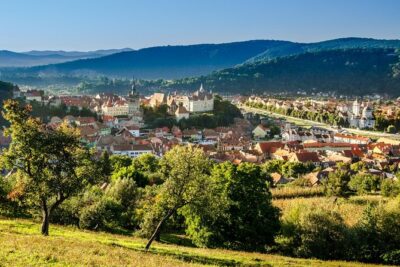
2-Day Medieval Transylvania with Brasov,Sibiu and Sighisoara Tour from Bucharest
Read our review →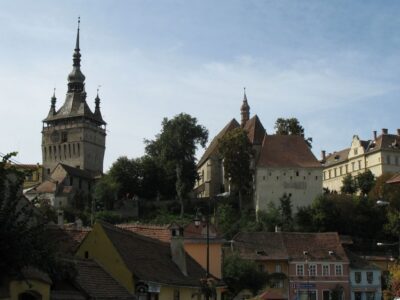
Transylvania: Dracula’s Castle and Birthplace Tour
Read our review →
SB01 – City Tour Sibiu: Exploring the Heart of Transylvania
Read our review →
Day trips and excursions in nature, cities in Transylvania, Brasov!
Read our review →
2-Day Transylvania from Bucharest: Brasov, Bran, Sighisoara
Read our review →
Browse the lists this tour appears in