
Reviewed · CITY TOURS
Bucharest City Tour 2 hours – by Car with a Private Guide
The most striking part of this Bucharest tour is the sharp contrast between Ceaușescu’s grand communist projects and the modest wooden homes at the National Village Museum. In one short drive, you move from a building meant to display state power to a village world built around practical homes, churches, mills, and local craft.
I like the private format, which lets you set the pickup time and adjust the route after the tour begins. I also like the useful all-in price: gas, parking, tolls, taxes, and the car are covered. The catch is time. Two hours is tight, so several sights may be viewed from outside or as quick stops rather than full visits.
In This Review
- Key points to know before booking
- A fast introduction to Bucharest’s two very different faces
- The Palace of Parliament and the cost of political power
- The National Village Museum brings Romania down to human scale
- Revolution Square connects the city to December 1989
- Ceaușescu Mansion reveals the dictator’s private world
- The Arch of Triumph recalls Romania’s national story
- The Romanian Athenaeum gives the drive a cultural pause
- Central Bucharest packs royal, religious, and civic landmarks together
- What the private format adds to a two-hour schedule
- Is $123.91 per person a fair price?
- Who should book this Bucharest tour?
- FAQ
- How long is the Bucharest City Tour?
- Is the tour private?
- Is hotel or accommodation pickup available?
- Is the tour offered in English?
- Is Nicolas the guide?
- What vehicle is used?
- Are fuel, parking, tolls, and taxes included?
- Are food and drinks included?
- Does the tour include admission tickets?
- Can I cancel for a full refund?
- Should you book it?
Key points to know before booking
- The Palace of Parliament gives the tour its strongest historical lesson, showing how communist ambition reshaped Bucharest.
- A private car or minibus keeps the tour flexible, with pickup at the address and time you provide.
- Nicolas may be your guide and driver, and he brings personal memories of life under communism into the conversation.
- The National Village Museum adds a welcome change of pace, with traditional houses, mills, and wooden churches from across Romania.
- The route links major sights across Bucharest, including the Romanian Athenaeum, central squares, the Arch of Triumph, and Ceaușescu Mansion.
- The $123.91 per-person price makes more sense for a small group, since the vehicle and guide are private for your party.
A fast introduction to Bucharest’s two very different faces
Bucharest can be hard to read at first. Its broad avenues, grand public buildings, old churches, royal landmarks, and communist blocks do not always fit into one tidy picture. This tour helps you connect those pieces without spending half your day working out buses, routes, and distances.
The private car matters here. You are not tied to a large group or a fixed public meeting point. Pickup is offered at the address and time you provide, and the private vehicle is for you and your friends or family. That makes the tour a practical choice after arrival, before a flight, or during a short stay.
Your guide is also the driver, and English is offered throughout. Nicolas is one guide associated with this experience. His style, based on the information provided, includes humor, family stories, and memories of Romania under communism. That personal angle can make the political story easier to grasp than a string of dates and names.
Still, keep the clock in mind. The route includes many major sights, but two hours does not leave room for long museum visits, detailed palace tours, and relaxed time at every stop. Think of this as a guided orientation with selected stops, not a full-day sightseeing program.
A few more Bucharest trips to weigh up
- Bucharest: 2-Hour City Highlights Bike Tour
★ 4.8 · 269 reviews - 4h Bucharest Private Tour (2h by Car and 2h Walking in Old Town)
★ 5.0 · 90 reviews - 2h Bucharest Private Tour by Car
★ 5.0 · 10 reviews
The Palace of Parliament and the cost of political power
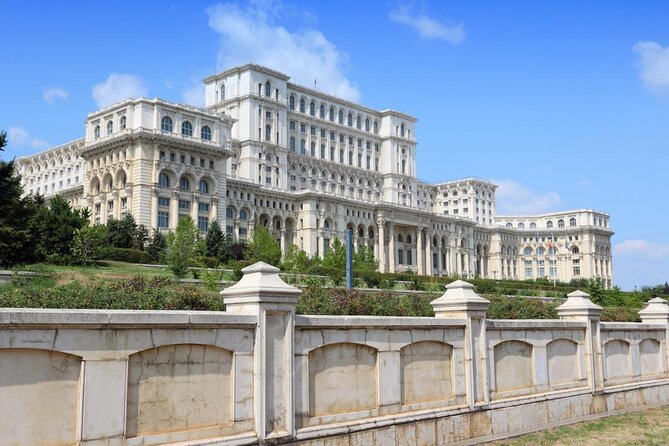
The Palace of Parliament, also called the People’s House, is the most dramatic stop. It is the second-largest administrative building in the world after the Pentagon, and its sheer scale is hard to understand until you see it in person.
The building was created under Nicolae Ceaușescu, whose communist government used vast public works to project authority. Your guide can explain how the building fits into the wider story of totalitarian rule, including the damage such a system can cause to a nation. The point is not only that the building is huge. It is that its size came from a political culture built around control, sacrifice, and personal power.
I find this stop useful because it gives Bucharest a clear starting point. The architecture can seem impressive from a distance, but the tour places that spectacle beside the human cost of communist rule. You get the grandeur and the warning at the same time.
Do not assume that a two-hour city drive includes a full interior visit. The provided details do not list admission tickets or an extended palace tour among the inclusions. The safest way to read this stop is as a major exterior landmark and a guided explanation, unless you confirm a separate entry plan when booking.
The National Village Museum brings Romania down to human scale
The National Village Museum provides the best contrast with the Palace of Parliament. Here, the focus shifts from state power to ordinary homes and local life.
The museum brings traditional Romanian houses together in one setting. You can see buildings made from wood, adobe, stone, and other local materials, representing different parts of the country. Mills and wooden churches add larger community and spiritual symbols to the collection.
The value of this stop is not simply visual. It gives you a way to understand how Romanian communities used local materials and adapted their homes to their surroundings. The tour description presents these villages as practical and sustainable places, with social and spiritual life tied closely to the land around them.
I would especially recommend this part for families. Children can understand a small house, a mill, or a wooden church more easily than a giant administrative building. Adults get a useful look at the modest lifestyle that existed long before the communist period.
Again, time may limit how much you see. A museum of this size rewards slow walking, but this is a two-hour driving tour with several other landmarks. Ask your guide how much time can be given to the museum on your chosen departure.
Revolution Square connects the city to December 1989
The route also reaches the former Central Committee building of the Romanian Communist Party, now associated with the Senate Palace. This is where the December 1989 Revolution began in Bucharest.
The building is important because it links architecture to action. It was not only an office for the ruling party. It became a place where people gathered, challenged the regime, and helped force Ceaușescu from power.
The guide can place the building within the story of the dictator’s fall, including the unanswered questions around his wealth, the state security service, and offshore accounts. These details add context, but the strength of the stop is the physical setting. You are looking at the place from which Ceaușescu fled as the government lost control.
I like this stop because it avoids treating communism as a distant chapter. The Revolution happened in modern Bucharest, and the city still carries its marks. If your guide, such as Nicolas, shares family memories from that period, the story can feel personal rather than abstract.
There is a limit here too. The tour information does not promise an interior visit or a long walk around Revolution Square. Expect an explanation from the car or during a brief stop, depending on traffic and the route chosen.
Same mountains, a completely different day out:
- Bucharest: Dracula’s Castle, Peles Castle, & Brasov Old Town
★ 4.5 · 17,858 reviews - Bucharest: Dracula Castle, Peles Castle & Brasov Old Town
★ 4.6 · 10,891 reviews - Bucharest: Dracula’s Castle, Peleș Castle & Brașov Day Trip
★ 4.5 · 5,919 reviews - Bucharest: Palace of Parliament Tickets and Guide
★ 4.3 · 3,182 reviews
Ceaușescu Mansion reveals the dictator’s private world
The Ceaușescu Mansion was the private residence of Nicolae and Elena Ceaușescu and their children, Nicu, Zoia, and Valentin, from 1965 to 1989.
This stop adds a different angle to the communist story. The Palace of Parliament shows public spectacle. The mansion points toward private privilege and the daily world of the ruling family.
The contrast matters. Communist governments often spoke in the language of equality, while the leaders lived with access and comfort unavailable to most citizens. A residence tied to the Ceaușescu family can help you see that gap in concrete terms.
The supplied details do not confirm that admission to the mansion is included. They also do not specify how long you will spend there. Treat it as a planned landmark on the driving route, and ask about entry if seeing the interior is important to you.
The Arch of Triumph recalls Romania’s national story
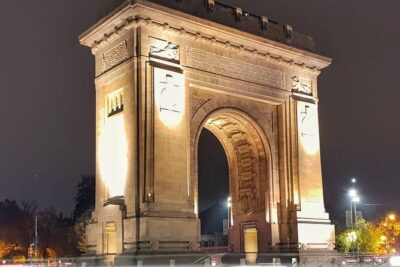
Bucharest’s Arch of Triumph reaches 27 meters high and recalls the great arch in Paris. Its design changed several times before arriving at its current form, so the monument represents more than one event or one political period.
The arch is tied to Romania’s fight for freedom and national unity. Depending on access and opening conditions, you may be able to see exhibits on the Great War for the Unification of Romania, the heraldry of major boyar families, the arch itself through photographs and models, and the Great Union of 1918.
The wording here matters: you may have the chance to see these exhibits, but the tour does not guarantee interior access in the two-hour schedule. If you want to climb or visit the exhibition areas, confirm the plan before you book.
Even from outside, the Arch of Triumph works well in a city overview. It gives you a national symbol to set beside the communist landmarks. The result is a broader picture of Romania, from royal and national aspirations to dictatorship and revolution.
The Romanian Athenaeum gives the drive a cultural pause
The Romanian Athenaeum is often treated as one of Bucharest’s main symbols. It represents Romanian culture and is included on the European Heritage list of historic landmarks.
The building gives the tour a change in tone. After the heavy political story around the Palace of Parliament, the former Communist Party headquarters, and the Ceaușescu Mansion, the Athenaeum points toward music, art, and civic culture.
You may only have time to admire the exterior and hear the guide’s explanation. The two-hour format and the number of stops make a full concert-hall visit unlikely unless arranged separately. Still, even a short stop can help you identify one of Bucharest’s most important cultural buildings for a later return.
I like having the Athenaeum on the route because it prevents the tour from becoming only a communism tour. Bucharest’s identity is wider than the Ceaușescu era, and this landmark makes that clear.
Central Bucharest packs royal, religious, and civic landmarks together
The central area offers the densest collection of buildings on the route. Here you can see boyar houses, luxury shops, churches, restaurants, cafes, inns, museums, casinos, government buildings, and statues.
The named landmarks include the Royal Palace, the Senate Palace, the National History Museum in the former Post Palace, the Lady’s Church, the CEC Palace, the Palace of the National Military Circle, Cantacuzino Palace, the Central University Library, hotels, and restaurants.
This part is ideal for getting your bearings. You can see how Bucharest’s royal, religious, commercial, and political layers sit close together. It is also one of the best sections for noting places to revisit on foot after the tour.
Do not expect a detailed interior tour of every building. There are simply too many. The value comes from the guide’s ability to point out what you are seeing and explain why the area matters, while the car saves you time between separated parts of the city.
What the private format adds to a two-hour schedule
A private car is more than a comfort feature here. It is the reason this ambitious route can work at all.
The vehicle is described as a private car or minibus used only by your group. That means you are not waiting for other passengers, and the guide can make changes to the daily route even after the tour starts. Traffic, opening times, weather, and your interests can all affect what deserves attention.
Pickup is offered, and you provide the address and time. All gasoline, parking, road tolls, and taxes are included. Food and drinks are not included, though the personal service described by one family included a stop at a favorite eclair shop. That small detail suggests you can ask for a brief local food stop if the schedule allows, but it should not be treated as a guaranteed part of the tour.
The private format also suits families and mixed-age groups. One family found Nicolas funny and engaging, and his stories about his own family life under communism helped keep everyone involved. He later helped with an airport transfer, which may be useful if you want to build a little extra local help into your Bucharest stay.
Is $123.91 per person a fair price?
At $123.91 per person, this is not the cheapest way to see Bucharest. The value depends heavily on group size.
For one or two people, the per-person cost is a serious consideration for only two hours. You are paying for a private vehicle, a licensed English-speaking guide and driver, pickup, flexibility, fuel, parking, tolls, and taxes. You are also paying for time saved, which can matter during a short visit.
For a family or small group, the price may feel more reasonable because the vehicle and guide serve only your party. Group discounts are offered, though the exact terms are not provided. Ask for the total price for your group rather than judging the per-person figure alone.
Admission fees are not listed among the included services, and food and drinks are excluded. Ask specifically about any palace, museum, mansion, or arch entry before booking. That avoids a surprise and helps you decide if the tour is mainly a driving overview or includes selected interiors.
Who should book this Bucharest tour?
I would choose this tour if you have limited time, want pickup from your accommodation, or prefer not to manage Bucharest’s transport on your own. It is also a good match for families, first-time visitors, and groups that want a private guide rather than a fixed large-group schedule.
The tour suits you if modern Romanian history interests you, especially communism and the 1989 Revolution. It also works well if you want a first look at the city before exploring the central areas on foot.
I would hesitate if your main goal is a slow museum day. Two hours and many stops mean short visits. You may leave with a clear map of Bucharest and a list of places to return to, but not with a detailed look inside every attraction.
Free cancellation is available if you cancel at least 24 hours before the start time. Changes or cancellations within 24 hours are not accepted for a refund. Service animals are allowed, the tour is near public transportation, and most people can participate.
FAQ
How long is the Bucharest City Tour?
The tour lasts approximately two hours.
Is the tour private?
Yes. Only your group participates, using a private car or minibus for your friends or family.
Is hotel or accommodation pickup available?
Yes. You provide the pickup address and the time you want to be collected.
Is the tour offered in English?
Yes. A licensed English-speaking guide and driver is available throughout the tour.
Is Nicolas the guide?
Nicolas is associated with the experience and has guided families on the tour. The service provides a licensed English-speaking guide and driver.
What vehicle is used?
The tour uses a private car or minibus, depending on the group and arrangements.
Are fuel, parking, tolls, and taxes included?
Yes. Gasoline, parking, road tolls, and all taxes are included.
Are food and drinks included?
No. Food and drinks are not included.
Does the tour include admission tickets?
Admission tickets are not listed among the included services. Confirm entry arrangements for the Palace of Parliament, the Village Museum, the Ceaușescu Mansion, or the Arch of Triumph before booking.
Can I cancel for a full refund?
Yes, if you cancel at least 24 hours before the experience start time. Cancellations within 24 hours are not refundable.
Should you book it?
Book this tour if you want a quick, private introduction to Bucharest with a guide who can connect communist-era landmarks to everyday Romanian life. The best reason to choose it is the combination of flexible pickup, private transport, personal storytelling, and a route that includes both monumental buildings and traditional homes.
For the best value, bring a small group and confirm which attractions you will enter. If you do that, the tour can give you a strong first map of Bucharest in two hours, then leave you free to return to the places that deserve more time.
Just added around Bucharest
- Village Museum Bucharest Guided Tour★ 5.0 · 6 reviews
- Bucharest: Dealu Mare Winery Private Trip with Wine Tasting★ 4.9 · 6 reviews
- Winery touring & private wine tasting – one day private tour★ 5.0 · 3 reviews
- Transylvania Tour: Dracula’s Castle, Peles Palace & Brasov★ 5.0 · 19 reviews
- Discover Medieval Transylvania Small Group Tour – 7 days★ 5.0 · 4 reviews
- Bucharest Airport Transfer To Constanta Mamaia★ 5.0 · 3 reviews
- Airport Henri Coanda (Otopeni) to Bucharest – Private Transfer – Driver★ 5.0 · 5 reviews
- Gems of Transilvania: Brasov,Sighisoara,Sibiu,Viscri and more★ 5.0 · 6 reviews
City Tours, compared.

Bucharest Panoramic Sightseeing – Private City Tour
Read our review →
SB01 – City Tour Sibiu: Exploring the Heart of Transylvania
Read our review →
City Tour Sighisoara Legends & Landmarks A Walk Through Time
Read our review →Browse the lists this tour appears in