
Reviewed · WALKING TOURS
Bucharest in a nutshell – half day private walking tour
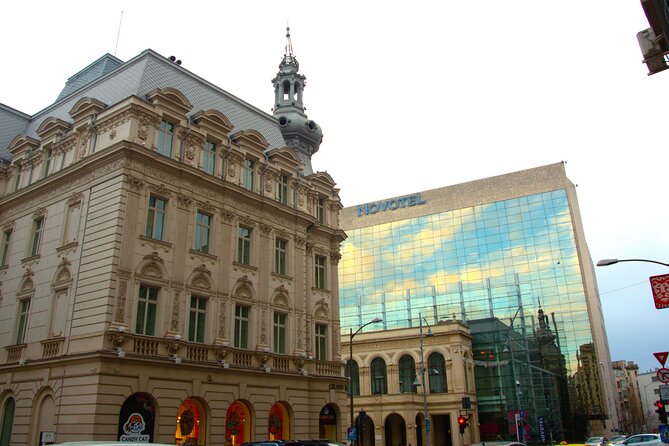
Bucharest’s past comes at you in sharp turns: a medieval church, Ottoman-era echoes, ornate royal buildings, and the grim marks of Communism. This four-hour private walk links those pieces in order, from the city’s birthplace to the Romanian Athenaeum.
I like the flexible format and the chance to shape the conversation around your interests. I also like that Razvan Trancu offers more than a city-center script, with suggestions for food, events, and trips beyond Bucharest. The main consideration is pace: you cover a lot of ground on foot, and several stops are exterior visits or brief looks rather than long indoor tours.
In This Review
- Key points to know before booking
- Why this route works for first-time visitors
- Starting at Hanul lui Manuc and Saint Anton Church
- Cărturești Carusel and the old center
- Bank, monastery, and beer hall: three views of old Bucharest
- CEC Palace and the grand route along Calea Victoriei
- University Square and the difficult Communist chapter
- Revolution Square and the path to the Athenaeum
- Razvan Trancu’s guiding style
- What $188 means for the value
- Who should choose this Bucharest walk
- Should you book it?
- FAQ
- Where does the Bucharest walking tour begin?
- Where does the tour finish?
- How long does the tour last?
- How much does the private tour cost?
- Is this a private tour?
- Which languages are available?
- Is the tour wheelchair accessible?
- Which Bucharest sites are visited?
- Are food and souvenirs included?
- Can the tour be canceled for a refund?
Key points to know before booking
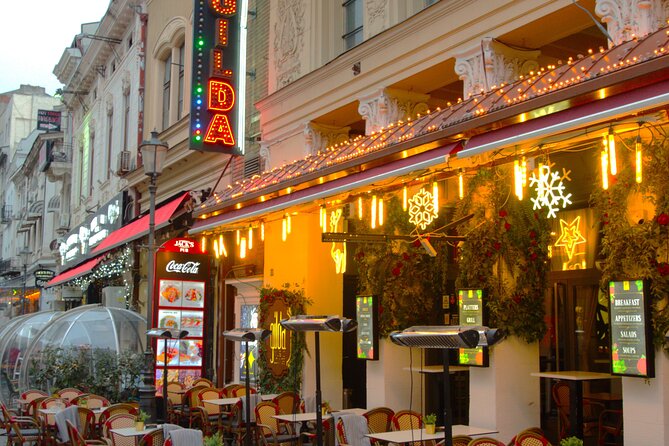
- Chronological storytelling: The route moves from the late Middle Ages through monarchy, Communism, the 1989 Revolution, and modern Romania.
- A private group of up to 12: You get a guide focused on your party rather than a large public crowd.
- Three useful languages: Tours are available in English, Italian, or Spanish.
- Strong guide-led experience: Razvan Trancu is praised for clear communication, punctuality, humor, time management, and flexibility.
- A practical starting point: Meet at the Starbucks by the main door of Hanul lui Manuc, then finish at the Romanian Athenaeum.
- Good first-day value: At $188 per group, the cost works out to about $15.67 per person for a full group of 12, while a smaller party pays more per person for the privacy.
Why this route works for first-time visitors
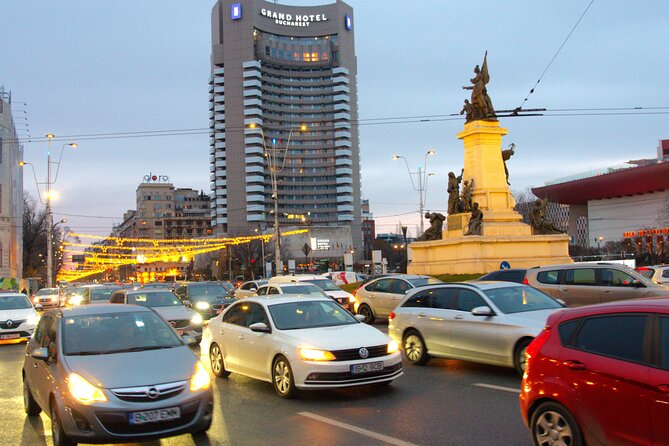
Bucharest can be hard to read at street level. Its old center has medieval churches beside later buildings, grand boulevards beside Communist-era scars, and polished cultural monuments close to places that feel worn and improvised.
This tour gives you a timeline instead of a pile of disconnected facts. You begin near the city’s traditional starting point, pass through the old center, then follow the route toward Calea Victoriei, University Square, and Revolution Square. By the end, you have a basic frame for understanding Bucharest’s culture, politics, architecture, and social changes.
I find that format especially helpful if you arrive in Bucharest without much background. The guide can explain why the historic center looks the way it does, how the monarchy shaped the city, and why the 1989 Revolution remains such a key part of modern Romanian identity.
Because the group is private, you can ask for more detail when a subject catches your attention. You can also request advice on restaurants, local events, other activities, or one- and two-day excursions outside the capital. That turns the walk into a useful orientation session, not just a sightseeing circuit.
A few more Bucharest trips to weigh up
- Bucharest: City Highlights Guided Walking Tour
★ 4.9 · 1,482 reviews - Bucharest Highlights Walking Tour
★ 5.0 · 469 reviews - Bucharest: Ghost Stories & Romanian Mythology Walking Tour
★ 4.9 · 287 reviews
Starting at Hanul lui Manuc and Saint Anton Church
The meeting point is the Starbucks coffee shop at Hanul lui Manuc, by the main door. This is a practical place to begin because you are already near the old historic center and close to one of Bucharest’s best-known historic landmarks.
The first scheduled stop is Biserica Sfântul Anton, or Saint Anton Church. You spend about 20 minutes here with a guided visit. This opening stop matters because it places Bucharest near its medieval roots, before the tour moves into the more familiar grand avenues and nineteenth-century buildings.
I like beginning with a church rather than a palace. It gives the route an older, more local starting point and helps you see that Bucharest did not begin as a city of monumental boulevards. The guide’s chronological approach should make the later changes easier to follow.
The church visit is fairly short, so you should not expect an extended religious art tour. Its value is the historical setting and the explanation that connects this early part of the city to the wider story.
Cărturești Carusel and the old center
The next stop is Cărturești Carusel, with about 10 minutes to look around. This elegant bookshop is one of the more visually striking modern spaces in the old center, and it gives the walk a change of mood after the church.
The stop is brief, so think of it as a quick look rather than a long shopping break. You may have time to appreciate the interior and its place within the old-center streets, but the tour is mainly using it as part of the neighborhood story.
That contrast is useful. Bucharest’s historic center is not preserved as a single period piece. It is a working district where old buildings, renovated commercial spaces, restaurants, churches, banks, and tourist sites sit close together. A private guide can point out those shifts as you walk instead of treating each building as an isolated object.
Bank, monastery, and beer hall: three views of old Bucharest
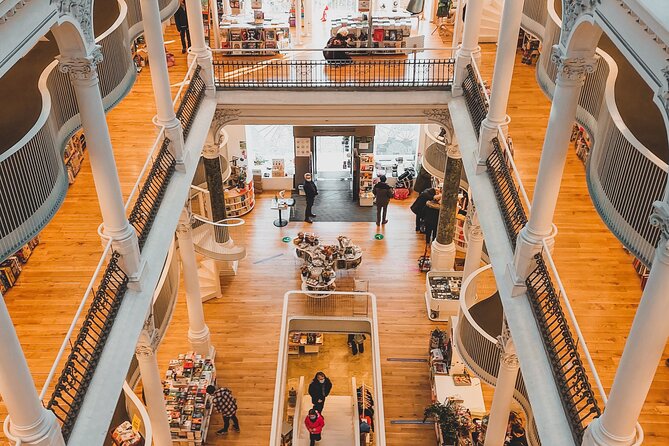
The route passes the National Bank of Romania for about 10 minutes. You do not have a listed interior visit here, but the building helps introduce the financial and institutional side of the capital.
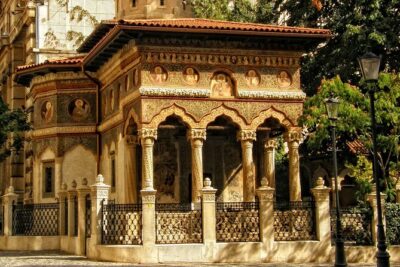
After that comes Stavropoleos Monastery, where you spend about 20 minutes on a guided visit. This is one of the tour’s more important stops. Its religious setting and architectural details give you another look at Bucharest’s earlier character, while the guide can place it within the city’s Ottoman-influenced past and later development.
The monastery visit also breaks up the walking with a focused stop. You have time to listen, look closely, and ask questions instead of simply passing another facade.
Caru’ cu bere follows with a 10-minute visit. This historic beer hall is an atmospheric stop, but the schedule suggests a short look rather than a meal. If you want to eat there, you would need to arrange that separately and account for the tour’s timing.
I like this section because the stops are varied. The National Bank represents finance and state power. Stavropoleos offers a religious and architectural connection to earlier Bucharest. Caru’ cu bere brings in the city’s social life and dining tradition. Together, they show more than a standard parade of monuments.
Same mountains, a completely different day out:
- Bucharest: Dracula’s Castle, Peles Castle, & Brasov Old Town
★ 4.5 · 17,858 reviews - Bucharest: Dracula Castle, Peles Castle & Brasov Old Town
★ 4.6 · 10,891 reviews - Bucharest: Dracula’s Castle, Peleș Castle & Brașov Day Trip
★ 4.5 · 5,919 reviews - Bucharest: Palace of Parliament Tickets and Guide
★ 4.3 · 3,182 reviews
CEC Palace and the grand route along Calea Victoriei
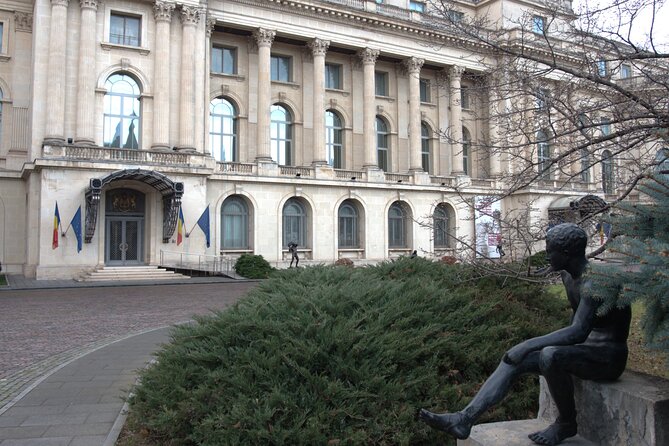
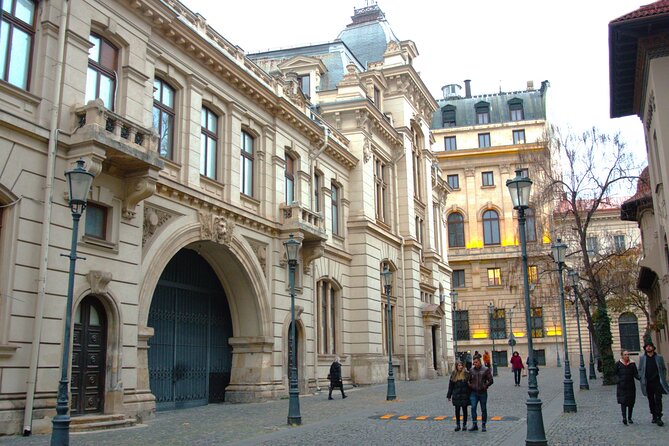
The tour passes the CEC Palace for about 10 minutes before moving along Calea Victoriei for about 20 minutes. This is where the monarchy period and Bucharest’s late nineteenth-century glory days come into clearer view.
Calea Victoriei is one of the city’s key historic routes, and walking it helps you understand the ambition behind Bucharest’s grand architecture. The focus here is not simply on pretty buildings. It is on the period when the capital was being reshaped through institutions, wealth, public culture, and royal-era urban planning.
Since both stops are listed as pass-bys, you should expect exterior commentary and street-level interpretation, not extended indoor access. That is not a flaw for a walking orientation. It keeps the group moving and lets the guide connect several landmarks over a wider area.
The route is also one reason comfortable shoes matter. The four-hour schedule includes many stops and substantial walking between them. The experience is wheelchair accessible, but you should still inquire in advance for practical route details, since the supplied information does not specify the exact street conditions or access arrangements at every stop.
University Square and the difficult Communist chapter
University Square receives about 30 minutes of guided attention. This is a substantial stop, and it gives the guide room to explain Bucharest’s political and social life beyond architecture.
The tour’s theme shifts here toward Communism and the painful social experiment that affected Romania. You are not just hearing about a government period in the abstract. You are being shown places where national events, public life, and political change came together.
This part may be the most useful for understanding why modern Bucharest can feel so layered. The city’s appearance reflects more than one building campaign or one political era. The monarchy, the Communist state, and the post-1989 period all left different marks.
A private format helps with a subject like this. You can ask for clarification, request more context, or spend extra time on an aspect that matters to you. Razvan is described as flexible and attentive to individual interests, which is valuable when the subject turns serious.
The tour does not present Communism as a footnote between nicer architectural stops. It gives the period a central place in the story. That balance is important if you want more than a decorative old-town walk.
Revolution Square and the path to the Athenaeum
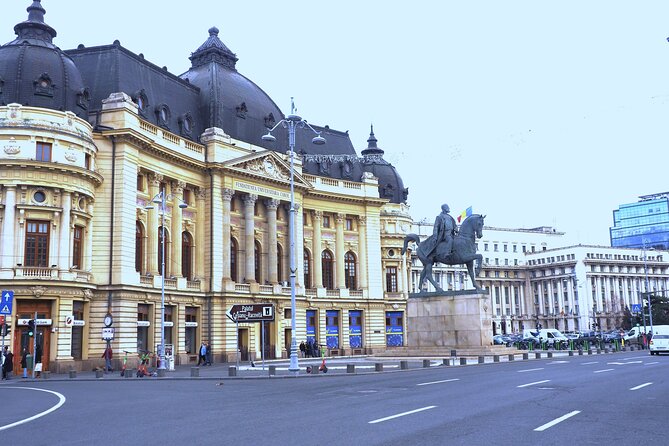
The route continues past the National Military Circle for about 10 minutes, then reaches Revolution Square for a 30-minute visit and guided tour. This is another major anchor of the experience.
Revolution Square is tied to the end of Communist rule and the Romanian Revolution. The half-hour visit gives you time to hear the political context and understand the importance of the place within the country’s recent past.
For me, this is where the route’s chronological design pays off. The early church, old-center buildings, royal boulevard, and Communist-era story are no longer separate subjects. They lead toward the events that changed Romania’s direction in 1989.
The square is also a strong place to discuss the gap between official public images and lived experience. A guide can provide the background needed to read the monuments and government buildings around you, rather than leaving you with only a photo stop.
The walk ends at the Romanian Athenaeum. That finish brings the tour back to Bucharest’s cultural and architectural ambitions. It is a fitting endpoint after the political weight of Revolution Square, and it leaves you near one of the city’s most important cultural landmarks.
The tour information does not include an interior visit to the Athenaeum, so you should view the finish as the end of the guided walk rather than a ticketed concert-hall tour.
Razvan Trancu’s guiding style
The guide is Razvan Trancu, an authorized local guide who leads in English, Italian, or Spanish. The strongest praise attached to the experience focuses on his communication, humor, punctuality, time management, and flexibility.
Those details matter more than a long list of qualifications. A four-hour walking tour can drag if the guide talks without reading the group, or it can feel rushed if the timing is poor. Clear communication and good time control help keep a route with many stops manageable.
Razvan is also presented as a guide who can adjust the experience to your needs and interests. You can ask for suggestions about dining, events, local activities, and one- or two-day trips outside Bucharest. That is particularly useful if this is your first time in Romania and you want help planning the rest of your stay.
The existing feedback is especially strong on his enthusiasm, broad command of the subject, humor, and willingness to go beyond the basic route. One verified booking from the Netherlands specifically praised his punctuality, flexibility, and communication. A verified booking from Italy highlighted his preparation, welcoming manner, and ability to point out both well-known and less obvious parts of the city.
I would still keep expectations realistic. A guide can explain a great deal in four hours, but this is an overview rather than an exhaustive study of Bucharest. The benefit is breadth, structure, and conversation.
What $188 means for the value
The price is $188 per private group of up to 12 people. With 12 participants, that is about $15.67 each. With two people, it is $94 each, so the value depends heavily on your group size.
For a larger family or group of friends, the price is appealing. You receive four hours with a licensed local guide, a route through several key parts of central Bucharest, and the ability to ask for tailored advice. A public walking tour may cost less per person, but it may not offer the same privacy or flexibility.
For a couple, the cost is harder to justify unless you place a high value on private guiding. You are paying for direct attention, language choice, and the chance to adjust the discussion. If you mainly want a quick introduction to the old center, a shorter group walk could be a better fit.
Food, snacks, souvenirs, and personal expenses are not included. The visit to Caru’ cu bere is not presented as a meal, so do not count on lunch being part of the four-hour outing.
The reserve-now-and-pay-later option gives you some planning flexibility, and cancellation is free up to 24 hours before the tour for a full refund. Starting times vary, so you need to check availability when choosing a date.
Who should choose this Bucharest walk
I would choose this tour if you want a first look at Bucharest that connects buildings to politics and social change. It suits you if you prefer asking questions rather than following a fixed speech, or if you want a guide who can help shape the rest of your Romania plans.
It is also a good match for families and private groups who want to move at their own pace within a clear four-hour framework. The English, Italian, and Spanish options make it accessible to a wider range of visitors.
You may want something else if you dislike walking, want long indoor visits, or prefer a narrow subject such as art, food, or Communist architecture. Several locations are pass-bys, and even the guided visits are limited in length.
Plan for comfortable footwear and keep the day flexible around the tour. Since the route finishes at the Romanian Athenaeum, you can continue sightseeing from there, but specific follow-up activities are not included.
Should you book it?
Book this tour if you want a well-organized private introduction to Bucharest’s full timeline, not just a stroll through the restaurant streets of the old center. Razvan Trancu’s strengths appear to be his communication, humor, punctuality, flexibility, and ability to connect history with useful local advice.
The best value comes with a larger private group, where the $188 fee is shared. For a couple, book it when personal attention and historical context matter more to you than finding the lowest-cost city walk.
FAQ
Where does the Bucharest walking tour begin?
It begins at the Starbucks coffee shop at Hanul lui Manuc, by the main door.
Where does the tour finish?
The tour finishes at the Romanian Athenaeum.
How long does the tour last?
The walking tour lasts four hours.
How much does the private tour cost?
The price is $188 per private group of up to 12 people.
Is this a private tour?
Yes. The experience is for a private group.
Which languages are available?
The live tour guide is available in English, Italian, and Spanish.
Is the tour wheelchair accessible?
Yes, the activity is listed as wheelchair accessible. You should inquire for specific route details before booking.
Which Bucharest sites are visited?
The route includes Saint Anton Church, Cărturești Carusel, Stavropoleos Monastery, Caru’ cu bere, University Square, and Revolution Square. It passes the National Bank of Romania, CEC Palace, Calea Victoriei, and the National Military Circle, and finishes at the Romanian Athenaeum.
Are food and souvenirs included?
No. Snacks, souvenirs, and personal expenses are not included.
Can the tour be canceled for a refund?
Yes. You can cancel up to 24 hours in advance for a full refund. You can also reserve now and pay later.
Just added around Bucharest
- Village Museum Bucharest Guided Tour★ 5.0 · 6 reviews
- Bucharest: Dealu Mare Winery Private Trip with Wine Tasting★ 4.9 · 6 reviews
- Winery touring & private wine tasting – one day private tour★ 5.0 · 3 reviews
- Transylvania Tour: Dracula’s Castle, Peles Palace & Brasov★ 5.0 · 19 reviews
- Discover Medieval Transylvania Small Group Tour – 7 days★ 5.0 · 4 reviews
- Bucharest Airport Transfer To Constanta Mamaia★ 5.0 · 3 reviews
- Airport Henri Coanda (Otopeni) to Bucharest – Private Transfer – Driver★ 5.0 · 5 reviews
- Gems of Transilvania: Brasov,Sighisoara,Sibiu,Viscri and more★ 5.0 · 6 reviews
Walking Tours, compared.
Ghost Stories & Romanian Mythology Walking Tour
Read our review →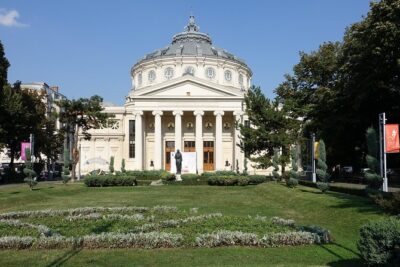
Walking Tour- Delightful Bucharest (Highlights, Stories, Sights)
Read our review →

4h Bucharest Private Tour (2h by Car and 2h Walking in Old Town)
Read our review →
Browse the lists this tour appears in