
Reviewed · WALKING TOURS
Bucharest: Walking tour with Italian speaking guide for small groups
Bucharest reveals itself best on foot, and this three-hour Italian-language walk connects its grand avenues with tucked-away courtyards, old churches, nightlife streets, and the monuments tied to Romania’s 1989 revolution. Guides such as Giuseppe and Filippo Di Cataldo bring history and anecdotes to places that can otherwise seem like a jumble of styles.
I like the small-group format, which should make it easier to ask questions and keep the pace human. I also like the route itself: Stavropoleos Monastery, Cărturești Carusel, the National Bank, Pasajul Villacrosse, and Revolution Square give you a useful first look at Bucharest’s many eras.
The main consideration is the walking. You will cover central Bucharest for close to three hours, with several stops but no food or drinks included. Comfortable shoes matter, and the tour is not suitable for children under 2, children under 3, or babies under 1 year according to the supplied restrictions.
In This Review
- Key points at a glance
- Starting beside Caru’ cu Bere in Old Town
- Stavropoleos Monastery and the texture of Old Town
- Cărturești Carusel, the National Bank, and the city’s contrasts
- Pasajul Villacrosse and Umbrellas Street
- Calea Victoriei, Bucharest’s elegant avenue
- Revolution Square and the memory of December 1989
- The Romanian Athenaeum and the return to the start
- What the three-hour format really gives you
- Why the Italian guide matters
- Is $35 a fair price?
- Accessibility, age limits, and practical planning
- Who should book this Bucharest walk?
- Should you book it?
- FAQ
- Where does the Bucharest walking tour begin?
- Where does the tour end?
- How long does the tour last?
- What language is the tour conducted in?
- How much does the tour cost?
- What places are included on the route?
- Is food or a drink included?
- Is the tour wheelchair accessible?
- What should I wear?
- Can I cancel the booking?
Key points at a glance
- Italian-speaking guidance: Giuseppe and Filippo Di Cataldo are named as guides associated with this experience.
- A useful central route: The walk links Old Town, Calea Victoriei, and Revolution Square without adding transport between sights.
- Strong mix of places: Expect Orthodox religious art, royal buildings, cafés, banks, bookshops, and revolution history.
- Small-group setting: A more personal format than a large city walk, with room for questions and conversation.
- Good first-day choice: The route helps you understand Bucharest’s layout and its shift from royal capital to communist-era city and modern European capital.
- Practical booking terms: The price is $35 per person, with free cancellation up to 24 hours before the start and a reserve-now, pay-later option.
Starting beside Caru’ cu Bere in Old Town
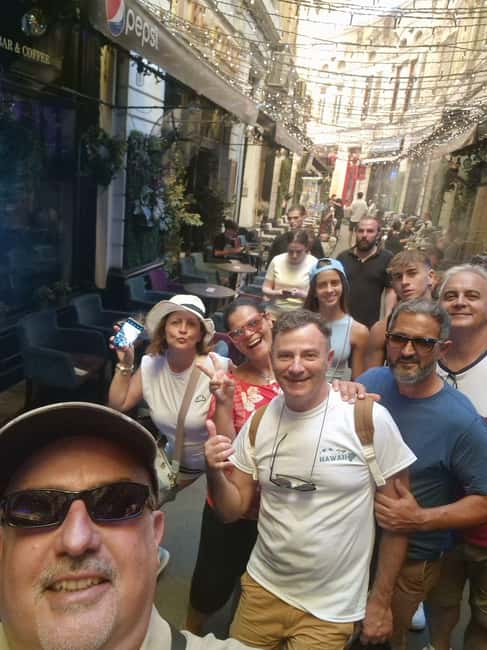
The meeting point is in front of Caru’ cu Bere on Stavropoleos Street 5. The guide will be recognizable by a professional identification card, so you should enter the exact location into your navigation app rather than relying only on the restaurant name.
This is a smart place to begin. Caru’ cu Bere is one of Bucharest’s best-known historic restaurants, and its ornate appearance immediately signals that this will not be a simple march from one modern attraction to another. You are already in the old center, where churches, banks, restaurants, shops, and nightlife occupy the same compact streets.
The tour returns to this point at the end. That makes it easy to continue with lunch, dinner, or your own Old Town wander afterward. Food and drinks are not included, so plan those separately.
A few more Bucharest trips to weigh up
- Bucharest: City Highlights Guided Walking Tour
★ 4.9 · 1,482 reviews - Bucharest Highlights Walking Tour
★ 5.0 · 469 reviews - Bucharest: Ghost Stories & Romanian Mythology Walking Tour
★ 4.9 · 287 reviews
Stavropoleos Monastery and the texture of Old Town
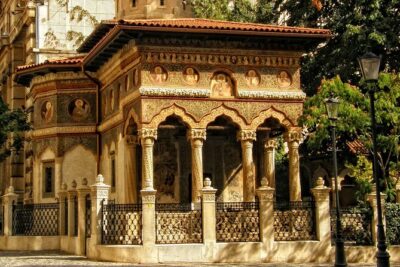
The first named stop is Stavropoleos Monastery, with about 10 minutes for a visit. This small Orthodox monastery is one of the most rewarding stops on a central Bucharest walk because it offers a quiet change from the surrounding streets.
You can expect the guide to explain the building’s place in Romanian religious and architectural history, as well as the details that make it different from the grand civic buildings later in the route. Ten minutes is enough for a focused introduction, though it is not enough for a long, unhurried visit.
From there, the route reaches Manuc’s Inn. The stop also allows about 10 minutes. An old inn is a useful clue to how people once moved through Bucharest, before today’s hotel districts and modern transport links. It adds a human, commercial side to the city’s past.
The Old Town portion also includes Lipscani Street, the best-known nightlife street in central Bucharest. During the day, you can focus on façades, lanes, and historic sites. At night, the same area takes on a livelier restaurant and bar role. That change is part of the appeal, but it also means the central streets can feel less calm at busy times.
Cărturești Carusel, the National Bank, and the city’s contrasts
The route continues through Bucharest Old Town, with several guided stops of about 10 to 15 minutes. One of the most photogenic is Cărturești Carusel, where the scheduled stop is about 10 minutes for photographs.
This bookshop is a modern attraction in a historic setting. It gives the walking tour a welcome change of pace: instead of hearing only about old churches, palaces, and political events, you see how Bucharest presents itself today. Bring your camera, but remember that this is a short photo stop rather than a long browsing session.
The National Bank of Romania follows with about 10 minutes of guided explanation. Its presence helps show why this part of the city mattered as a center of finance and administration. The route is particularly useful here because the buildings are not just decorative backdrops. They reflect the ambitions of a capital trying to present itself as modern, prosperous, and connected to Europe.
The itinerary also includes two additional guided stops of about 10 minutes each, although the supplied details do not name them. That means the precise order and emphasis may depend on the guide and the day. You should expect the walk to keep moving through the historic center rather than spend long periods inside any single attraction.
Pasajul Villacrosse and Umbrellas Street
Pasajul Villacrosse is another short guided stop, listed at about 10 minutes. This covered passage adds an intimate architectural detail to a route otherwise filled with major squares and formal avenues.
It is the sort of place that can be easy to miss if you explore only by map pins. A guide gives it context and helps you notice how smaller passages fit into the city’s older commercial fabric. The stop is not presented as a long interior visit, so think of it as a compact explanation and visual pause.
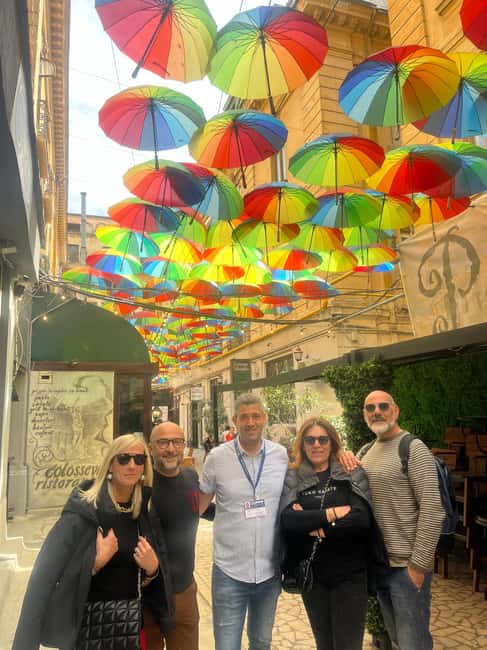
Nearby Umbrellas Street receives about five minutes for photographs. This is a very brief stop, but it gives the tour a lighter moment between more serious subjects. If you enjoy colorful urban details, it is worth having your phone ready before you arrive.
The short timing at both places is typical of a city overview. You will see a lot, but you will not have extended time at every site. If one location catches your interest, make a note and return later on your own.
Same mountains, a completely different day out:
- Bucharest: Dracula’s Castle, Peles Castle, & Brasov Old Town
★ 4.5 · 17,858 reviews - Bucharest: Dracula Castle, Peles Castle & Brasov Old Town
★ 4.6 · 10,891 reviews - Bucharest: Dracula’s Castle, Peleș Castle & Brașov Day Trip
★ 4.5 · 5,919 reviews - Bucharest: Palace of Parliament Tickets and Guide
★ 4.3 · 3,182 reviews
Calea Victoriei, Bucharest’s elegant avenue
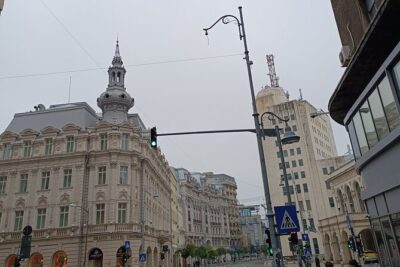
The walking route then reaches Calea Victoriei, described as Bucharest’s most elegant boulevard. It is lined with historic buildings, high-fashion shops, and fine bistros, so the avenue provides a different view of the capital from the tighter streets of Old Town.
I like this part of the route because it lets you compare two sides of Bucharest within the same outing. Old Town feels tied to trade, inns, churches, and nightlife. Calea Victoriei presents a more formal city, shaped by state institutions, wealthy patrons, culture, and public ceremony.
The guide’s stories matter here. A row of impressive façades can blur together without context, especially when several historical periods meet on one street. The tour is designed to explain the buildings and the changes behind them, rather than simply point at them.
You should also expect regular walking between stops. The tour includes no private transport, and the appeal is precisely that you see the streets at ground level. Wear comfortable shoes and allow for the possibility that the pace will suit a city walk more than a slow architectural sketching session.
Revolution Square and the memory of December 1989
The longest scheduled stop is Revolution Square, with about 25 minutes of guided explanation. This is the emotional and political center of the route.
Revolution Square is closely tied to the end of Nicolae Ceaușescu’s dictatorship in December 1989. A guide can help you connect the open space, surrounding buildings, and public monuments with the events that changed Romania. This is where the tour moves beyond attractive architecture and gives you a clearer sense of modern Romanian history.
The square also brings together buildings from different periods. The Romanian Athenaeum, the Royal Palace, and the National Library are all named as part of the surrounding scene. Their differing roles and styles help explain why Bucharest can feel suspended between earlier royal ambitions, communist rule, and the present day.
The 25-minute allocation is useful because this subject needs more than a passing comment. It gives the guide time to place the events in context and answer questions. Still, the experience remains a walking overview, not a museum visit or a dedicated revolution-history tour.
The Romanian Athenaeum and the return to the start
The Romanian Athenaeum receives about 15 minutes of guided attention. It is one of Bucharest’s most recognizable cultural buildings, and its location near Revolution Square makes it a natural final highlight.
The stop gives the guide a chance to discuss culture and public life alongside politics and commerce. That balance is one of the route’s strengths. You are not seeing Bucharest only as a collection of old buildings. You are also seeing the institutions that shaped its identity.
After the Athenaeum, the tour returns to Caru’ cu Bere. Finishing where you began keeps the logistics simple and leaves you in a useful central location. You can continue exploring Old Town, stop for a meal at your own expense, or use the end point as a reference for the rest of your visit.
What the three-hour format really gives you
The tour lasts three hours, with starting times available according to the date you choose. The published stop timings add up to a substantial portion of that time, while the rest is used for walking, transitions, and commentary.
That format suits you if you want a broad introduction before exploring individual sites in greater detail. In one outing, you get religious architecture, historic commercial spaces, finance, culture, royal associations, modern urban presentation, and the story of 1989.
The tradeoff is depth. You should not expect long interior visits, extended free time, or admission to a series of museums. Several stops last only 5 or 10 minutes. I see that as a fair arrangement for a first orientation, but you should book a more specialized experience later if you want to study one subject closely.
Why the Italian guide matters
The live guide language is Italian, and the tour is designed specifically for Italian-speaking visitors. That matters when a place requires explanation rather than simple identification.
Names, dates, political changes, and architectural details can become hard to follow when you are processing them in a second language. A guide speaking Italian can make the connections clearer and leave you free to ask about the points that interest you most.
The named guides include Giuseppe and Filippo Di Cataldo. The supplied feedback gives special weight to their approachable manner, clear historical explanations, and ability to add anecdotes. One description of Filippo points to a city tour that revealed Bucharest in a different light, while Giuseppe is described as prepared, friendly, and easy to interact with.
Those details suggest a conversational approach rather than a stiff recital of dates. That is valuable on a three-hour walk, when good pacing and a pleasant tone can make the difference between useful sightseeing and information overload.
Is $35 a fair price?
At $35 per person, this is priced as a guided city orientation rather than a premium private tour. The value comes from the route, the Italian commentary, and the time saved in connecting the main central districts.
You are paying for a live guide and a small-group walking format. You are not paying for food, drinks, museum admissions, or private transport. Since the named stops are mainly viewed from the outside or visited briefly, the price is easiest to justify if you want context and company, not a package of paid attractions.
I would consider it good value for an Italian-speaking visitor who has three hours and wants an organized introduction to Bucharest. It is less compelling if you prefer to explore at your own pace, spend 30 minutes in every church, or stop often for coffee and photographs.
The reserve-now, pay-later option also helps if your schedule is still taking shape. Cancellation is free up to 24 hours in advance for a full refund, which gives you some flexibility.
Accessibility, age limits, and practical planning
The activity is listed as wheelchair accessible. You should still consider that it is a three-hour city walk with multiple stops and movement between them, so confirm any personal mobility needs when booking.
The experience is not suitable for children under 2 years, children under 3 years, or babies under 1 year, as stated in the activity information. It is also not suitable for people with hearing impairments.
Wear comfortable walking shoes. Alcohol, drugs, littering, explosives, and audio recording are not allowed. Personal expenses are your responsibility, so carry what you need for refreshments after or before the tour.
Who should book this Bucharest walk?
I would choose this tour if you speak Italian and want a friendly introduction to Bucharest’s central districts. It suits first-time visitors, couples, families with older children, and anyone who prefers stories and local context over a list of isolated photo stops.
It is especially useful early in a stay. After three hours, you will have a clearer sense of where Old Town ends, how Calea Victoriei relates to the historic center, and why Revolution Square matters. You will also have a short list of places worth revisiting.
I would hesitate if you dislike walking, need long visits at each stop, or want a food tour. Nothing to eat or drink is included, and the route is cultural and historical rather than culinary.
Should you book it?
Book this three-hour walk if an Italian-speaking guide, a small group, and a broad central route match your plans. The strongest reasons are the mix of Bucharest’s old lanes and grand avenues, the attention given to December 1989, and the approachable guiding style associated with Giuseppe and Filippo Di Cataldo.
Skip it if you want a slow, highly specialized tour or a package with entry tickets and refreshments. For most Italian-speaking visitors making a first visit to Bucharest, $35 is a sensible price for a well-shaped introduction that leaves you at Caru’ cu Bere with a better map of the city in your head.
FAQ
Where does the Bucharest walking tour begin?
It begins in front of Caru’ cu Bere at Stavropoleos Street 5, 030081, Bucharest. The guide will have a professional identification card.
Where does the tour end?
The tour ends back at Caru’ cu Bere, the same place where it begins.
How long does the tour last?
The walking tour lasts three hours. Starting times depend on availability for the date you select.
What language is the tour conducted in?
The live tour guide speaks Italian. Italian is the listed language for the activity.
How much does the tour cost?
The listed price is $35 per person.
What places are included on the route?
The route includes Old Town, Lipscani Street, Stavropoleos Monastery, Manuc’s Inn, Cărturești Carusel, the National Bank of Romania, Pasajul Villacrosse, Umbrellas Street, Revolution Square, Calea Victoriei, and the Romanian Athenaeum.
Is food or a drink included?
No. Food, beverages, and personal expenses are not included.
Is the tour wheelchair accessible?
Yes, the activity is listed as wheelchair accessible.
What should I wear?
Comfortable walking shoes are recommended because the experience involves walking through central Bucharest for three hours.
Can I cancel the booking?
Yes. You can cancel up to 24 hours in advance for a full refund. A reserve-now, pay-later option is also available.
Just added around Bucharest
- Village Museum Bucharest Guided Tour★ 5.0 · 6 reviews
- Bucharest: Dealu Mare Winery Private Trip with Wine Tasting★ 4.9 · 6 reviews
- Winery touring & private wine tasting – one day private tour★ 5.0 · 3 reviews
- Transylvania Tour: Dracula’s Castle, Peles Palace & Brasov★ 5.0 · 19 reviews
- Discover Medieval Transylvania Small Group Tour – 7 days★ 5.0 · 4 reviews
- Bucharest Airport Transfer To Constanta Mamaia★ 5.0 · 3 reviews
- Airport Henri Coanda (Otopeni) to Bucharest – Private Transfer – Driver★ 5.0 · 5 reviews
- Gems of Transilvania: Brasov,Sighisoara,Sibiu,Viscri and more★ 5.0 · 6 reviews
Walking Tours, compared.
Ghost Stories & Romanian Mythology Walking Tour
Read our review →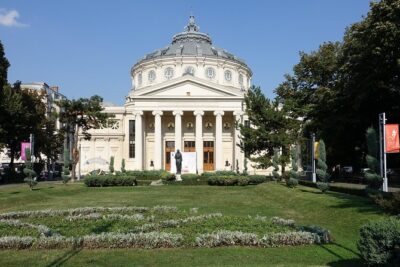
Walking Tour- Delightful Bucharest (Highlights, Stories, Sights)
Read our review →

4h Bucharest Private Tour (2h by Car and 2h Walking in Old Town)
Read our review →
Browse the lists this tour appears in