
Reviewed · PAINTED MONASTERIES TOURS
Bucovina Painted Monasteries & Transylvania Tour: 4-Day Private
Romania’s painted monasteries are the heart of this trip. Their walls carry huge, finely detailed scenes from the Bible, some painted more than 500 years ago. You also get medieval Sighișoara, fortified Viscri, old Brașov, and royal Peleș Castle, so the tour connects Bucovina’s Orthodox art with Transylvania’s Saxon and royal past.
I like the private transport, which gives you one-on-one time with guides such as Toni Tatar or Marius. I also like the smart contrast between quiet convents and lively old cities. The main catch is pace: this is a wide-ranging four-day route, and some days put a lot of ground between stops. Also, check the entrance-fee details carefully, since some admissions are listed as included while several interior visits are payable locally.
In This Review
- Key points at a glance
- Why the painted monasteries deserve a full day
- Day 1: Agapia and Văratec, two large convent communities
- Day 2: three painted churches, three different moods
- Sucevița’s Byzantine and Gothic mix
- Moldovița and the defensive purpose of monasteries
- Voroneț and the blue everyone remembers
- What the private vehicle changes
- Day 3: Sighișoara, Viscri, and Brașov
- Day 4: the Black Church and Peleș Castle
- Hotels, meals, and the real cost
- Who will enjoy this four-day route
- FAQ
- Where does the tour start and finish?
- How many nights and breakfasts are included?
- Is this a private tour?
- Which monasteries are included?
- Are meals and drinks included?
- What happens if I need to cancel?
- Should you book it?
Key points at a glance
- Voroneț’s famous blue frescoes: See the monastery often called the Sistine Chapel of the East, known for its intense Voroneț blue.
- Three major Bucovina monasteries in one day: Allow two hours each at Sucevița, Moldovița, and Voroneț.
- A private guide makes the art readable: Toni and Marius are named guides associated with the experience, with strong attention to history, religion, and practical help.
- Transylvania gets its proper share: Walk through UNESCO-listed Sighișoara, Viscri’s fortified church, and Brașov’s old center.
- Three hotel nights and three breakfasts: Your basic lodging and morning meal are covered, but lunch, dinner, drinks, and snacks are not.
- Budget for local admissions: Viscri, the Black Church, and Peleș Castle list entrance fees separately, despite the general mention of included tickets.
Why the painted monasteries deserve a full day
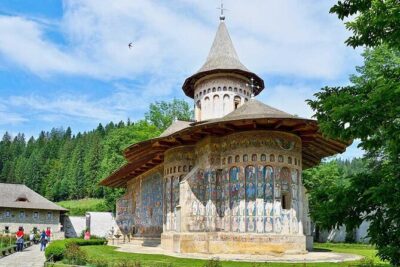
The monasteries of northern Moldavia are not plain churches with a few decorative panels. Their exterior walls are covered with large religious scenes arranged like a picture book in stone and plaster. You will see biblical stories, saints, battles between good and evil, and carefully repeated patterns.
That outdoor art matters because you can understand the buildings before stepping inside. The paintings were meant to teach people who could not read, and each wall turns the church into a visual lesson. Your guide can help explain the religious meaning, the artistic differences, and the reason these monasteries were built in such a remote part of the country.
The settings are quiet. These are working Orthodox religious communities, not just museum pieces. At Agapia and Văratec, hundreds of nuns live on the grounds or in the surrounding monastic settlements. Keep your voice low, dress modestly, and treat the place as a house of worship first and a sightseeing stop second.
Photography rules can vary. At least one monastery has charged a small fee of 10 lei for outdoor photographs, with indoor photos prohibited. Carry some Romanian currency, and follow posted instructions rather than assuming that every church allows photography.
More Transylvania Tours in Bucharest
- Transylvania and Dracula Castle Full Day Tour from Bucharest
★ 4.5 · 1,589 reviews - Castles of Transylvania: Private Day Trip from Bucharest
★ 4.5 · 248 reviews - 2-Day Medieval Transylvania with Brasov,Sibiu and Sighisoara Tour from Bucharest
★ 4.5 · 145 reviews
Day 1: Agapia and Văratec, two large convent communities
Agapia Monastery gives you an excellent opening to the religious side of the tour. Built between 1641 and 1643 by Gavriil Coci, brother of the Moldavian ruler Vasile Lupu, the complex later received paintings by Nicolae Grigorescu between 1858 and 1861.
Grigorescu is one of Romania’s major painters, and his work gives Agapia a different feel from the medieval exterior frescoes you see farther north. You have about an hour here, enough to visit the principal church and absorb the setting without turning the stop into a rushed photo call.
Agapia is also one of Romania’s largest nunneries, with roughly 300 to 400 nuns. That population changes how you see the place. It is a living community with worship, work, and daily routines, not merely a preserved monument.
Văratec offers another hour and another sense of scale. With more than 400 nuns, it is described as the largest nun monastery in Romania. The value of visiting both Agapia and Văratec is the comparison. You see two substantial Orthodox communities in the same region, rather than checking off a single famous church and moving on.
The drawback is that the first day may feel more religious and architectural than scenic. If your main goal is castles, cafés, and city walks, you may need to adjust your expectations. If you are curious about Orthodox life, church art, and quiet places, this opening is well chosen.
Day 2: three painted churches, three different moods
Day 2 is the artistic centerpiece. Sucevița, Moldovița, and Voroneț each receive about two hours. That generous timing is useful because the paintings are dense. A quick half-hour stop would leave you looking at colors without understanding the scenes.
Sucevița’s Byzantine and Gothic mix
Sucevița combines Byzantine forms with Gothic details and features associated with the painted churches of northern Moldavia. Both its inner and outer walls carry murals depicting episodes from the Old and New Testaments.
This is a place where a guide earns his keep. The sheer number of images can overwhelm you, especially if you do not know where to look. Marius has been praised for explaining the differences between the monasteries, the periods in which they were made, and the work of individual artists and artisans.
Give yourself time to look at the church as a whole before studying individual panels. The wall paintings are not isolated decorations. Their placement, scale, and sequence create a religious program around the building.
Same mountains, a completely different day out:
- Bucharest: Dracula’s Castle, Peles Castle, & Brasov Old Town
★ 4.5 · 17,858 reviews - Bucharest: Dracula Castle, Peles Castle & Brasov Old Town
★ 4.6 · 10,891 reviews - Bucharest: Dracula’s Castle, Peleș Castle & Brașov Day Trip
★ 4.5 · 5,919 reviews - Bucharest: Palace of Parliament Tickets and Guide
★ 4.3 · 3,182 reviews
Moldovița and the defensive purpose of monasteries
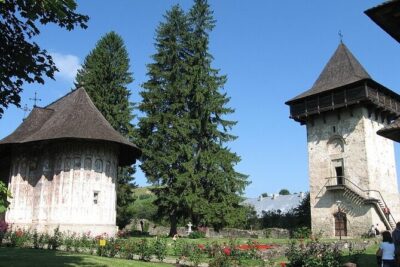
Moldovița was built in 1532 by Petru Rareș, the illegitimate son of Stephen the Great. Its original purpose included protection against Ottoman forces from the east, so the monastery carries both spiritual and defensive meaning.
That context helps explain why these churches are more than pretty rural buildings. Moldavia was a frontier zone, and rulers used monasteries to support faith, preserve culture, and reinforce political power. Ask your guide to point out the elements that connect the church to the wider fortified complex.
The two-hour visit is also a chance to step back from the walls. Look for the relationship between the church, the surrounding buildings, and the enclosed grounds. The art is the headline, but the complete setting tells you how the monastery functioned.
Voroneț and the blue everyone remembers
Voroneț is the star of the day for many people. Stephen the Great built it in 1488, reportedly in only three months and three weeks, to mark victory at the Battle of Vaslui. Its frescoes are known for a striking blue pigment that Romanians call Voroneț blue.
The color is memorable, but do not let the nickname reduce the church to a single shade. The exterior scenes are packed with figures and movement. Your two-hour visit gives you time to examine the details, compare the blue with the other colors, and notice how much of the structure is painted.
One unusual strength of this tour is that it does not treat the monasteries as interchangeable. Marius has been praised for showing differences between older churches associated with Stephen I and his followers, as well as newer painting and restoration work. That turns the day into an art lesson rather than a sequence of identical stops.
You may also have time for the painted egg museum associated with the wider Bucovina experience, although it is not listed as a scheduled stop here. Do not count on it as part of the formal program, but ask your guide if timing allows.
What the private vehicle changes
A private tour is especially useful on a route that joins Bucharest, Bucovina, and Transylvania. You do not have to match the pace of a large coach group or wait for people scattered across a city. Pickup can be arranged anywhere in Bucharest, with a stated 9:00 am start, and the tour returns you to Bucharest on Day 4.
The vehicle is described in the experience information as comfortable and efficient. Marius has also been associated with a spacious, air-conditioned touring van, while another account describes a comfortable new van. That matters on a four-day route with repeated road stretches.
The guide is not only there to point at buildings. Toni Tatar is described as professional, warm, and careful with details. Marius is praised for explaining religious art and for adjusting the day so the group saw a lot without being pushed past its limits.
There is also a practical side to private guiding. One guide helped a sick member of a group find an emergency room, navigate the medical system, and return to the tour. That is not a service you should expect to need, but it shows the value of having a dedicated local person rather than an anonymous driver or a guide who disappears after a scheduled stop.
Day 3: Sighișoara, Viscri, and Brașov
Day 3 shifts from painted Orthodox churches to Transylvania’s medieval and Saxon heritage.
Sighișoara’s historic center is the kind of place where you should put the camera away for a few minutes and simply walk. The old citadel is enclosed by medieval walls and listed as a UNESCO World Heritage Site. Two hours gives you time to explore the central streets and get a feel for the compact hilltop town.
The appeal here is scale. Sighișoara is not just a single castle room or church interior. Its old town works as a complete medieval setting, with lanes, walls, and preserved buildings creating a sense of how the settlement developed.
Viscri offers a quieter stop. Its fortified church is also UNESCO-listed and gives you a look at Saxon defensive architecture in a rural village setting. You have about an hour here, and the church admission is not included in the listed schedule.
Viscri is a good counterpoint to Sighișoara. The larger town shows a famous medieval citadel shaped by commerce and tourism. Viscri gives you a smaller community and a fortified religious building. The contrast helps explain why Transylvania cannot be reduced to Dracula stories and dramatic castles.
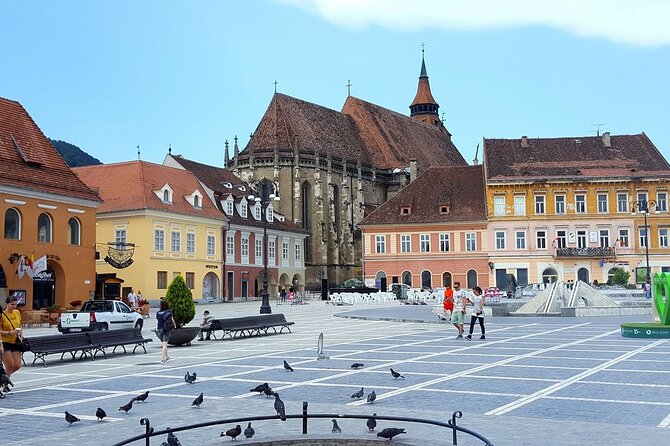
Brașov’s historical center receives about two hours. The city was once a regional capital of the Transylvanian Saxons and a major trading point between East and West. Its old center gives you a more urban version of the same cultural meeting point.
The schedule lists the Black Church separately on Day 4, so use your Brașov time for the public squares, streets, and general character of the old center unless your guide changes the order. The city is also linked to Romania’s national anthem, an unusual detail that adds a modern national layer to the medieval setting.
Day 4: the Black Church and Peleș Castle
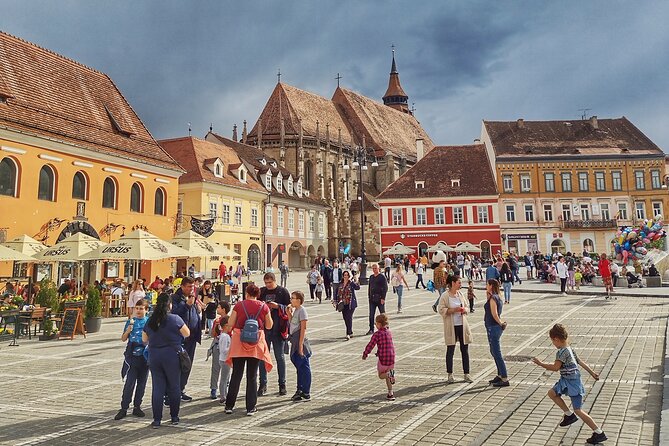
The Black Church is Romania’s major Gothic monument and one of the most important Lutheran churches in the region. It was built by the city’s German community, a reminder that Transylvania’s story includes Saxon settlers, trade networks, and Protestant traditions alongside Romanian Orthodox culture.
The visit is scheduled for about an hour. Admission is not included in the listed details, so plan to pay on site. This is another reason to confirm the final ticket arrangements before departure.
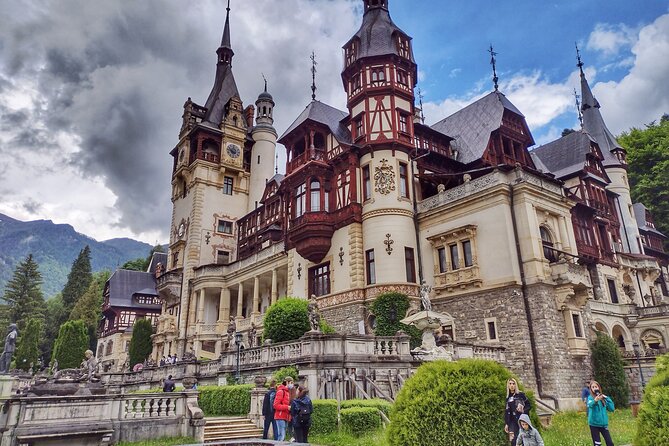
Peleș Castle then brings you into the age of Romania’s monarchy. Built between 1873 and 1914 near Sinaia, it served as the summer residence of King Carol I. The building is Neo-Renaissance, and its location in the Carpathian Mountains gives the final day a very different mood from the monasteries and fortified villages.
One hour is enough for a focused visit, but it is not a leisurely castle day. Interior access may depend on the ticket you buy, and the entrance fee is listed as separate. If you care most about the inside rooms and collections, ask how much of the allocated hour will be available for the interior rather than only the grounds.
Peleș is a fitting final stop because it connects Romania to European royal culture while remaining distinctly local. The castle was part of the country’s effort to present itself as a modern European kingdom. After several days of medieval churches and fortified towns, you finish with a building tied to national ambition and royal life.
Hotels, meals, and the real cost
The price is listed at $1,356.43 per person. For four days, that is a serious outlay, but it covers a private tour, Bucharest pickup and drop-off, three hotel nights, and three breakfasts. The private format is the main reason to compare this with a group coach trip, not just the number of attractions.
The hotels are described as three-star properties, though accommodation has been called lovely and, in one case, more like five-star comfort. Since the exact hotels are not named here, do not book this expecting a particular room, spa, or city-center address. Ask for the hotel names and locations if those details matter to you.
Lunches, dinners, drinks, and snacks are not included. That gives you freedom to choose local meals, but it also means the advertised price is not your final spending figure. Some accounts describe delicious and affordable food, yet you should still budget for four days of meals.
The entrance information needs special attention. The highlights mention included entrance fees, while the daily schedule marks Agapia, Văratec, Sucevița, Moldovița, Voroneț, Sighișoara, and Brașov as included, and Viscri, the Black Church, and Peleș Castle as not included. The general notes also mention purchasing tickets locally, with figures of €25 or €30 per person appearing in the details.
That conflict may reflect different ticket arrangements or an outdated description. Contact Crafted Tours Romania before booking and ask exactly which admissions are covered, which are payable on site, and what the €25 to €30 figure includes.
Who will enjoy this four-day route
I would choose this tour if you want Romania’s major cultural sights but do not want to manage the driving, hotel changes, and regional planning yourself. It suits people who like art, faith, architecture, and old towns more than nightlife or long free periods.
It is also a good fit for a couple, family, or small group that values private conversation with a guide. You can ask questions as they arise, and the day can be managed with more personal attention than a large scheduled tour.
You should have a moderate level of physical fitness. The program includes repeated walking at monasteries, citadels, churches, and historic centers. The description does not promise wheelchair access or a low-step route, so raise mobility concerns before booking.
Dress modestly for the Orthodox monasteries. Trousers or a long skirt are the safe choice for access to the grounds and churches. A head covering was not required in one account, but local rules can vary.
Cancellation terms are firm. Cancel at least six full days before the start for a full refund. Cancellation two to six days before may return 50 percent, while cancellation less than two full days before brings no refund. Bad weather can lead to a new date or a full refund.
FAQ
Where does the tour start and finish?
The tour starts in Bucharest and returns to Bucharest. Pickup can be arranged anywhere in Bucharest, with a stated start time of 9:00 am.
How many nights and breakfasts are included?
The package includes three nights in three-star hotels and three breakfasts.
Is this a private tour?
Yes. Only your group participates, and the experience includes private transport and a private guide.
Which monasteries are included?
The route visits Agapia, Văratec, Sucevița, Moldovița, and Voroneț. Entrance fees are marked as included for these stops in the daily details.
Are meals and drinks included?
Only breakfast is included. Lunch, dinner, drinks, and snacks are separate.
What happens if I need to cancel?
Cancel at least six full days before the start for a full refund. Cancellation two to six full days before may receive a 50 percent refund. Less than two full days before is nonrefundable. Poor weather may result in a different date or a full refund.
Should you book it?
Book this tour if the painted churches are high on your Romania list and you want a local guide to explain what you are seeing. The combination of Agapia and Văratec, three major Bucovina churches, Sighișoara, Viscri, Brașov, and Peleș Castle packs a great deal of culture into four days.
Do not book it expecting a slow holiday with long mornings and unplanned afternoons. The route covers a large part of Romania, and the schedule is full. Before paying, confirm the hotel locations, the exact entrance fees, and the likely vehicle. If those points are clear, the private format gives this ambitious trip its best value: less logistical worry, more guide time, and a direct look at Romania’s art, faith, and medieval towns.
More 4-Day Experiences in Bucharest
- 4-Day Private Tour in Transylvania from Bucharest
★ 5.0 · 48 reviews - Transylvania Castles 4-day tour from Bucharest
★ 5.0 · 31 reviews - 4 Days Private Tour in Transylvania: Sibiu, Sighisoara and Brasov
★ 5.0 · 18 reviews - 4-Day Private Tour of Transylvania from Bucharest
★ 5.0 · 16 reviews
More Painted Monasteries Tours in Bucharest
- 11-Day Romania Tour from Bucharest with Transylvania & Bucovina
★ 5.0 · 6 reviews - Transylvania & Bucovina Private Tour – 6 days
★ 5.0 · 3 reviews - Bucovina Painted Monasteries Day Tour
★ 5.0 · 83 reviews - 1-Day Bucovina Painted Monasteries tour from Suceava – English
★ 5.0 · 33 reviews
Just added around Bucharest
- Village Museum Bucharest Guided Tour★ 5.0 · 6 reviews
- Bucharest: Dealu Mare Winery Private Trip with Wine Tasting★ 4.9 · 6 reviews
- Winery touring & private wine tasting – one day private tour★ 5.0 · 3 reviews
- Transylvania Tour: Dracula’s Castle, Peles Palace & Brasov★ 5.0 · 19 reviews
- Discover Medieval Transylvania Small Group Tour – 7 days★ 5.0 · 4 reviews
- Bucharest Airport Transfer To Constanta Mamaia★ 5.0 · 3 reviews
- Airport Henri Coanda (Otopeni) to Bucharest – Private Transfer – Driver★ 5.0 · 5 reviews
- Gems of Transilvania: Brasov,Sighisoara,Sibiu,Viscri and more★ 5.0 · 6 reviews
Painted Monasteries Tours, compared.
1-Day Bucovina Painted Monasteries tour from Suceava – English
Read our review →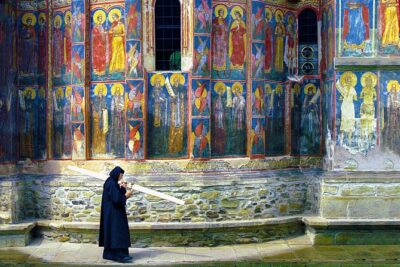
Day trip from Iasi to the UNESCO Painted Monasteries in Bucovina
Read our review →
11-Day Romania Tour from Bucharest with Transylvania & Bucovina
Read our review →

Two days tour to Bucovina & UNESCO Painted Monasteries
Read our review →Browse the lists this tour appears in