
Reviewed · WALKING TOURS
Guided Walking Tour of Historical Bucharest
Bucharest’s story is written in sharp contrasts: medieval ruins beside grand banks, Orthodox churches beside French-inspired palaces, and huge communist boulevards built over older neighborhoods. This three-hour private walk ties those pieces together, from Manuc’s Inn and Vlad the Impaler’s old court to the balcony where Nicolae Ceaușescu gave his final speech.
I like the route for two reasons: it covers the city’s key sights without making you sit on a bus, and it explains how monarchy, dictatorship, the Cold War, and the 1989 Revolution changed Bucharest. Guides such as Alina bring strong local knowledge and personal memories. The catch is simple: this is a lot of ground, and the walk can stretch beyond three hours or approach 17,000 steps.
In This Review
- Key points to know before booking
- Why this Bucharest walk works so well
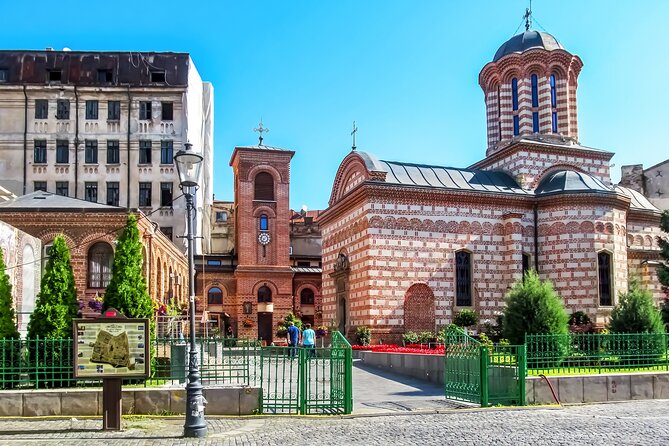
- Starting at Manuc’s Inn and St. Anton Church
- Old Princely Court and Vlad the Impaler
- Unirii Square and the scale of socialist Bucharest
- Constitution Square and the Palace of Parliament
- Churches, CEC Palace, and Calea Victoriei
- The Old Center, Macca-Villacrosse Passage, and the National Bank
- University Square and Bucharest’s civic center
- The 1989 Revolution at Revolution Square
- Military Circle and the final stretch
- How hard is the walk?
- Who will get the most from this tour?
- Booking value and practical planning
- Should you book the Guided Walking Tour of Historical Bucharest?
- FAQ
- How long is the Guided Walking Tour of Historical Bucharest?
- Where does the tour begin?
- Where does the tour end?
- Is the tour private?
- Is the tour offered in English?
- Does the tour enter the Palace of Parliament?
- How much walking is involved?
Key points to know before booking
- A private English-language walk: Only your group takes part, so you can ask questions and set the pace more easily.
- A wide city-center route: You visit the Old Princely Court, Unirii Square, Calea Victoriei, University Square, and Revolution Square.
- History is the main event: Buildings matter, but the guide spends more time on the people, politics, and events connected to them.
- Strong views of the Palace of Parliament: You see the giant building from Unirii Boulevard and Constitution Square, with good photo angles.
- Expect serious walking: A moderate level of fitness is required, and water is especially useful in hot weather.
- Best as an early Bucharest activity: It gives you a useful map of the center and ideas for where to return later.
Why this Bucharest walk works so well
At $30.77 per person, the tour sits in the reasonable range for a private three-hour city walk, especially if two or more people share the booking. You are not paying for an entrance-heavy excursion. The value comes from having one person connect Bucharest’s scattered sights into a single story.
That matters here. Bucharest can feel disjointed at first. The Old Town has narrow lanes and restored restaurants, while Unirii Boulevard is broad, formal, and dominated by the scale of the communist period. Calea Victoriei brings another shift, with historic churches, banks, shops, and elegant buildings. A guide helps you see that these are not random changes. They reflect different rulers, ambitions, and political eras.
The tour is private, which is a real advantage. You can ask about Romanian customs, architecture, communism, religion, or daily life without waiting for a large group to catch up. You can also ask the guide to clarify a point, though one account found the English difficult to follow at times. Alina is often named as the guide, and the tour also has a mention of Elena. The experience may therefore depend on who leads your walk.
A few more Bucharest trips to weigh up
- Bucharest: 3-Hour Dark History Tour with a Local
★ 4.9 · 301 reviews - Bucharest: Small Group History, Art & Secrets Tour
★ 4.7 · 152 reviews - Bucharest Jewish Heritage | Holocaust Memorial | Private Car Tour
★ 5.0 · 38 reviews
Starting at Manuc’s Inn and St. Anton Church
The meeting point is outside the main entrance of Manuc’s Inn, 62 Strada Franceză, in Bucharest’s Old Center. This is a sensible starting place because the inn introduces you to the city’s old commercial world before the route moves into palaces, boulevards, and political landmarks.
You begin by hearing about the inn’s past, then move toward St. Anton Orthodox Church. The church was once the coronation church of Wallachian rulers and sits in the heart of the old city. That early pairing gives you two useful ideas right away: Bucharest was both a trading center and a political center, and religion was closely linked with royal power.
Do not expect a long interior visit at every church or building. This is mainly an outdoor walking tour, with short stops and explanations along the way. The first part works best if you enjoy listening while looking closely at façades, street plans, and surviving fragments rather than collecting entrance tickets.
Old Princely Court and Vlad the Impaler
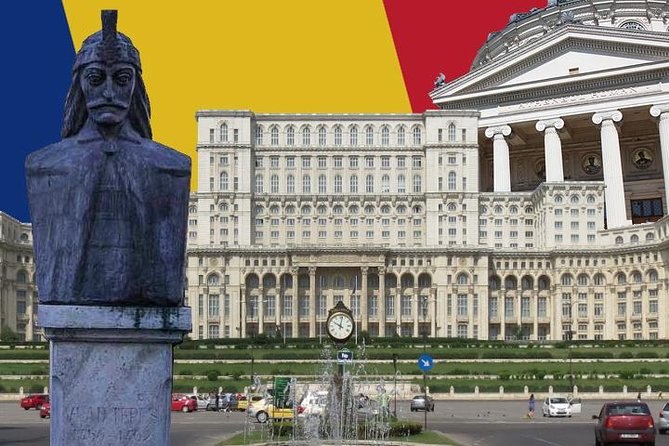
The ruins of the Old Princely Court are among the most important early stops. This was the palace complex of Wallachian rulers and is linked with Vlad the Impaler, the historical figure who later became the model for Dracula legends.
The ruins are not grand in the way a complete palace would be. Their appeal is that they show how old Bucharest sits beneath the modern capital. You get a physical connection to the medieval city, then hear how rulers used this area as a seat of power.
The listed stop is short, about five minutes, but the guide adds meaning that a quick look alone cannot provide. If you are especially interested in medieval history, ask questions here. If your main interest is architecture, this is still a useful opening chapter before the route reaches larger and more decorative buildings.
Unirii Square and the scale of socialist Bucharest
From the old court, the route continues to Unirii Square, the heart of modern Bucharest. The square has refurbished fountains and open views, making it one of the easier places for photographs. It also provides a dramatic change from the tight streets of the Old Center.
Next comes Unirii Boulevard, once called the Boulevard of Socialist Victory. It was designed on a vast scale and is sometimes compared with the Champs-Élysées. The comparison is about width, ceremony, and political display, not about copying Paris in every detail.
This is one of the tour’s strongest sections because the guide can explain how Ceaușescu’s regime reshaped the city. The boulevard and its surrounding buildings were part of a grand urban project that changed Bucharest’s center and erased older streets and neighborhoods. You begin to understand communism not only as a political system, but as something imposed through concrete, distance, and monumental planning.
The Palace of Parliament then comes into view beyond the boulevard. It is one of Bucharest’s most recognizable sights, and the route gives you more than one viewpoint.
Same mountains, a completely different day out:
- Bucharest: Dracula’s Castle, Peles Castle, & Brasov Old Town
★ 4.5 · 17,858 reviews - Bucharest: Dracula Castle, Peles Castle & Brasov Old Town
★ 4.6 · 10,891 reviews - Bucharest: Dracula’s Castle, Peleș Castle & Brașov Day Trip
★ 4.5 · 5,919 reviews - Bucharest: Palace of Parliament Tickets and Guide
★ 4.3 · 3,182 reviews
Constitution Square and the Palace of Parliament
At Constitution Square, directly in front of the parliamentary buildings, you stop for photographs and a closer look at the scale of the area. The Palace of Parliament dominates the view. Even from outside, the building communicates the confidence and excess of Ceaușescu’s final years.
The guide’s explanation is particularly useful here because the building can otherwise become a simple photo stop. You hear how the dictatorship and its city-building plans affected Bucharest, and how the palace fits into the wider story of socialist victory and political control.
The tour does not list an interior visit to the Palace of Parliament. That is important when comparing options. You are seeing the building from the outside and learning its context, not taking a ticketed palace tour. If entering the building is a priority, you will need a separate arrangement.
Churches, CEC Palace, and Calea Victoriei
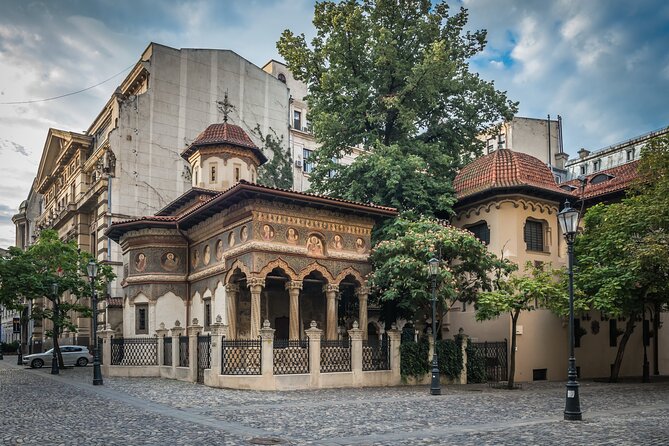
After the huge spaces around Unirii, the route turns back toward older and more varied parts of central Bucharest. One church on the route was built in 1724 and has its own story to tell. The precise name is not clearly identified in the tour details, but the stop adds another layer to the city’s religious and architectural past.
You also hear about the CEC Palace, one of the city’s most distinctive historic buildings. Its ornate exterior makes a good contrast with the stern mass of the Palace of Parliament. The route then follows part of Calea Victoriei, or Victoria Avenue, which is lined with shops and major civic buildings.
This stretch is where the tour’s focus becomes clearest. You are not simply ticking off monuments. You are comparing different ideas of what a capital should look like: princely, religious, commercial, royal, communist, and modern.
The Old Center, Macca-Villacrosse Passage, and the National Bank
Returning to the Old Center, you enter an area shaped by more than 500 years of urban life. The streets and alleyways can be confusing if you are new to Bucharest, so it helps to keep a map open on your phone or ask the guide to point out your position as you go.
The Macca-Villacrosse Passage is one of the route’s more atmospheric stops. Its covered passage and curved form offer a change from the city’s large squares. You hear about its past while walking through a space that still feels connected to Bucharest’s café and restaurant culture.
The National Bank of Romania adds another important piece. Its grand building represents money, state power, and the city’s role as a national capital. The guide explains its history rather than merely pointing out its façade. That approach suits anyone who wants to know why a building matters, not just what it looks like.
The Old Center can also be a practical place to note restaurants, cafés, and bars for later. One guide has offered suggestions for lunch, dinner, and drinks, so bring your questions if you want local ideas after the walk.
University Square and Bucharest’s civic center
The route then reaches University Square, one of Bucharest’s main public spaces. Here you see the University of Bucharest, founded in 1864 under Alexandru Ioan Cuza, as well as Suțu Palace, now the Bucharest History Museum.
Suțu Palace was once the home of Costache Suțu. Its presence shows how public institutions in Bucharest often occupy buildings first built for private wealth or political influence. Colțea Hospital and Church, an important central landmark built in 1888, adds a medical and religious angle to this section.
You also pass the National Theatre of Bucharest. The building has undergone several design changes in its relatively short history, which makes it a useful example of how public architecture can shift with the times. These stops are brief, but together they help you read the square as a working civic center rather than just an intersection.
The 1989 Revolution at Revolution Square
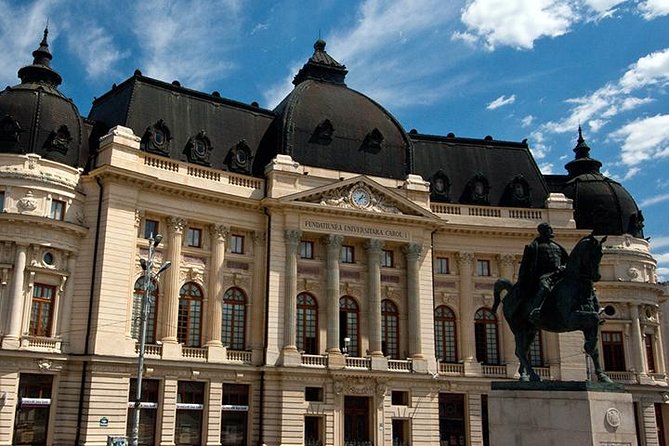
The most powerful section for many people is the area connected with the Romanian Revolution of December 1989. Here the guide points out the balcony where Ceaușescu made his final public speech, the former Communist Party headquarters, the University Library, King Carol I’s equestrian statue, and memorials connected with the uprising.
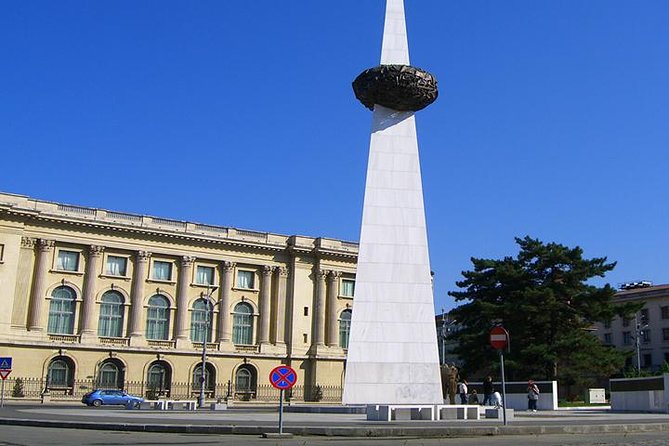
The 25-meter Memorial of Rebirth is the central marker. It commemorates the struggles and victims of the Revolution, and its unusual form has prompted plenty of discussion. The tour gives you a chance to consider both the monument and the events it represents.
This part requires a guide who can handle recent political history with care. The subject is not distant or abstract. Romanian guides who grew up during communism may add memories from their own families and childhoods, which can make the period more immediate. At the same time, you should know that the presentation may include strong personal views about communism, the monarchy, current politics, or disputed interpretations of the past.
That can be worthwhile if you enjoy open discussion and competing viewpoints. If you prefer a strictly neutral script, ask questions politely and separate personal opinion from established history. A small number of accounts found political discussion distracting, and one reported hearing conspiracy claims. This is the clearest reason to consider the guide’s style before booking.
Military Circle and the final stretch
The walk continues to the Military Circle and the Sărindar Fountains. The Military Circle is an impressive historic building, and the fountains give you another attractive setting for photographs.
The final stop is described as a place built for the people of Bucharest by the people of Bucharest more than a century ago, with gardens and a striking historic building. Since the tour ends back at the meeting point, confirm the exact final location with the guide, especially if you have hotel plans or a bus to catch.
The route covers many sights, but most stops are short, often around five minutes at the major listed points. The real length comes from the walking and the guide’s commentary. Some tours finish near the advertised three hours, while an enthusiastic guide may continue for an extra hour.
How hard is the walk?
Take the physical demand seriously. One person recorded more than 17,000 steps during the tour, even without a fast pace. That figure will vary by route, pace, and guide, but it gives you a useful idea of the day’s effort.
You should be comfortable walking for several hours on city streets and standing during explanations. In warm weather, carry water. Heat can make the route feel much harder, especially around the exposed spaces of Unirii Boulevard and Constitution Square.
The tour requires a moderate level of fitness. Children must be accompanied by an adult. Service animals are allowed, and the route is near public transportation. The experience is offered in English by mobile ticket, with pickup advertised as available. The stated meeting point remains outside Manuc’s Inn, so confirm pickup details before the morning of the tour.
Who will get the most from this tour?
I would choose this walk early in a Bucharest stay. It gives you a working map of the Old Center, Calea Victoriei, University Square, Unirii, and the Revolution area. Afterward, you can return to the buildings that caught your eye or use the guide’s food and drink suggestions.
This is a good fit for you if:
- You want history tied to actual streets and buildings.
- You prefer a private guide to a large group.
- You enjoy architecture but also want politics and social history.
- You want to understand the effects of Ceaușescu’s rule on the city.
- You are happy to walk several miles and pause often for explanations.
- You like personal stories and a guide who may offer strong opinions.
It may be less suitable if you want a relaxed stroll, a short list of only the prettiest buildings, or an interior tour of the Palace of Parliament. It is also not ideal for anyone who dislikes political discussion or needs a tightly timed three-hour schedule.
Booking value and practical planning
The $30.77 price is good value for a private introduction, particularly when split between a couple or small group. You get a long route, a local English-speaking guide, and context for sights that would otherwise be easy to miss. The value drops if you are expecting admission to museums or the Palace of Parliament, since the listed stops are mainly exterior visits and free viewing points.
The tour is popular enough that it is booked around 60 days ahead on average. If your dates are fixed, reserve early. You receive confirmation at booking unless you book within one day of departure, when confirmation depends on availability.
Free cancellation is available up to 24 hours before the start time. Changes or cancellations inside that window are not accepted for a refund. The walk also depends on good weather, with a different date or full refund offered if the operator cancels because conditions are poor.
Should you book the Guided Walking Tour of Historical Bucharest?
Book it if you want Bucharest explained through its changes: medieval Wallachia, royal ambition, Orthodox faith, French-influenced city building, communism, and the 1989 Revolution. The route covers a lot, and the strongest praise goes to the guide’s energy, local insight, storytelling, and ability to make history feel connected to daily life.
Go in prepared for a brisk, information-heavy walk. Carry water, wear comfortable shoes, allow more than three hours if your guide is especially talkative, and be ready for personal interpretations of Romanian politics. With those expectations, this is a useful and fairly priced first look at Bucharest’s complicated center.
FAQ
How long is the Guided Walking Tour of Historical Bucharest?
The tour lasts approximately three hours, though it may run longer depending on the guide and the pace of the group.
Where does the tour begin?
It begins outside the main entrance of Manuc’s Inn, Hanul lui Manuc, at 62 Strada Franceză in Bucharest’s Old Center.
Where does the tour end?
The activity information says it ends back at the meeting point.
Is the tour private?
Yes. Only your group participates in the activity.
Is the tour offered in English?
Yes. English is the stated tour language, and a mobile ticket is provided.
Does the tour enter the Palace of Parliament?
No interior visit is listed. You see the Palace of Parliament from viewpoints along Unirii Boulevard and at Constitution Square.
How much walking is involved?
A moderate level of fitness is required. The route involves several hours of walking, and one account recorded more than 17,000 steps. Carry water, especially in hot weather.
Just added around Bucharest
- Village Museum Bucharest Guided Tour★ 5.0 · 6 reviews
- Bucharest: Dealu Mare Winery Private Trip with Wine Tasting★ 4.9 · 6 reviews
- Winery touring & private wine tasting – one day private tour★ 5.0 · 3 reviews
- Transylvania Tour: Dracula’s Castle, Peles Palace & Brasov★ 5.0 · 19 reviews
- Discover Medieval Transylvania Small Group Tour – 7 days★ 5.0 · 4 reviews
- Bucharest Airport Transfer To Constanta Mamaia★ 5.0 · 3 reviews
- Airport Henri Coanda (Otopeni) to Bucharest – Private Transfer – Driver★ 5.0 · 5 reviews
- Gems of Transilvania: Brasov,Sighisoara,Sibiu,Viscri and more★ 5.0 · 6 reviews
Walking Tours, compared.
Ghost Stories & Romanian Mythology Walking Tour
Read our review →
Walking Tour- Delightful Bucharest (Highlights, Stories, Sights)
Read our review →

4h Bucharest Private Tour (2h by Car and 2h Walking in Old Town)
Read our review →
Browse the lists this tour appears in