
Reviewed · WALKING TOURS
Timisoara All in One – Walking and Tram Tour
Timisoara’s story comes in layers: Ottoman rule, Austrian military power, Baroque churches, and elegant Art Nouveau façades. This private walking and transport tour links those chapters in four to five hours, so you can see more than the central squares alone. The guide also brings the past to life when a site itself is closed, as with the Banat Museum.
I like the one-group format, which lets you slow down for photos or ask for extra explanation. I also like the practical mix of walking and private transportation, especially if you want to reach districts beyond the old center. The main consideration is that the Banat Museum is currently closed, and food, drinks, and admission tickets are not included.
In This Review
- Key points to know before booking
- Why this tour works for a first look at Timisoara
- Starting at the Banat Museum’s castle
- Ottoman Timisoara in Libertatii Square
- Saint George’s Square and the lost central mosque
- The Theresia Bastion, built in 1732
- Unirii Square, the city’s grand visual finish
- Walking, private transport, and the tour’s reach
- The guide makes the difference
- What $92.92 per person buys you
- Who should book this experience
- Should you book the Timisoara All in One tour?
- FAQ
- How long does the Timisoara All in One tour last?
- What time does the tour start?
- Where does the tour begin?
- Where does the tour end?
- Is this a private tour?
- Is transportation included?
- Are food and drinks included?
- Is the Banat Museum open during the tour?
- Is the tour offered in English?
- Can I cancel for a full refund?
Key points to know before booking
- Ottoman Timisoara gets proper attention: Libertatii Square and Saint George’s Square focus on the city’s former Ottoman period.
- The 1732 Theresia Bastion is a hands-on stop: You get about 20 minutes to explore this Austrian defensive work.
- Unirii Square is the visual high point: Baroque architecture and some of Timisoara’s finest Art Nouveau buildings meet here.
- Private transport saves time: You can cover places beyond the central walking zone without arranging your own taxi.
- The guide can adapt to your pace: Time for photographs and practical help were important parts of the experience, including support for a guest with a bad knee.
- The price reflects privacy: At $92.92 per person, this makes the most sense for people who value a private guide and efficient sightseeing.
Why this tour works for a first look at Timisoara
Timisoara is easy to underestimate if you only stroll along its prettiest square. The center is compact, but the city’s story is not. Military defenses, religious buildings, former Ottoman landmarks, and districts outside the core all help explain why Timisoara looks and feels different from other Romanian cities.
This tour gives you a guided introduction instead of leaving you to admire façades without context. You begin at 9:00 am and spend roughly four to five hours moving between stops on foot and by private transportation. That is enough time for a serious orientation without taking your entire day.
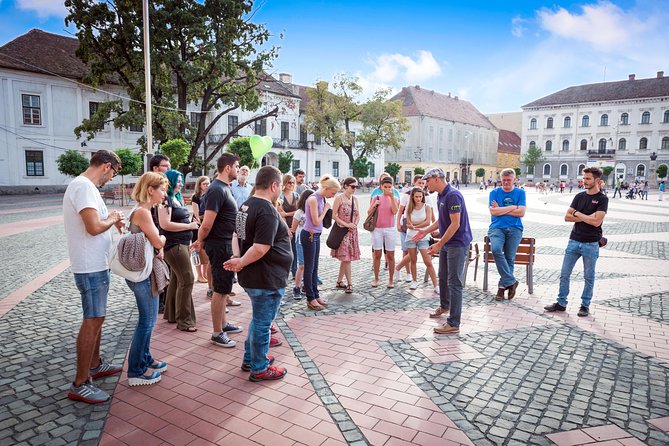
The private setup matters. Only your group joins the activity, so you are not tied to the pace of a large crowd. If you want a longer look at a building, need help with walking, or take many photographs, the guide can respond more easily than on a standard group outing.
The tour is offered in English. Guides connected with the experience include Sergiu and Ludovic. The strongest praise has focused on clear English, patience, local knowledge, and a willingness to explain rather than rush through a list of dates.
A few more Timisoara trips to weigh up
- Timisoara: Guided Walking Tour
★ 4.9 · 38 reviews - Timișoara Highlights – Walking Tour
★ 5.0 · 28 reviews - Timisoara: Classic Walking Tour
★ 5.0 · 26 reviews
Starting at the Banat Museum’s castle
The first stop is the Banat Museum, although the museum is currently closed. That means you should not expect to enter galleries or examine exhibits during this visit. Instead, your guide discusses the castle that houses the museum.
That may sound like a modest opening, but it gives the tour a useful start. Rather than wasting time at a closed door, you get architectural and historical context from outside. Still, keep your expectations straight: admission is not included, and the museum closure means this is a talk about the building, not a museum visit.
This is also a reminder to check the museum’s current status if seeing its collections is important to you. The tour continues even with the closure, but the first stop will feel more worthwhile to someone interested in the city’s setting and past than to someone seeking indoor exhibits.
Ottoman Timisoara in Libertatii Square
At Libertatii Square, the focus shifts to Timisoara during the Ottoman occupation. You spend about 20 minutes here, with admission free.
The value of this stop lies in the story. A central European city can look heavily Austrian at first glance, particularly once you see military works and formal Baroque planning. The Ottoman chapter complicates that quick impression. Your guide helps connect the square to a period that is easy to miss if you only photograph the surrounding buildings.
Twenty minutes is a sensible amount of time for a guided explanation and photographs. You will not get an extended study of every façade, but you should come away with a clearer sense of how Timisoara changed hands and how those changes shaped the city.
This is one of the tour’s better features because it does not treat history as a single Austrian or Romanian timeline. The Ottoman period receives its own place in the walk.
Saint George’s Square and the lost central mosque
Saint George’s Square is a shorter stop, about 10 minutes, and centers on the former Central Mosque that existed here around 400 years ago. The building is no longer there, which makes the guide’s explanation especially useful.
This is the kind of detail you could easily walk past without help. A present-day square rarely announces what occupied it centuries earlier. The stop asks you to picture the older city beneath the current one, and it adds another layer to the Ottoman story begun in Libertatii Square.
The 10-minute timing tells you what to expect: a focused explanation, not a long break or an interior visit. If you enjoy historical reconstruction and city changes, this will likely be one of the most memorable short stops. If you prefer surviving buildings only, it may feel less concrete than the bastion or the grand squares.
Same mountains, a completely different day out:
- The Classic Tour of Timisoara
★ 5.0 · 154 reviews - Weekly Guided Tour in English – Tuesday, Thursday, Saturday
★ 5.0 · 84 reviews - Day trip to Corvin Castle and Sibiu (and back) from Timisoara
★ 5.0 · 30 reviews - Danube Gorge & Banat Waterfalls
★ 5.0 · 27 reviews
The Theresia Bastion, built in 1732
The Maria Theresia Bastion gives you a physical link to the Austrian period. Built by the Austrians in 1732, it is the most substantial stop for understanding Timisoara as a fortified city.
You have about 20 minutes to explore. That should give you time to look at the structure, take photographs, and hear why it mattered. The tour does not simply rush past it from a vehicle. You get a proper pause, which is important at a site whose scale and shape make more sense when you can move around it.
Admission is free. That keeps the stop straightforward, though you should not assume that every area connected with the bastion will operate as a museum or paid attraction. The supplied plan promises exploration and explanation, not a separate indoor program.
For me, this is where the tour’s balance works best. The squares give you urban history and architecture. The bastion gives you a surviving defensive work that makes the city’s strategic importance easier to grasp.
Unirii Square, the city’s grand visual finish
Unirii Square is described as the former city center and likely the most beautiful square in Timisoara today. Allow about 20 minutes here.
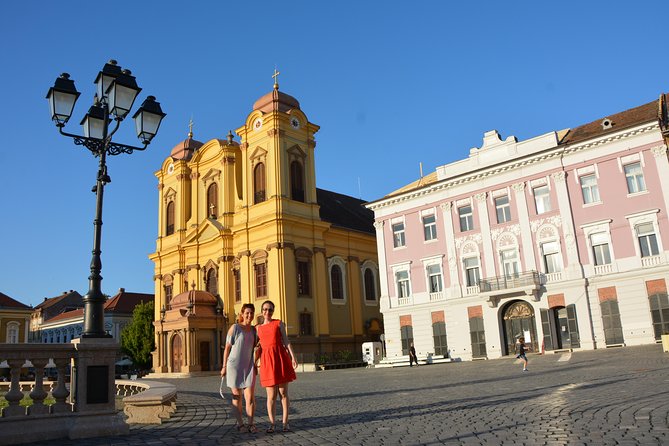
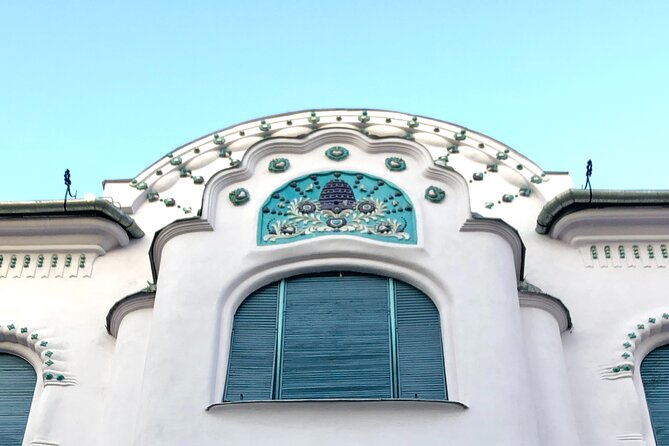
The architectural mix is the reason to pay attention. The square is mainly Baroque, but it also contains some of the city’s finest Art Nouveau buildings. That combination gives you a quick lesson in how Timisoara changed over time without losing the formal shape of its older urban core.
This is a strong place for photographs, but the guide’s explanation keeps it from becoming only a photo stop. Look for contrasts between the orderly Baroque setting and the more decorative Art Nouveau details. Your guide can point out what you might otherwise overlook while you frame the square.
The 20-minute stop is useful but not generous for a person who loves architecture and photographs every façade. One guest specifically appreciated having enough time for photos, so you should feel comfortable telling the guide if you need a little longer. In a private group, that request is more realistic than it would be on a fixed large-group schedule.
Walking, private transport, and the tour’s reach
The experience is presented as a walking and tram tour, while the included feature is private transportation. The supplied details do not specify exactly where a tram ride occurs, so you should confirm the transport plan if riding a tram is essential to your decision.
What is clear is the practical purpose of transport: you can cover more ground and visit important districts outside the city center. That is the tour’s answer to a common problem. A central walking tour shows you the prettiest core, but reaching outlying areas on your own can take extra planning and time.
Private transportation also makes the half-day schedule more efficient. You do not need to work out local routes between each historical point, and your group is not waiting for a large tour party to gather. That convenience is part of what you are paying for.
The tradeoff is that private transport can make the experience feel less like a long, spontaneous city walk. If you want to wander every lane at leisure, a self-guided day may suit you better. If you want a broad introduction with less logistical work, the transport is a clear advantage.
The guide makes the difference
A history tour lives or dies by the guide. Here, the key strengths are explanation, English, patience, and flexibility.
Sergiu is associated with the experience, and Ludovic has also guided it. Feedback has highlighted very strong English and an ability to explain Timisoara clearly. That matters in a city whose past includes several ruling powers and buildings that no longer serve their original purpose.
The personal manner is just as important. On a rainy day, the guide provided umbrellas and continued the tour. When a guest had a bad knee, the guide offered practical help and made the pace more manageable. That does not mean you should assume every mobility need can be accommodated, but it does show the benefit of a private arrangement.
If photography is your priority, say so at the beginning. The guide has allowed ample time for pictures, which is useful at Unirii Square and the bastion. You can get more from the tour by telling the guide what interests you most: Ottoman history, architecture, military sites, or photographs.
What $92.92 per person buys you
At $92.92 per person, this is not the cheapest way to see Timisoara. The value depends heavily on group size and your preference for private service.
For a couple or small group, the price buys an English-speaking guide, private transportation, and a focused half-day route. You are also paying to avoid planning the connections between central sights and districts beyond the core. That can be worthwhile on a first day in town, especially if you have limited time.
The price is less attractive if you are traveling alone and mainly want to see the free squares. Libertatii Square, Saint George’s Square, the Theresia Bastion, and Unirii Square do not require admission fees. You could visit the central areas independently and spend less, though you would give up the guide’s historical explanations and private transport.
Group discounts are available, so check the final per-person price for your party. The larger your private group, the easier it is to see the tour as a useful shared expense rather than a premium solo activity.
Food and drinks are not included. Bring what you need for the morning, particularly because the tour lasts four to five hours and the timing does not list a meal break.
Who should book this experience
I would recommend this tour to a first-time visitor who wants a well-organized introduction to Timisoara without spending a full day on foot. It also suits people who care about the city’s political and architectural layers, not only its most photogenic square.
It is a good fit for families because children can participate when accompanied by an adult, and the private format gives parents more control over pace. It may also work well for older visitors or anyone who prefers not to handle transport between districts alone. The guide’s response to a guest with a bad knee is encouraging, but you should still explain your needs before starting.
Photographers should also consider it. You have a private guide, free time for pictures, and several strong subjects: the bastion, the Baroque setting of Unirii Square, and Art Nouveau façades.
I would be more cautious if your main goal is a museum visit, a food experience, or a long tram ride. The Banat Museum is closed for now, food and drinks are excluded, and the exact tram component is not spelled out in the available details.
The tour is confirmed within 48 hours of booking, subject to availability. It is free to cancel up to 24 hours before the 9:00 am start, but changes or cancellations inside that window are not accepted for a refund. Meet at Strada Alba Iulia 2, Timișoara 300077, and return there when the activity ends.
Should you book the Timisoara All in One tour?
Book it if you want private guidance, efficient transport, and historical context in one half-day outing. The route covers more than a simple old-town stroll, and the guide’s patience, clear English, umbrella help, and attention to photography add real practical value.
Skip it if you are happy exploring free central sights alone or if entering the Banat Museum is essential. For most first-time visitors with limited time, though, this is a sensible way to meet Timisoara’s Ottoman, Austrian, Baroque, and Art Nouveau sides without wrestling with the city’s transport plan yourself.
FAQ
How long does the Timisoara All in One tour last?
The tour lasts approximately four to five hours.
What time does the tour start?
The tour starts at 9:00 am.
Where does the tour begin?
The meeting point is Strada Alba Iulia 2, Timișoara 300077, Romania.
Where does the tour end?
The activity ends back at the meeting point.
Is this a private tour?
Yes. Only your group participates in the activity.
Is transportation included?
Yes. Private transportation is included.
Are food and drinks included?
No. Food and drinks are not included.
Is the Banat Museum open during the tour?
The Banat Museum is currently closed. The guide discusses the castle that houses the museum instead, and admission is not included.
Is the tour offered in English?
Yes. The tour is offered in English.
Can I cancel for a full refund?
Yes, if you cancel at least 24 hours before the experience start time. Cancellations or changes made less than 24 hours before the start are not accepted for a refund.
Just added around Timisoara
- Bite your way through Timisoara – Timisoara’s Street Food Tour★ 5.0 · 14 reviews
- The Grand Tour of Communist Ages at Timisoara★ 5.0 · 17 reviews
- The Jewish Heritage Tour of Timisoara★ 5.0 · 9 reviews
- Timisoara Downtown Dream Tour★ 5.0 · 5 reviews
- Ecumenical Tour of Timisoara★ 5.0 · 15 reviews
- Nera Gorge National Park – Private Day Tour from Timisoara★ 4.5 · 4 reviews
- One Day in Transylvania – Departure from Timisoara★ 5.0 · 16 reviews
- Day Trip to Turda Salt Mine and Corvin Castle from Timisoara★ 5.0 · 10 reviews
Walking Tours, compared.
Ghost Stories & Romanian Mythology Walking Tour
Read our review →
Walking Tour- Delightful Bucharest (Highlights, Stories, Sights)
Read our review →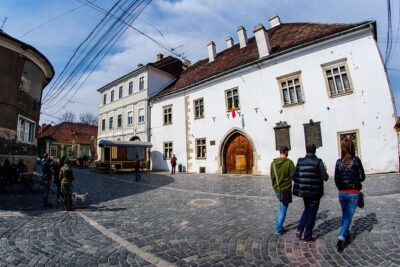

4h Bucharest Private Tour (2h by Car and 2h Walking in Old Town)
Read our review →
Browse the lists this tour appears in