
Reviewed · COMMUNISM & CEAUSESCU TOURS
Communism Walking Tour from Lenin to Ceausescu in Bucharest
Bucharest’s communist story is easiest to understand on foot, where grand boulevards, old churches, royal buildings, and revolution sites sit close together. This 2.5-hour walk connects Nicolae Ceausescu’s grand rebuilding scheme with the December 1989 uprising that ended his rule.
I like the route for two reasons: it links major sights rather than treating them as isolated photo stops, and it puts daily life under communism at the center of the story. Guides Alex and Lucia have both drawn praise for clear storytelling, humor, and the ability to explain complicated events to mixed-age groups. The main drawback is that the tour is largely an outdoor history lesson, so you should expect to view several buildings from outside rather than tour their interiors.
In This Review
- Key points to know before booking
- Why Bucharest makes a strong communism walking tour
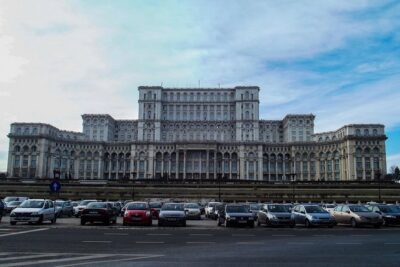
- The Palace of Parliament and Ceausescu’s grand design
- Antim Monastery and the cost of a new boulevard
- Patriarchal Palace and the first steps toward democracy
- Piata Unirii and the boulevard of Socialist Victory
- Old Town after the old regime
- University’s Square and Romania’s bloody revolution
- The Royal Palace and the Palace of the Republic
- Ateneul Roman and the five lei detail
- Revolution Square and Ceausescu’s last speech
- What $24 gets you
- Who will enjoy this walk most
- Practical details for a smoother morning
- Should you book the Lenin to Ceausescu walk?
- FAQ
- Where does the communism walking tour start?
- What time does the tour begin?
- Where does the tour end?
- How long does the tour last?
- Is the tour offered in English?
- What is included in the price?
- Are food and drinks included?
- How many people can join the tour?
- Can I cancel for a full refund?
Key points to know before booking
- Ceausescu’s final project: Begin at the Palace of Parliament, the enormous administrative building at the heart of his last major scheme.
- A city reshaped by force: See how Socialist Victory Boulevard cut through older Bucharest, including the area around Antim Monastery.
- The revolution becomes personal: University’s Square and Revolution Square connect political change with the people killed in December 1989.
- Nine stops in one compact walk: The route covers Parliament, churches, royal buildings, Old Town, and major public squares.
- English-language guiding: The tour is offered in English, with guides such as Alex and Lucia leading the walk.
- Good value for history fans: At $24 per person, the cost covers a local guide, though food, drinks, and interior admission are not included.
Why Bucharest makes a strong communism walking tour

Bucharest can feel like several cities placed side by side. An ornate church may sit near a broad socialist boulevard. A former royal palace may face a square linked to the final days of communism. The city’s contrasts are not just architectural. They show how Romania’s rulers repeatedly tried to reshape public life.
That is what makes this route useful. You are not simply collecting landmarks. You are following the chain of decisions that changed Bucharest, from communist urban planning to the bloody revolution of 1989.
The tour starts at 10:30 a.m. in front of the Palace of Parliament at Bulevardul Unirii 5. It ends at Revolution Square, so the walk has a clear historical direction. You begin with Ceausescu’s grandest construction project and finish at the place where he gave his last public speech.
The group can include up to 25 people. That is not a private tour, but it is still a manageable size for a city walk. You should be prepared to stay close to the guide, especially around busy streets and large open squares.
More communism & ceausescu tours in Bucharest:
- The Real tour of Communism
★ 5.0 · 666 reviews - Life under Communism
★ 5.0 · 358 reviews - 3-Hour Guided Tour of Communist Bucharest
★ 4.9 · 303 reviews
The Palace of Parliament and Ceausescu’s grand design
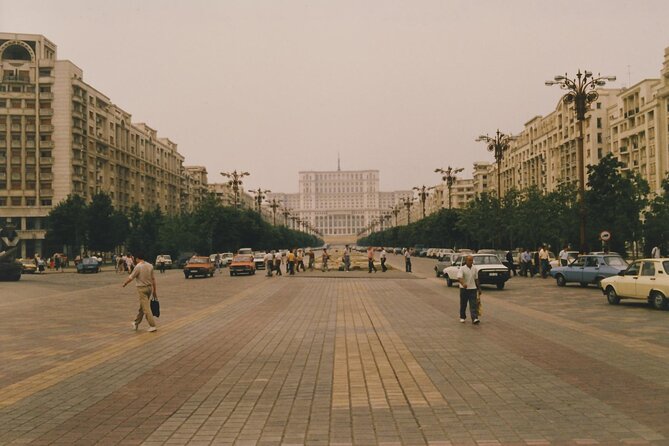
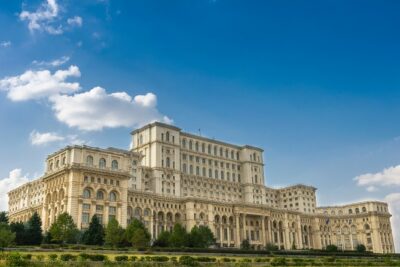
The Palace of Parliament is the most dramatic opening point possible for this subject. It is described as the second-largest administrative building in the world, and its scale gives you an immediate sense of Ceausescu’s ambitions.
Your guide uses the building to explain the final communist rebuilding project. The palace was not planned as an isolated office block. It formed part of a wider effort to create a new political center, with broad avenues and monumental spaces designed to project state power.
The 20-minute stop is free, but the tour does not include an interior visit. That matters if you are hoping to see the famous rooms inside. The value here is the outside perspective and the explanation of how the building fits into the larger plan for Bucharest.
I would take a moment to study the surrounding space rather than rushing into photographs. The size of the building is impressive, but the guide’s political context is what turns it from a giant structure into evidence of a particular system and its priorities.
Antim Monastery and the cost of a new boulevard
Antim Monastery brings a more intimate scale to the walk. It belongs to the older city and was nearly demolished to make room for Socialist Victory Boulevard.
That contrast is central to the tour. The palace shows the new regime’s desire for monumentality. Antim Monastery shows what had to be threatened or removed to make that vision possible. You get a direct look at the conflict between older Bucharest and the city Ceausescu wanted to build.
The stop lasts about 15 minutes and admission is free. There is no promise of an extended interior visit, so approach it as a historical site within the route rather than a separate church tour.
I like this part because it keeps the discussion from becoming only a story about leaders and buildings. Urban planning affects ordinary neighborhoods, places of worship, and the shape of daily movement through a city. At Antim, you can see that political choices were also choices about what Bucharest would remember and what it would lose.
Patriarchal Palace and the first steps toward democracy
The Patriarchal Palace adds another layer to the story. Its design was inspired by the Garnier Opera in Paris, giving the site an architectural link to western Europe. Its political meaning is even more important for this tour: it is tied both to the beginning of democracy in Romania and to the start of the communist movement.
You spend around 20 minutes here. The guide’s job is to connect the building to the political changes around it, not simply describe its appearance. That makes this a useful pause after Antim Monastery, since you move from threatened religious architecture to a site connected with major shifts in Romanian government.
This is also one of the points where a good guide matters most. Romanian political history can become a blur of parties, movements, and changing institutions. Alex has been praised for connecting the dots, while Lucia has been described as a strong English-language guide. The exact guide depends on the departure, but the tour clearly relies on spoken explanation rather than printed material.
A few more Bucharest trips to weigh up
- Bucharest: City Highlights Guided Walking Tour
★ 4.9 · 1,482 reviews - Bucharest Highlights Walking Tour
★ 5.0 · 469 reviews - Bucharest: Ghost Stories & Romanian Mythology Walking Tour
★ 4.9 · 287 reviews - Bucharest: Guided Walking Tour with Romanian Snack
★ 4.9 · 228 reviews
Piata Unirii and the boulevard of Socialist Victory

Piata Unirii was built during the 1980s as part of Socialist Victory Boulevard. Today, it is known for its dancing fountains, which give the square a very different public image from the one it had under communism.
The 20-minute stop lets you consider how political spaces change meaning. A place created to express state power can later become a public gathering point and a familiar city landmark. The fountains are a visual feature, but the bigger subject is the boulevard itself and the scale of the rebuilding project.
You will spend time outside, and the square is broad and open. Wear comfortable shoes and bring water, especially in warm weather. Food and drinks are not included, so plan to eat before the walk or after it.
The sequence works well. After seeing the palace and the older places threatened by the boulevard, you now see one of the spaces produced by that plan. The route keeps returning to the same question: what did the regime want Bucharest to look like, and what did that transformation mean for the people who already lived there?
Old Town after the old regime
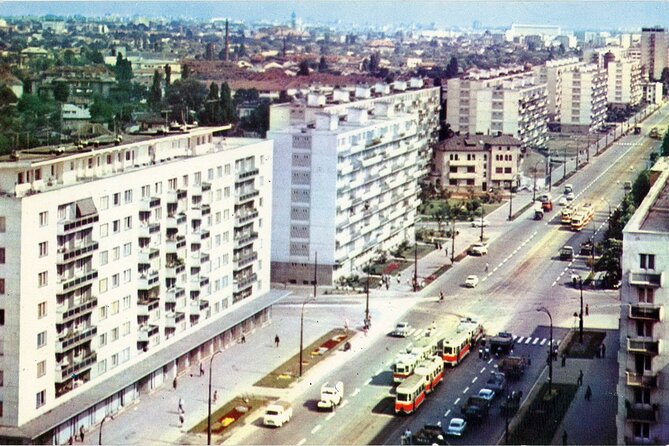
Bucharest’s Old Town is presented as a symbol of the former regime that became neglected during the communist era. That detail helps you look beyond the area’s current appeal.
Today, Old Town is one of the city’s best-known districts, but the tour places it within the story of decline, neglect, and changing political priorities. The 15-minute stop is short, yet it gives you a chance to compare the old urban fabric with the huge avenues and administrative buildings seen earlier.
This is not a restaurant crawl or a nightlife stop. The focus remains on how the district fit into communist Bucharest. If you want extensive time for cafés, shops, or close architectural study, you will need to return on your own after the tour.
I appreciate that the route does not present the old center as a timeless postcard. It shows that buildings and neighborhoods can lose official importance under one government and regain it under another. That is a useful way to read the city for the rest of your stay.
University’s Square and Romania’s bloody revolution
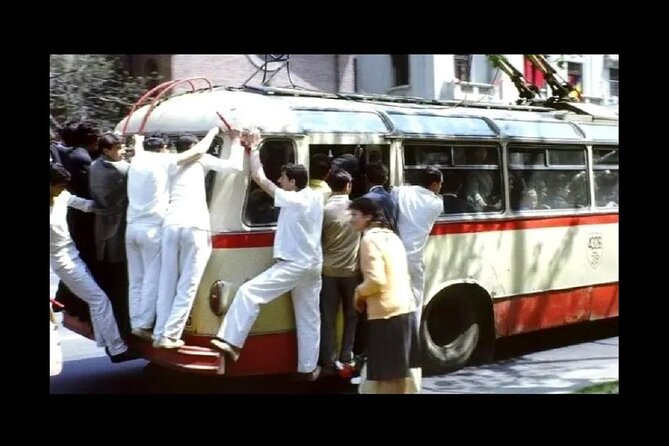
University’s Square is one of the most serious stops. Romania was the only country in the communist bloc where the regime ended in a bloody revolution, and many victims were shot in this square.
The 15-minute visit gives the events of December 1989 a physical setting. Instead of hearing only about political collapse in the abstract, you stand in the place connected with the violence and uncertainty of those days.
This part may feel heavier than the earlier architectural stops. That is appropriate. A tour about communism should not reduce the period to unusual buildings or stories about Ceausescu’s excesses. The square brings attention back to the people who paid the highest price when the system fell.
The guide’s delivery matters here. Alex has been praised for his storytelling, humor, and ability to adjust to different age groups. That combination can help with a difficult subject, though you should still expect a serious account rather than a light sightseeing talk.
The Royal Palace and the Palace of the Republic
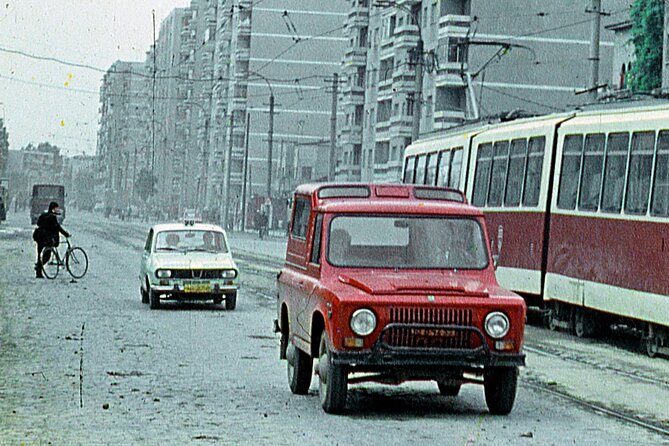
The Royal Palace now houses the National Art Museum. Before communism, it served as the winter home of Romania’s royal family. During the early communist years, it became the Palace of the Republic and a protocol building.
This one site lets you trace a change in political ownership. A royal residence became a symbol of a new state. The building’s use changed, but its role as a place where power was displayed remained.
The stop lasts about 15 minutes. As with the Palace of Parliament, the free walking tour does not include museum admission. If you want to see the National Art Museum’s collections, you will need to make a separate visit.
For me, this is one of the best examples of why the route is more than a Ceausescu-focused tour. It shows that the communist period did not begin from nothing. It took over existing buildings, institutions, and symbols, then gave them new meanings.
Ateneul Roman and the five lei detail
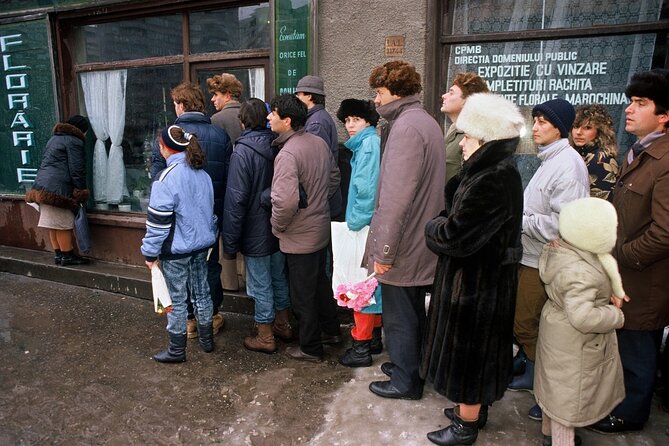
Ateneul Roman is one of Bucharest’s most representative buildings, and its image appears on the five lei banknote. The stop is brief, about five minutes, but it gives the walk an architectural pause before the final political chapter.
You may find this stop especially useful if you enjoy linking a city’s everyday objects with its landmarks. A banknote is something you handle without much thought. Seeing the building in person gives that small piece of Romanian currency a clear place in the city.
Because the stop is short, do not expect a full architectural lecture or an interior tour. It works as a quick orientation point and as part of the route toward Revolution Square.
Revolution Square and Ceausescu’s last speech
The final stop is Revolution Square, where the main building was once the Central Committee of the Communist Party. Nicolae Ceausescu delivered his last speech to the Romanian people from this location.
The tour allows about 25 minutes here, the longest stop of the day after the Palace of Parliament and Piata Unirii. That extra time makes sense. Revolution Square brings together the end of Ceausescu’s public authority, the outbreak of protest, and the transition toward democracy.
The walk ends here, at Piata Revolutiei. That is convenient because you finish in one of Bucharest’s key historical areas rather than backtracking to the starting point. You can also use the square as a place to pause and think through the sequence of sites you have just seen.
The ending gives the tour a strong shape. You start with a regime’s huge building project and finish with the moment its leader lost control of the public. The physical route mirrors the political story.
What $24 gets you
At $24 per person, this is a fair price for a 2.5-hour guided walk if you want context rather than a self-guided list of locations. You are paying for a local English-speaking guide who can connect architecture, political change, and personal stories across nine stops.
The price does not include food, drinks, or admission to attractions. Every scheduled stop is listed with free admission, but that means you should not assume you will enter the Palace of Parliament, the National Art Museum, or another interior during the walk.
The strongest value comes from the route and the explanation. You could visit many of these squares yourself, but it would be harder to understand how Socialist Victory Boulevard, the Palace of Parliament, the royal buildings, and the revolution sites fit together.
The tour is recommended by 100 percent of the supplied ratings, with a perfect score from 21 reviews. That is a small sample, so I would not treat it as a guarantee. Still, the repeated praise for interesting stories, clear connections, and guides such as Alex gives you a useful picture of what the experience does best.
Who will enjoy this walk most
I would choose this tour if you want to understand modern Romanian history while seeing central Bucharest. It suits first-time visitors who need a clear introduction, as well as families and mixed-age groups. One three-generation group found the subject accessible to everyone, which suggests the guide keeps the material understandable rather than overly academic.
It is also a good fit for history students and serious readers. One reviewer with a background in history praised Alex’s strong cultural and scientific knowledge, along with his humor and ability to adapt to the group.
You should think twice if you want long indoor visits, museum time, or a relaxed stroll with little political discussion. This is a subject-led tour. The pace moves through nine stops in about two and a half hours, and the emphasis is on explanation.
The tour is offered in English only. If you do not understand English well, the experience may be difficult. One Italian-speaking participant used Google translation and found it hard to follow, despite finding the subject interesting. That is a practical warning: book only if you can comfortably follow spoken English for most of the walk.
Practical details for a smoother morning
The meeting point is Bulevardul Unirii 5, Bucharest, at 10:30 a.m. The end point is Revolution Square. Check the exact starting address before leaving your hotel, since the Palace of Parliament area is large and the guide will be waiting at a specific point.
Wear shoes suited to city walking. The route covers large squares, older streets, and several outdoor stops. The tour is near public transportation, and most people can participate. Service animals are allowed.
A mobile ticket is provided, and confirmation arrives when you book. The group can have a maximum of 25 people. Free cancellation is available until 24 hours before the start time. If you cancel later, the cost is not refunded, and changes made inside that 24-hour period are not accepted.
The experience requires a minimum number of people. If the operator cancels because that number is not met, you can choose another date or experience, or receive a full refund.
Should you book the Lenin to Ceausescu walk?
Book it if you want a focused explanation of Bucharest’s communist period, especially the link between Ceausescu’s building projects and the 1989 revolution. The route is well planned, the price is reasonable, and the final stop at Revolution Square gives the story a clear finish.
Skip it if your priority is entering museums, touring the Palace of Parliament, or spending a long time in Old Town. Those visits require separate plans. Also skip it if spoken English is a major barrier.
For most visitors with an interest in twentieth-century Europe, this is a useful two and a half hours. It gives you a better way to read Bucharest’s grand avenues, surviving older buildings, royal spaces, and revolution squares long after the guide has said goodbye.
FAQ
Where does the communism walking tour start?
The tour starts at Bulevardul Unirii 5 in Bucharest, in front of the Palace of Parliament area.
What time does the tour begin?
The scheduled start time is 10:30 a.m.
Where does the tour end?
The walk ends at Revolution Square, also called Piata Revolutiei.
How long does the tour last?
The tour lasts approximately 2 hours and 30 minutes.
Is the tour offered in English?
Yes. The experience is offered in English with a local guide.
What is included in the price?
A local guide is included. The listed price is $24 per person.
Are food and drinks included?
No. Food and drinks are not included.
How many people can join the tour?
The maximum group size is 25 people.
Can I cancel for a full refund?
Yes, if you cancel at least 24 hours before the experience starts. Cancellations made less than 24 hours before the start time are not refunded.
Just added around Bucharest
- Village Museum Bucharest Guided Tour★ 5.0 · 6 reviews
- Bucharest: Dealu Mare Winery Private Trip with Wine Tasting★ 4.9 · 6 reviews
- Winery touring & private wine tasting – one day private tour★ 5.0 · 3 reviews
- Transylvania Tour: Dracula’s Castle, Peles Palace & Brasov★ 5.0 · 19 reviews
- Discover Medieval Transylvania Small Group Tour – 7 days★ 5.0 · 4 reviews
- Bucharest Airport Transfer To Constanta Mamaia★ 5.0 · 3 reviews
- Airport Henri Coanda (Otopeni) to Bucharest – Private Transfer – Driver★ 5.0 · 5 reviews
- Gems of Transilvania: Brasov,Sighisoara,Sibiu,Viscri and more★ 5.0 · 6 reviews
Communism & Ceausescu Tours, compared.
Communism in Bucharest – Landmarks, Museum & Communist Appetizers
Read our review →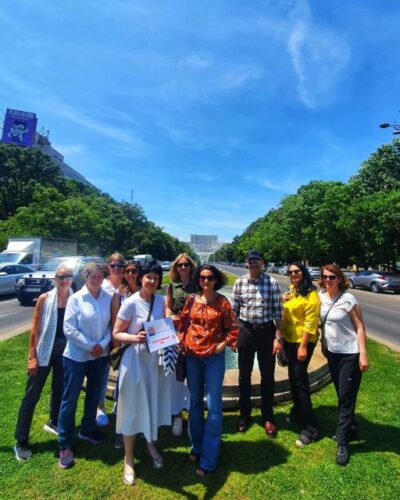
Museum of Communism Ticket with Communist Coffee
Read our review →
Dinner+Tour at Museum of Communism after closing
Read our review →Browse the lists this tour appears in