
Reviewed · COMMUNISM & CEAUSESCU TOURS
The Real tour of Communism
Bucharest’s communist past is easiest to grasp on foot, where grand government buildings, altered neighborhoods, and surviving churches reveal how power reshaped daily life. This tour links the former Great National Assembly, the Palace of Parliament, Old Town, and Revolution Square into one clear story.
I like the personal accounts of rationing and ordinary life, and I like the small communist-era snack that gives the subject a taste of the period. The guides, including Octavian, Daniela, Andreea, John Sever, and Mihai, are praised for answering questions and connecting the past with Romania today.
The main drawback is simple: you spend about three hours outdoors, with no hotel pickup and only short stops at each sight. Cold, rain, or strong heat can make the walk harder, so wear sensible shoes and dress for the forecast.
In This Review
- Key points to know before you book
- Why this communist history walk works in Bucharest
- Starting at the Patriarchal Cathedral
- The Palace of Parliament and the price of grand ambition
- Mihai Voda Monastery and the churches that moved
- Old Town, communist dining, and everyday choices
- Revolution Square and the fall of Ceausescu
- The guides make the difference
- Walking conditions, timing, and practical value
- Who should book this walk
- Should you book The Real Tour of Communism?
- FAQ
- How long is The Real Tour of Communism?
- Where does the tour begin?
- Where does the tour end?
- Is the Palace of Parliament admission included?
- Are the other listed stops free to enter?
- How much does the tour cost?
- How many people can join the tour?
- Is the tour offered in English?
- Is food included?
- Can I cancel for a full refund?
Key points to know before you book
- Follow the story from the Patriarchal Cathedral to Revolution Square, a route that moves from communist power to the 1989 collapse.
- See the Palace of Parliament from the outside, with its enormous scale explained, but note that admission is not included.
- Hear how churches were physically moved, rather than demolished, during Ceausescu’s redevelopment projects.
- Learn about daily life, including food shortages, rationing, favored restaurants, architecture, and the effects still felt in Bucharest.
- Expect a small group of no more than 15 people, which leaves room for questions and personal discussion.
- Plan for changing weather, since this is a walking tour and the cancellation terms allow a new date or full refund if poor weather stops the outing.
Why this communist history walk works in Bucharest
Romania’s communist period can seem abstract if you only read about party leaders and dates. This walk gives the subject physical markers. You see where political authority operated, where huge building projects changed the city, and where the 1989 uprising ended the regime.
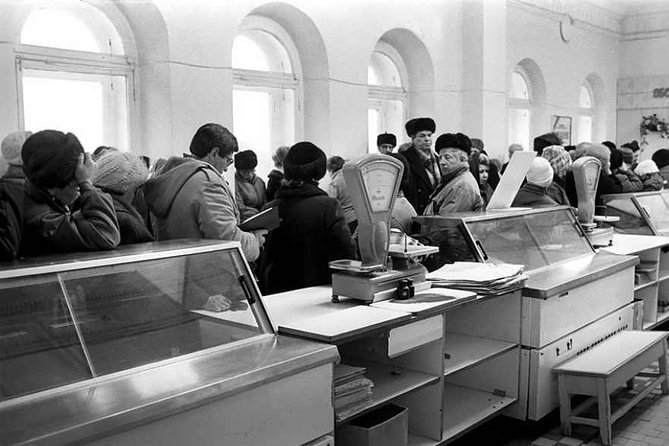
The route also avoids treating communism as only an architectural subject. Guides explain what the system meant at home: rationing, restricted choices, political control, and the gap between official messages and ordinary experience. Personal memories are especially useful here. Several guides draw on their own lives or family experiences, giving you a more human sense of a period that ended only a few decades ago.
I also like the route’s ending. Revolution Square is not simply another handsome Bucharest plaza. It is the place where the final days of Nicolae Ceausescu’s rule and the first days after his fall come into focus. Ending there gives the walk a clear shape and a strong emotional finish.
The tour costs $32.65 per person. For three hours with a small group and a guide who can answer questions, that is a fair price, especially if Romanian communist history is new to you. You are paying for interpretation rather than entry tickets or transport. Since most stops are free and the Palace of Parliament admission is not included, keep your expectations clear: this is primarily a guided city walk, not an interior tour of the parliament building.
More communism & ceausescu tours in Bucharest:
- Life under Communism
★ 5.0 · 358 reviews - 3-Hour Guided Tour of Communist Bucharest
★ 4.9 · 303 reviews - Bucharest Essential Tour: Old Town, Calea Victoriei & Communism
★ 5.0 · 142 reviews
Starting at the Patriarchal Cathedral
The meeting point is the Patriarchal Cathedral at Aleea Dealul Mitropoliei 25. The cathedral sits inside a larger estate, and the meeting place can be less obvious than the address suggests. Walk up the slope toward the cathedral area rather than waiting on a nearby street.
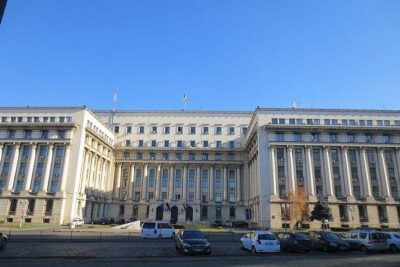
Your first stop takes about 15 minutes. The Patriarchal Palace once served as the headquarters of the Great National Assembly during the communist period. That makes it a useful opening scene, since the building connects religious surroundings with the political machinery of the one-party state.
The stop is brief, so do not expect a long interior visit. Its value comes from the explanation of what happened here and how communist institutions used existing spaces of authority. The cathedral itself also helps place the period in a broader Romanian setting, where religious buildings survived even as the government tried to reshape the city around its own power.
Because the tour begins here, arrive ready to walk. The activity has no hotel pickup, and you will need to make your own way to the start. The location is near public transportation, which helps if you are staying outside central Bucharest.
The Palace of Parliament and the price of grand ambition
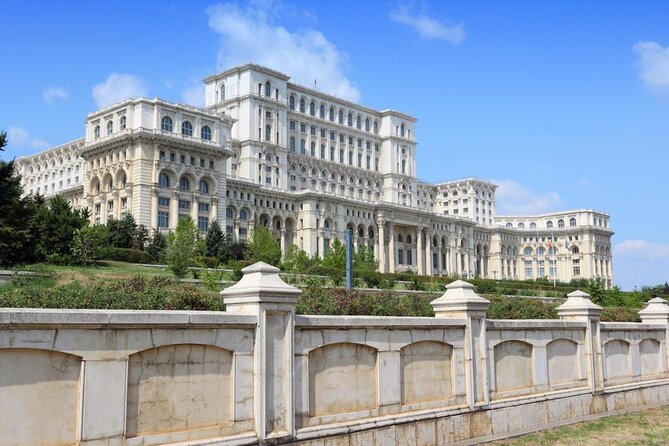
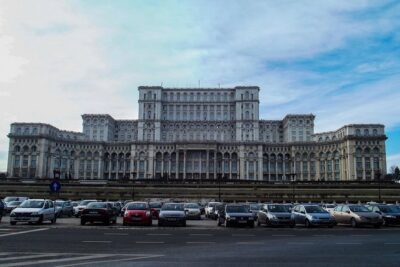
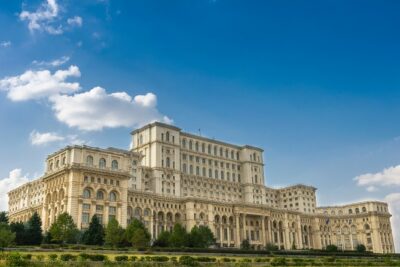
The Palace of Parliament receives about 15 minutes on the route. You learn why it is described as the second-largest building in the world and how its scale reflects Ceausescu’s political vision.
This is one of the tour’s key visual moments. The building is so large that it can be hard to understand its purpose from a photograph alone. A guide’s explanation helps connect the monumental design with the priorities of the regime: concentrated authority, public display, and vast redevelopment.
The stop is mainly interpretive rather than a full building visit. Admission is not included, and the tour information does not promise an interior visit. If you want to tour the inside, treat that as a separate plan and check its arrangements independently.
That limitation matters. If your main goal is to explore grand interiors, this walk may not be enough on its own. If you want to understand why the building exists and what it represented, the short stop fits the tour well.
The Palace also raises a more difficult question: what happens to a city when political power can remove streets, homes, and older buildings with little public consent? Guides use Bucharest’s architecture to explain those costs rather than presenting the building as an isolated curiosity.
Mihai Voda Monastery and the churches that moved
At Mihai Voda Monastery, the tour turns to one of the strangest effects of communist redevelopment. Some churches from the 16th and 17th centuries were physically moved instead of demolished.
The stop lasts about 15 minutes and admission is free. The church-moving story gives you a break from the usual focus on concrete, government offices, and monumental avenues. It also shows that the period’s destruction was not total. Some buildings survived through unusual engineering and determined efforts to preserve them.
You will not simply hear that old churches were in the way. The guide explains why certain buildings were spared and how they were translated, or shifted, to new positions. That detail helps you see redevelopment as a force acting on real places, not just as a change on a planning map.
This is also a good stop for anyone who likes architecture but does not want a tour limited to façades. The building itself becomes evidence of political pressure, compromise, and survival. Since the visit is short, ask questions when the guide pauses. The small group limit of 15 should make that possible.
Same mountains, a completely different day out:
- Bucharest: Dracula’s Castle, Peles Castle, & Brasov Old Town
★ 4.5 · 17,858 reviews - Bucharest: Dracula Castle, Peles Castle & Brasov Old Town
★ 4.6 · 10,891 reviews - Bucharest: Dracula’s Castle, Peleș Castle & Brașov Day Trip
★ 4.5 · 5,919 reviews - Bucharest: Palace of Parliament Tickets and Guide
★ 4.3 · 3,182 reviews
Old Town, communist dining, and everyday choices
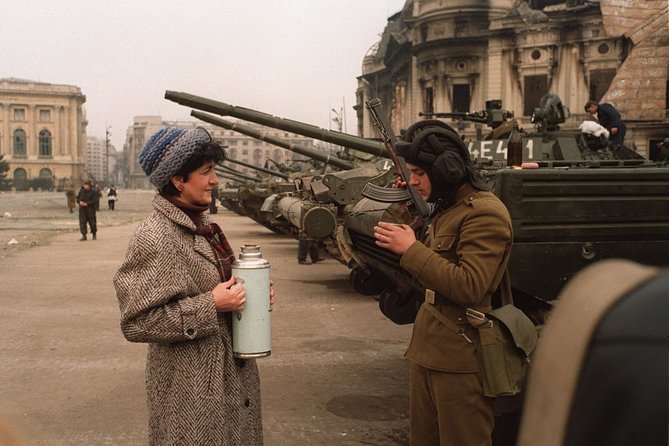
In Bucharest’s Old Town, you hear about restaurants favored by the communist leadership. The subject may sound lighter than the Palace of Parliament or the 1989 uprising, but it adds an important social layer.
Communist systems often presented equality while leaders enjoyed better access. Restaurants, food, and public privilege reveal that gap in a way that political speeches cannot. Here, the guide connects Old Town locations with the habits of the ruling class and explains how food reflected status.
The tour also covers ordinary shortages and rationing. That contrast is one of its strongest features. You hear about what leaders could obtain, then learn how limited food choices affected households. A snack that survived from the communist era is included, giving you a small, concrete link to the period rather than another hour of dates and names.
Food is not treated as a gimmick. It helps explain why political history remains part of family memory. A shortage is not just a policy. It changes how people shop, plan meals, save supplies, and remember their younger years.
There is also a planned coffee and restroom break around the middle of the walk, according to the tour details and guide practice described for the experience. This matters more than it may sound. Three hours on foot can feel long in January rain or summer heat, and a pause gives you time to warm up, cool down, and ask follow-up questions.
Revolution Square and the fall of Ceausescu
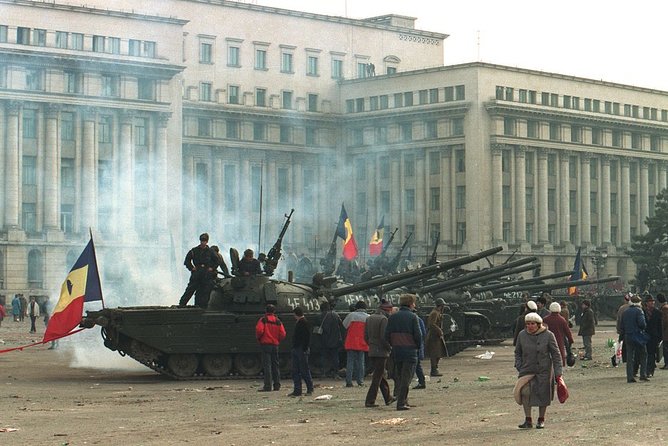
The walk ends at Revolution Square, or Piața Revoluției. This is where the route’s separate threads come together: political control, public architecture, ordinary hardship, and the collapse of the regime.
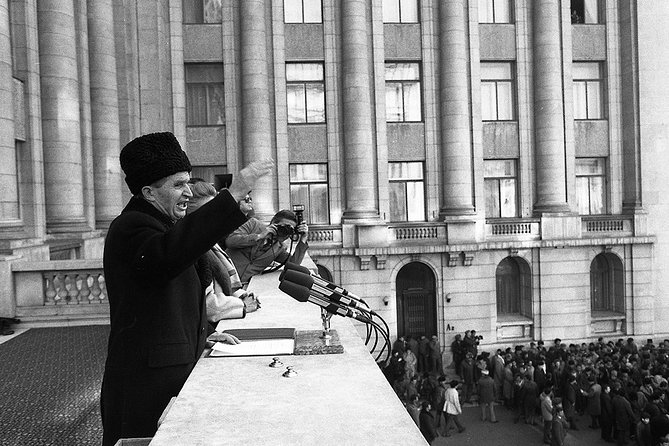
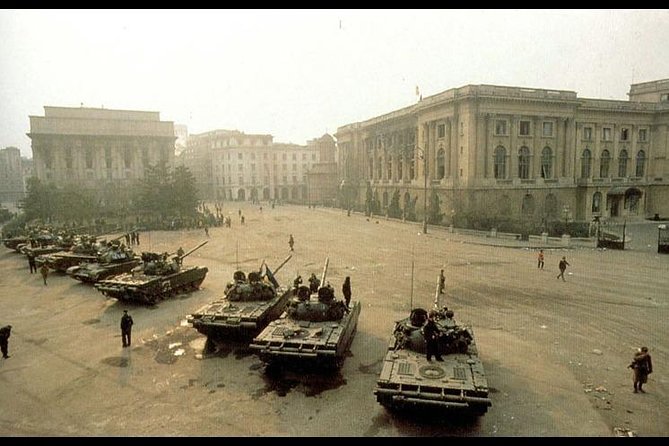
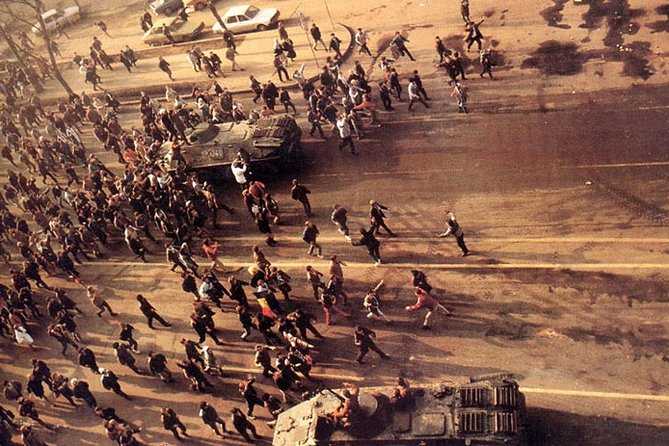
Romania’s 1989 revolution was the only bloody revolution among the former Iron Curtain countries. At Revolution Square, the guide explains the last days of Ceausescu in power and the first days after more than 40 years of communist rule.
This final stop is not just a date marker. You learn how the change unfolded and why the square became central to the story. The guide also places the revolution in the wider context of Romanian politics, including the confusion and uncertainty that followed the end of the old system.
The best guides keep the scale manageable. They explain major events without turning the walk into a lecture full of names and political factions. Daniela is praised for giving the right level of detail while connecting earlier events to current issues. Octavian is noted for sharing personal memories, and John Sever is described as adding material from before, during, and after the communist years.
Because the tour finishes here, you can continue exploring central Bucharest afterward. There is no return transport, so the ending is convenient if you plan to stay in the city center. It also means you should not book the tour assuming you will be taken back to your hotel.
The guides make the difference
This experience depends heavily on the person leading it. The subject is serious, and a guide who simply recites political facts would make the three hours feel heavy. The strongest approach here is story-led and conversational.
Guides named in the tour feedback include Octavian or Oktavian, Daniela, Andreea, Andrea, John Sever, Octavia, and Mihai. Names may vary by departure, but the consistent strengths are clear: organized explanations, personal examples, patience with questions, and an ability to connect architecture with home life.
I would especially value the personal memories. Romania’s communist period is recent enough that many people remember it directly, including rationing and the tougher years. Firsthand context can show you what official histories often leave out, such as how shortages felt in practice or why certain buildings remain a source of frustration.
The tour is also praised for balance. That does not mean softening the harms of the regime. It means explaining how Romanian communism differed from other Eastern European systems and showing both the political structure and its effect on society.
With a maximum of 15 people, the group should remain small enough for questions. Still, a walking tour is not a private seminar. If you want a very slow, highly specialized discussion of one building, this format may not suit you. If you want a clear introduction with room for conversation, it is a good match.
Walking conditions, timing, and practical value
Plan on about three hours, though the pace can vary. The listed stops are each around 15 minutes, with time between them for walking and explanation. The route covers central Bucharest, but you should still have a moderate level of physical fitness.
Wear shoes that can handle uneven city surfaces and bring layers. The tour is listed as operating in all weather conditions, while the cancellation terms also state that poor weather may lead to a different date or a full refund. In practice, dress for the conditions and check any weather notice before setting out.
The mobile ticket is convenient, and confirmation is received at booking. Service animals are allowed. Public transportation is nearby, but hotel pickup and drop-off are not included.
The free-cancellation rule is useful: cancel at least 24 hours before the start time for a full refund. Changes or cancellations inside that window are not accepted for a refund. The weather exception allows a new date or full refund if the experience is canceled for poor conditions.
The strongest value comes from the guide’s interpretation. You are not paying for a long list of paid attractions. You are paying to understand why Bucharest looks the way it does and how political choices affected food, buildings, churches, and public life.
Who should book this walk
I would choose this tour early in a Bucharest visit if you want the city to make more sense. It gives you useful context before you visit other former communist places along the lower Danube, and it helps you read Bucharest’s large government buildings with more care.
It suits you especially well if you enjoy:
- Recent political history explained through real places
- Architecture and city change
- Personal stories about daily life
- Small-group walks with time for questions
- A balanced account rather than a simple good-versus-bad story
Families with young children may find three hours of political history demanding, especially in poor weather. People with limited mobility should also think carefully about the walking requirement and moderate fitness note.
If you want to enter the Palace of Parliament, arrange that separately. If you want a broad, human explanation of Romanian communism, the route offers much better value than wandering past the buildings alone.
Should you book The Real Tour of Communism?
Yes, if you want to understand Bucharest rather than simply photograph it. The route covers the main political and architectural markers, but its real strength is the link between those places and daily life under communism.
Book it for the guide’s explanations, the personal memories, the moved churches, and the clear ending at Revolution Square. Skip it only if you dislike walking, need guaranteed indoor shelter, or want a detailed interior visit to the Palace of Parliament. At $32.65, with a small group and about three hours of guided context, it is a sensible introduction to one of Europe’s most complicated recent chapters.
FAQ
How long is The Real Tour of Communism?
The walking tour lasts approximately three hours.
Where does the tour begin?
It begins at the Patriarchal Cathedral, Aleea Dealul Mitropoliei 25, Bucharest.
Where does the tour end?
The tour ends at Revolution Square, Piața Revoluției, in Bucharest.
Is the Palace of Parliament admission included?
No. Admission to the Palace of Parliament is not included in the tour price.
Are the other listed stops free to enter?
The Patriarchal Cathedral area, Mihai Voda Monastery, and Old Town stops are listed with free admission.
How much does the tour cost?
The price is $32.65 per person.
How many people can join the tour?
The group has a maximum of 15 travelers.
Is the tour offered in English?
Yes. The experience is offered in English.
Is food included?
A snack that survived from the communist period is included. Other food and drinks are not included unless specifically stated.
Can I cancel for a full refund?
Yes. You can cancel at least 24 hours before the start time for a full refund. Cancellations or changes made less than 24 hours before the start time are not accepted for a refund.
Just added around Bucharest
- Winery touring & private wine tasting – one day private tour★ 5.0 · 3 reviews
- Village Museum Bucharest Guided Tour★ 5.0 · 6 reviews
- Bucharest: Dealu Mare Winery Private Trip with Wine Tasting★ 4.9 · 6 reviews
- Transylvania Tour: Dracula’s Castle, Peles Palace & Brasov★ 5.0 · 19 reviews
- Discover Medieval Transylvania Small Group Tour – 7 days★ 5.0 · 4 reviews
- Bucharest Airport Transfer To Constanta Mamaia★ 5.0 · 3 reviews
- Airport Henri Coanda (Otopeni) to Bucharest – Private Transfer – Driver★ 5.0 · 5 reviews
- Gems of Transilvania: Brasov,Sighisoara,Sibiu,Viscri and more★ 5.0 · 6 reviews
Communism & Ceausescu Tours, compared.
Communism in Bucharest – Landmarks, Museum & Communist Appetizers
Read our review →

Museum of Communism Ticket with Communist Coffee
Read our review →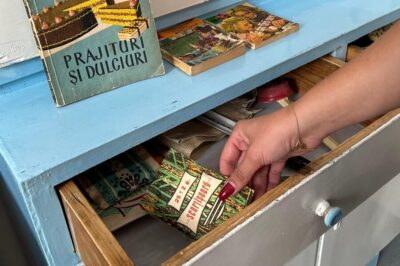
Dinner+Tour at Museum of Communism after closing
Read our review →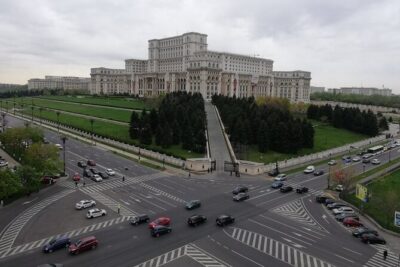
Contrasts of Communism – Small Group Walking Tour in Bucharest
Read our review →Browse the lists this tour appears in